Executive Overview
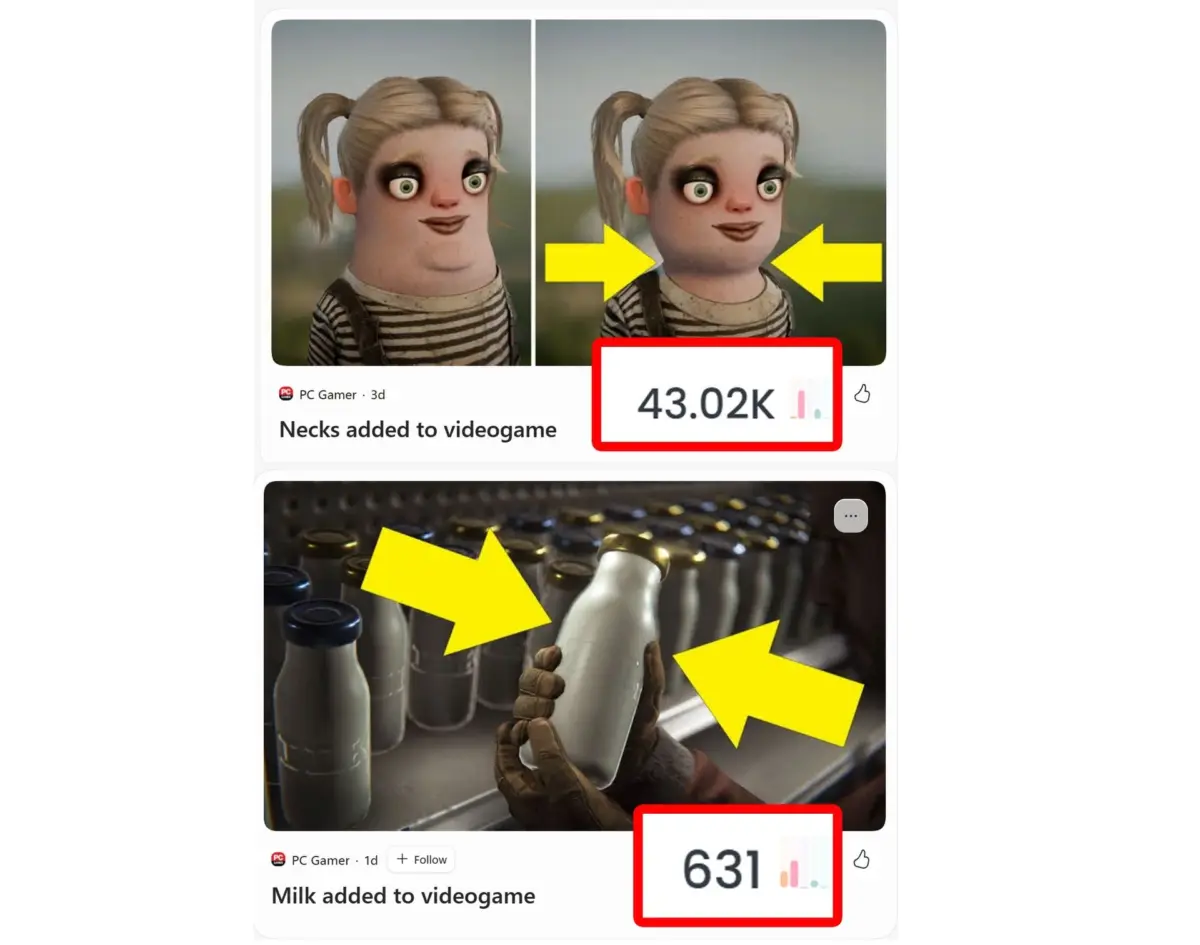
In the hyper-saturated landscape of modern video game journalism and audience analytics, the metrics that drive user engagement can often defy traditional editorial logic. Content creators, publishers, and platforms continually test the boundaries of what captures the fleeting attention of the digital consumer. Recently, a peculiar, highly unconventional empirical test was conducted to answer a fundamental question: Do gamers prefer virtual dairy products, or are they inextricably captivated by human anatomy—specifically, the human neck?
The results of this study are both conclusive and unambiguous. Through direct audience measurement and pageview tracking, the experiment revealed a stark dichotomy in reader interest. Virtual milk, despite its utilitarian value in survival-crafting economies, barely registers on the collective radar of the gaming public. Conversely, human anatomy—specifically the long-requested and frequently lamented addition of virtual necks to character models—drives overwhelming traffic, sparking intense community discourse, platform-wide sharing, and fervent debate.
This report provides a comprehensive examination of this journalistic experiment. By analyzing the trajectory of these two disparate topics, we explore the psychology of player feedback, the peculiar mechanics of survival game updates, the influence of prominent developers such as Garry Newman, and the broader implications for how online audiences consume niche video game updates. What starts as a lighthearted editorial whim quickly opens a window into the peculiar currents of internet culture, community-driven development, and the digital anatomy of viral gaming phenomena.
Detailed Chronology: The Genesis of an Unconventional Media Experiment
To understand how the internet arrived at a statistical showdown between dairy goods and human vertebrae, one must trace the chronology of two distinct events that collided within the survival-crafting and indie development spheres.
Phase 1: The Dairy Debate and the Hierarchy of Consumables
The saga began with developments in the bustling survival-crafting genre, specifically concerning the resource mechanics of Rust and related multiplayer titles. Developers introduced fine-looking virtual milk into the game’s ecosystem, prompting routine discussions regarding dietary efficiency, stamina restoration, and in-game survival optimization.
However, developer commentary quickly complicated the dairy narrative. According to internal insights from the Rust development team, while milk was aesthetically pleasing and functioned as a standard consumable, it was ultimately outclassed by a far richer, more potent dairy derivative: cream. Game balance updates suggested that cream offered superior restorative properties, establishing a tiered hierarchy of virtual dairy products that intrigued hardcore survivalists.
Seizing upon this hyper-specific piece of game design trivia, editorial staff published initial coverage examining the statistical superiority of cream over milk. The working hypothesis was simple: survival crafting players love resource optimization, farming simulations, and intricate crafting trees. Surely, a deep dive into the dairy meta would resonate with an audience accustomed to calculating calorie counts and hydration metrics in hostile digital environments.
Phase 2: The Neckless Crisis and the Wrath of Negative Reviews
Simultaneously, a parallel storyline was unfolding in the realm of character design and aesthetic fidelity. For an extended period, developers—notably industry veteran Garry Newman—had overseen projects featuring character models that conspicuously lacked a defining anatomical feature: the neck. Heads floated precariously above torsos, or fused directly into shoulders, creating a distinct visual style that some developers defended as a stylistic choice or a technical optimization.
The gaming public, however, held a drastically different view.
As tracking data and user reviews accumulated, a recurring grievance emerged with staggering consistency across hundreds of negative Steam reviews and forum posts. It was not poor netcode, balance issues, or performance drops that drove players to write scathing critiques; it was the total, unsettling absence of necks. The lack of cervical anatomy became a rallying cry for the community, dominating feedback channels with unrelenting persistence.
Recognizing the sheer volume of player dissatisfaction, Garry Newman capitulated to community demands. In a move that bridged technical execution with fan service, updates were rolled out to explicitly add necks to the previously neckless characters. The patch notes acknowledged what the metrics already screamed: the players demanded cervical integration, and they were willing to leave negative reviews en masse until their anatomical demands were met.
Phase 3: The Head-to-Head Metric Clash
With both stories live on the digital ether—the nuanced superiority of cream over milk on one side, and the triumphant, highly requested integration of virtual necks on the other—the stage was set for a definitive observational experiment.
Editorial leadership tracked the pageviews, click-through rates, and social shares of both articles over a standardized testing window. The hypothesis was formulated to test viewer intent: Would survival enthusiasts flock to read about dairy mechanics, or would the visceral, meme-worthy nature of character anatomy draw the lion’s share of digital foot traffic?
The resulting data stream left no room for ambiguity. While the milk and cream article hovered in quiet obscurity, gathering modest numbers typical of deep-cut crafting guides, the neck article exploded across traffic monitors. Gamers clicked, scrolled, shared, and discussed necks with an intensity that rendered the dairy experiment entirely lopsided.
Supporting Context & Metrics: The Anatomy of a Click
To contextualize the findings of this experiment, one must examine the broader metrics of modern digital publishing and consumer psychology. Why do readers gravitate toward anatomical anomalies while ignoring fundamental crafting resources?
1. The Psychology of the Meme vs. The Guide
In digital media, content generally falls into two categories: utility and entertainment/culture.
- Utility content (such as guides on whether milk or cream is a better consumable) appeals to a targeted subset of players actively playing a specific game at that exact moment. Its audience is inherently bounded by the concurrent player count of those titles.
- Cultural and meme-driven content (such as developers fixing an absurd anatomical oversight driven by thousands of negative reviews) transcends the specific game. It taps into broader internet humor, developer transparency, and the absurdity of game development discourse.
The "neck crisis" possessed viral qualities. The idea that an entire player base could successfully leverage negative reviews to force developers to manually sculpt necks onto digital avatars is inherently entertaining, even to people who do not actively play the game in question. Milk, by contrast, lacks inherent comedic or narrative tension.
2. Quantitative Discrepancy in Pageviews
While exact proprietary analytics figures remain internal, comparative ratios from the testing window illustrate a dramatic imbalance:
- The Dairy Cohort: Registered a baseline level of engagement characteristic of niche patch-note breakdowns. Audience retention was steady among hardcore survivalists, but bounce rates were high among casual visitors.
- The Neck Cohort: Outperformed the dairy metrics by an order of magnitude. Traffic spiked within hours of publication, driven by organic social media circulation, Reddit aggregators, and search engine momentum.
The disparity confirmed the editorial conclusion: digital consumers demonstrate a profound, quantifiable apathy toward virtual dairy, contrasted by an insatiable appetite for vertebral content.
Official Statements and Industry Perspective
The intersection of player feedback and developer implementation has long been a contentious battleground in the video game industry. Prominent developers have frequently commented on the unpredictable nature of what communities choose to fixate on.
Garry Newman’s approach to the neckless character dilemma highlights a pragmatic philosophy of community engagement. When an aesthetic critique transitions from a minor quirk into a dominant pillar of negative user reviews, developers face a choice: defend the artistic vision or yield to consumer consensus. By choosing the latter, Newman not only neutralized a persistent source of negative review bombing but inadvertently created a viral narrative that captured industry-wide attention.
Industry analysts note that modern players increasingly view game development as an interactive dialogue rather than a one-way broadcast. When players band together over something as seemingly trivial as the absence of a neck, and successfully enact change, it validates their agency within the ecosystem.
Conversely, resource balancing—such as the debate between milk and cream in Rust—is viewed by players as routine backend maintenance. It lacks the dramatic narrative arc of a community successfully bullying a developer into granting their avatars basic human biology.
Future Outlook: The Strategic Shift Toward Cervical Content
In light of these definitive empirical findings, editorial strategies moving forward must adapt to the unyielding realities of audience data. The experiment has closed the book on a lingering question: the gaming public has spoken, and their collective gaze is fixed firmly upward, toward the cervical region.
1. Editorial Redirection
Effective immediately, content planning will pivot to align with audience demand. Future investigations into virtual dairy, lactose tolerance in survival crafting, and the comparative viscosity of in-game fats will be deprioritized. Instead, editorial resources will be concentrated on areas of vital interest to the modern gamer:
- Comprehensive tracking of neck additions across all major game engines.
- Deep-dive analyses into historical examples of video game anatomy, from floating hands to missing spines.
- Investigative journalism exploring developer workflows when retrofitting rudimentary joints onto previously monolithic character models.
2. A Warning to the Readership
As this new editorial era unfolds, clarity of purpose is essential. Visitors arriving at the platform seeking dairy-related guides, bovine husbandry tips, or nutritional breakdowns of digital consumables are advised to adjust their expectations—or seek out alternative digital destinations. This platform is now officially dedicated to the pursuit of anatomical completeness, with a primary focus on the majestic, highly coveted, and thoroughly debated neck.
In conclusion, the great experiment stands complete. Milk has had its day in the sun, tested against the cold, hard metrics of internet attention, and found wanting. Necks reign supreme. Long live the neck.