Executive Overview
The landscape of B2B software has undergone a tectonic shift. For years, the metric for exceptional performance in enterprise SaaS was straightforward: a healthy, venture-backed or public tech company aimed for year-over-year revenue growth exceeding 30%, ideally hovering in the 40% to 50% range. Today, that baseline has evaporated.
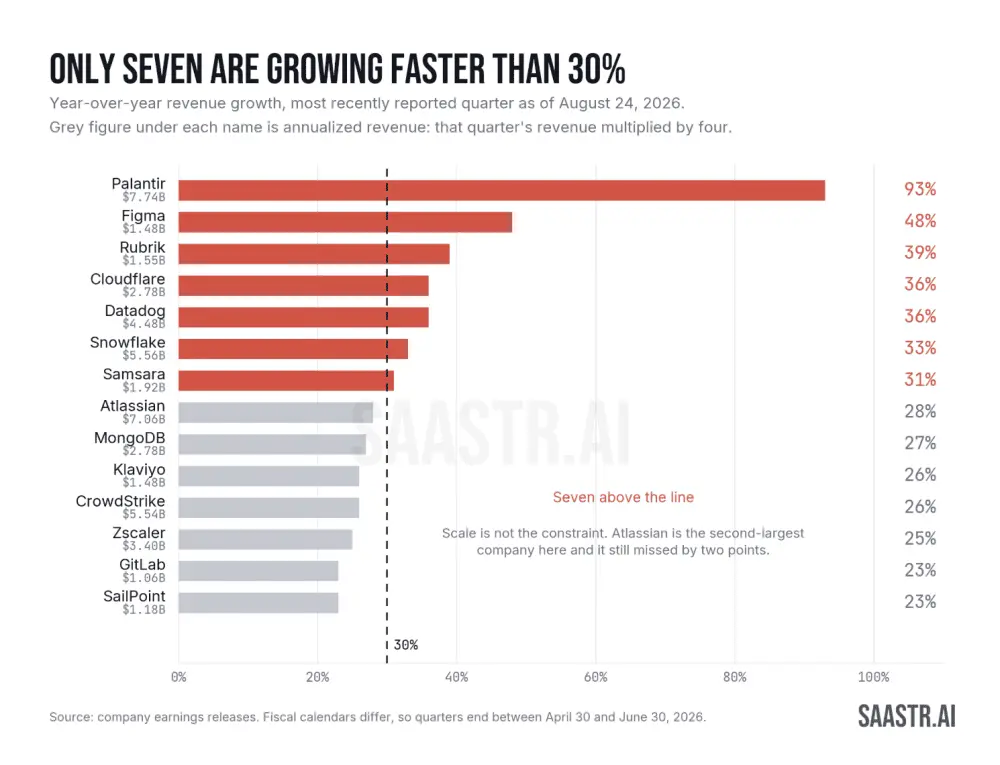
According to recent public earnings reports and independent financial indices, exactly seven public B2B software companies are growing faster than 30%. This is not merely a truncated leaderboard at the top of the sector; it is the entire list.
This contraction highlights a broader, more profound market evolution. The median growth rate of the SaaS Capital Index, which peaked comfortably above 30% during the pandemic-era boom of 2021, has compressed dramatically. Today, what was once the median growth rate has become the 90th percentile. Meanwhile, a staggering divide has opened up between legacy public SaaS firms and a new generation of AI-native platforms that are doubling and tripling their revenues at unprecedented scales.
For CEOs, founders, and investors managing through this environment, the takeaway is stark: the B2B software market is no longer a single, continuous spectrum. It is deeply bifurcated, governed by entirely new rules of pricing, scaling, and valuation multiples.
Detailed Chronology: The Death of the 30% Median
To understand where the software market stands today, one must trace how quickly the goalposts moved between 2021 and mid-2026.
2021: The Peak of the Traditional SaaS Era
At the height of the zero-interest-rate policy (ZIRP) era, hyper-growth was ubiquitous. Capital was cheap, tech budgets were expanding, and remote-work tailwinds drove unprecedented demand for digital tools. The SaaS Capital Index median growth rate sat comfortably above 30%. Half of all index constituents were clearing thresholds that only a tiny fraction of public companies can reach today.
2023–2025: Macro Correction and Cost Rationalization
As inflation spiked and interest rates climbed, enterprise buyers radically tightened their belts. Software budgets shifted from expansion to consolidation. License optimization—cutting unused "seats"—became a primary sport for corporate CFOs. During this period, growth rates across the board compressed. Companies that had coasted on seat-expansion models suddenly found their top lines stalling.
Mid-2026: The New Reality
Fast-forward to mid-2026, and an independent analysis of the SaaS Capital Index data file paints a sobering picture. Among 58 constituents reporting both growth and valuation multiples:
- 18 companies are growing at under 10% (trading at a median valuation multiple of 1.9x revenue).
- 23 companies are growing between 10% and 20% (trading at 3.1x revenue).
- 11 companies are growing between 20% and 30% (sitting in a dense high-quality band that commands a 5.5x median multiple).
- Only 6 companies sit above the 30% growth line.
If you are the CEO of a $200 million ARR B2B enterprise growing at 18%, you are not underperforming your peers. You are your peers. The median has shifted, and the market rewards even a few percentage points of additional growth with exponential expansions in enterprise value.
Supporting Context & Metrics: Scale, Valuation, and the Cluster Below the Line
A deeper dive into the data reveals fascinating nuances regarding scale. For years, conventional wisdom dictated that as a software company grew larger—approaching billions in ARR—its growth rate would inevitably decelerate to single digits.
Today’s market breaks that rule, but scale alone does not separate the winners from the rest of the pack.
Scale Is No Longer the Primary Bottleneck
Looking at the cluster of companies just beneath the 30% threshold, scale proves to be an inconsistent predictor of growth deceleration:
- Atlassian, the second-largest company on the tracking list at roughly $7 billion in annualized revenue, missed the 30% line by a mere two percentage points.
- Samsara successfully cleared the hurdle at a $1.9 billion run rate.
- Snowflake cleared the mark at $5.6 billion, while CrowdStrike narrowly missed it at $5.5 billion.
These are exceptionally well-run enterprises, yet they sit in a valuation band that demands a premium for every fractional increase in top-line expansion. Moving from an 18% growth rate to 22% is not merely a four-point improvement; historical valuation multiples suggest it can nearly double an enterprise’s total valuation.
The Two Generations Side-by-Side
While public companies fight for fractional points in the 20% to 30% bracket, a second generation of private and hyper-growth companies is operating in an entirely different financial universe:

- Anthropic saw its run rate multiply sevenfold in a single year, posting Q2 revenue exceeding $11.5 billion compared to $787 million in the same period a year prior—all while maintaining positive adjusted operating income.
- Higgsfield, a platform that literally did not exist before March 2025, crossed a $500 million annualized run rate by June 2026 and hit $700 million by August, securing a $400 million funding round at a $5.4 billion valuation while remaining cash-flow positive.
- Harvey, operating via a traditional per-seat licensing model for law firms, roughly doubled its ARR in just seven months, proving that traditional go-to-market motions can still thrive if paired with high-utility AI applications.
Official Statements & Structural Shifts: What the Winners Have in Common
Why are certain companies breaking away from the pack while others stall? An analysis of the top performers reveals two distinct structural advantages: usage-based pricing models and non-headcount drivers of expansion.
1. The Death of the Seat-Based Monopoly
Four of the seven public companies outpacing the 30% threshold do not primarily charge by the seat. Palantir, Datadog, Cloudflare, and Snowflake all rely on usage or consumption-based billing models.
When an enterprise customer deploys more AI workloads, runs heavier data pipelines, or routes machine-to-machine traffic, their bill goes up automatically. There is no need for a lengthy sales cycle, no requirement to convince a cost-conscious CFO that internal headcount has grown, and no friction during annual contract renewals. The AI boom flows directly into the vendor’s revenue stream.
As Cloudflare’s leadership noted during their earnings call, the massive shift toward AI answer engines and agent-driven commerce represents a complete rewrite of the internet for automated traffic. Companies whose revenue scales with machine activity are reaping the rewards.
2. The Figma Playbook: Layering Credits on Seats
For companies locked into a seat-based model, Figma stands out as the ultimate case study. Growing 48% year-over-year in the quarter ending June 30—marking its third consecutive quarter of accelerating growth—Figma achieved a net dollar retention (NDR) rate of 136%.
How did they pull it off? Figma didn’t abandon its seat model; instead, it layered a consumption layer on top of it. By introducing AI credit monetization, customers expanded their spend along two parallel dimensions: traditional seats and AI add-ons.
Rather than cannibalizing seat counts, AI credits drove them higher. For example, one major enterprise customer added more than 25,000 paid seats through an AI credit expansion. While this transition did compress gross margins temporarily by five points due to upfront inference costs, it provides the clearest actionable playbook for legacy B2B firms looking to adapt.
3. The Toll Booth Strategy: Databricks and Stripe
For firms that are neither small startups nor pure AI labs, success lies in becoming the indispensable infrastructure upon which the boom is built.
- Databricks reached $6.9 billion in annualized revenue, growing over 80% year-over-year, with AI products alone accounting for $1.7 billion of that total. CEO Ali Ghodsi attributed this acceleration to agentic AI generating massive volumes of queries and data consumption.
- Stripe, a 15-year-old payments giant, grew its revenue 33% in 2025 to reach $6.8 billion—its fastest growth rate since 2021 on a revenue base four times larger. By processing payments for the AI labs and the sprawling ecosystem of developer tools (like Replit, Vercel, Cursor, and Midjourney), Stripe successfully positioned itself as the toll booth for the entire technological revolution.
Future Outlook: Navigating the Two-Market Reality
The macroeconomic forecasts for the broader software sector remain modest. First Analysis projects average software revenue growth of 14.3% for 2026 and 11.3% for 2027, while PitchBook estimates a median 2026 growth rate of 13.2%.
Against this backdrop, the structural reality for industry leaders is clear: It is no longer one market.
The broad middle tier of healthy 30% to 50% public SaaS growers has vanished. In its place, we find:
- A small, elite group of public giants compounding on AI-driven usage demand.
- A large, capable cohort clustered in the low-to-mid twenties, fighting intensely for valuation multiples.
- A long tail of single-digit growers trading at compressed revenue multiples.
- A parallel universe of AI-native private companies doubling and tripling at breathtaking scales.
Strategic Takeaways for B2B Leaders
For executives steering companies through this transition, the path forward requires confronting difficult operational choices:
- Re-examine Pricing Architecture: If your revenue is tied strictly to human headcount, you are tethered to corporate cost-cutting cycles. Transitioning toward consumption, usage, or hybrid credit models—as Figma and the infrastructure giants have demonstrated—removes growth friction.
- Accept Margin Compression During Transitions: Building out AI infrastructure and absorbing early-stage inference costs will temporarily squeeze gross margins. Market leaders are proving that investors will tolerate margin pressure if the top-line acceleration is undeniable.
- Avoid the Incremental Trap: Fighting legacy competitors for a 3-point gain in a crowded 3.1x valuation band yields diminishing returns. True enterprise value creation now requires aligning your product with the structural shifts driving modern enterprise spend—whether by powering AI workflows directly or by serving as the essential infrastructure supporting them.
The rules of B2B software have been rewritten. Those who adapt their business models to the realities of consumption and automated scale will capture the next generation of enterprise value; those who do not risk being left behind in a rapidly shrinking middle.