Executive Overview
For years, Elon Musk has played the role of the ultimate industrial showman, dazzling public markets and consumers alike with promises that blur the line between science fiction and tangible engineering. Yet, when Musk took the stage in Texas for a heavily hyped livestreamed spectacle, the centerpiece of the evening was not merely a vehicle; it was a profound economic and strategic misdirection.
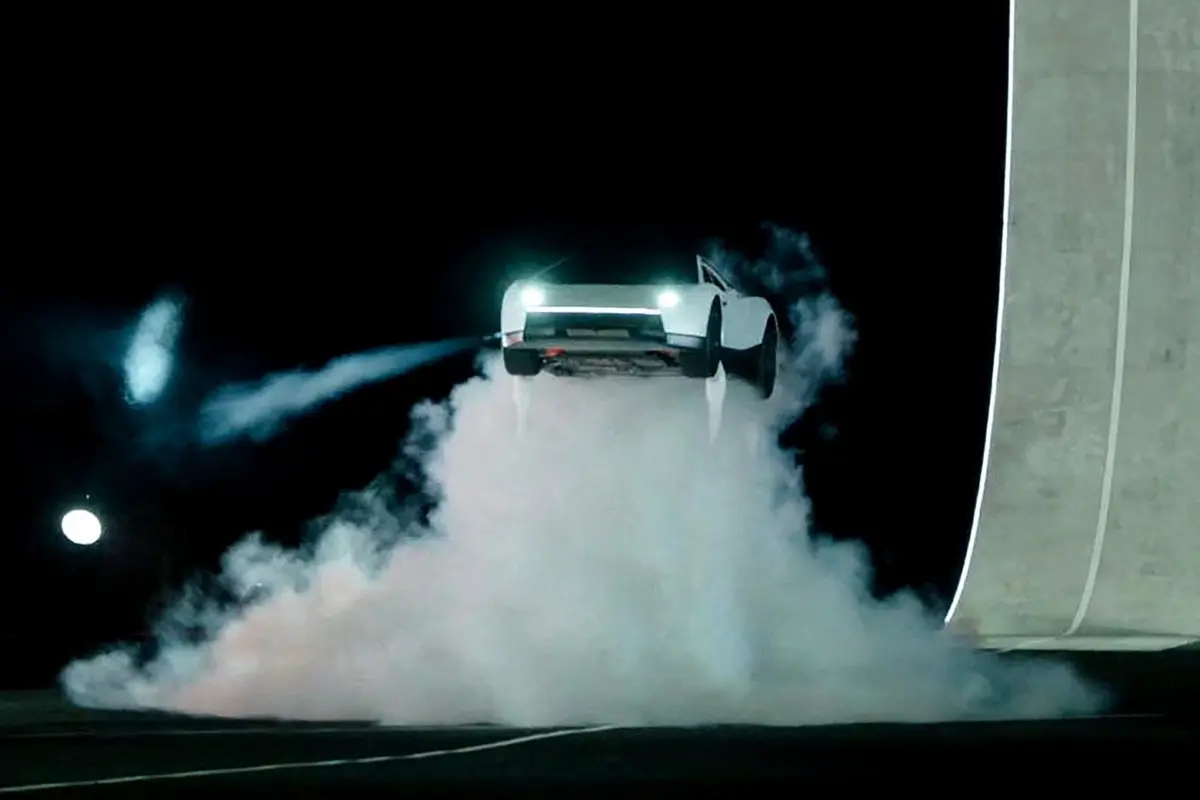
Unveiling the long-delayed next-generation Tesla Roadster—a machine he claimed could briefly achieve flight using SpaceX-engineered gas thrusters—Musk dominated the global news cycle. Yet beneath the spectacle of downforce-generating fans, 0-to-60 mph acceleration times of 0.8 seconds, and acrobatic jumps over parked EVs lies a much larger corporate reality. The new Roadster is not the future of Tesla; it is the ultimate marketing device designed to mask the sunsetting of Tesla as a traditional automotive manufacturer.
Industry analysts, financial insiders, and market watchers are increasingly aligning around a singular conclusion: the flamboyant integration of SpaceX technology into a Tesla product launch is the clearest signal yet of an impending, monumental corporate merger. As Tesla faces shrinking profit margins, fierce international competition, regulatory headwinds, and the exhaustion of its traditional EV growth model, Musk is preparing to fuse the automaker with his private aerospace juggernaut. The resulting entity would form a $3.5 trillion galactic mega-corporation, shifting its focus definitively away from consumer cars and toward autonomous robotaxis, humanoid robotics, artificial intelligence, and space-based infrastructure.
Detailed Chronology: From the Stage Spectacular to the Corporate Horizon
The roadmap leading to this pivotal moment has been defined by decades of broken timelines, bold pivots, and shifting corporate identities.
The Texas Showcase and the "Flying" Roadster
During the Thursday evening event in Texas, Musk channeled his inner carnival barker, declaring to a roaring crowd, "What you see with your eyes, you will not believe!" The vehicle on display—a striking aesthetic mashup of a 1970s-era Lotus Esprit and the legendary SR-71 Blackbird spy plane—was framed as the pinnacle of human engineering.
To demonstrate its capabilities, Tesla erected a gigantic C-shaped ramp. The Roadster ascended to the curve, utilized a downforce-generating fan system to defy gravity while inverted, and then blasted free. It executed a controlled flip before touching down in a cloud of compressed air, subsequently leaping over a lineup of parked Tesla vehicles with another airborne roll.
While visually breathtaking, the stunt was functionally reminiscent of Musk’s iconic 2018 PR spectacle, when his original red Roadster was launched into space atop a SpaceX Falcon Heavy rocket. However, the engineering reality of the new Roadster remains elusive. Tesla’s latest pricing structure requires customers to commit $50,000 for a "Performance" trim, $250,000 for a "Thrust" version, and an unpublicized, invite-only sum for the "Rocket" trim equipped with SpaceX thrusters. Delivery dates have been pushed to 2028, invoking the time-tested consumer caveat of caveat emptor when dealing with Musk’s ambitious timelines.
The Death of the Manual Drive
During the presentation, Musk dropped a detail that fundamentally redefines Tesla’s corporate trajectory: the new Roadster will be the last manually drivable car the company ever builds.
This declaration marks the formal closure of Tesla’s first chapter. The future belongs entirely to the Cybercab—a steering-wheel-free, pedal-less autonomous robotaxi designed for rideshare fleets—and Optimus, Musk’s ambitious line of humanoid robots. Musk claims Optimus will eventually push Tesla’s market capitalization from its current $1.4 trillion to an astronomical $25 trillion, retailing at $30,000 per unit to replace human labor in everything from assembly plants to elder care and planetary colonization.
The Mechanics of the Merger
By embedding SpaceX gas thrusters into the star of what was supposed to be a long-awaited Tesla automotive showcase, Musk signaled that the two companies’ destinies are inextricably linked. Tesla is burning through capital via massive expenditures in artificial intelligence and data centers, causing it to shed its identity as a pure-play EV juggernaut.
According to financial analysts, including Barclays’ Dan Levy, a Tesla-SpaceX merger is increasingly viewed as a near-certainty. Under the anticipated structure, SpaceX would acquire Tesla, allowing existing Tesla shareholders to swap their equity for SpaceX stock. This maneuver will leverage SpaceX’s unrivaled ability to raise capital on public and private markets, using those funds to subsidize the costly pivot toward Cybercabs, Optimus robotics, and competing with tech giants like Anthropic and OpenAI in the generative AI space.
Supporting Context & Metrics: The Numbers Behind the Pivot
To understand why Musk is engineering a merger that effectively sunsets Tesla’s traditional automotive manufacturing model, one must examine the shifting financial and geopolitical realities facing the company.
Financial Resilience vs. Margin Compression
For the 2025 fiscal year, Tesla delivered an impressive 1.6 million manually drivable vehicles, generating approximately $95 billion in revenue, primarily from its automotive sector alongside its growing solar and energy storage divisions. On paper, these figures denote a healthy industrial giant.
However, beneath the headline revenue figures lies severe margin compression. Tesla has not introduced an all-new, non-flying consumer vehicle since the Cybertruck debuted in 2019. Furthermore, the company has officially ceased production of its high-priced luxury staples—the Model S sedan and the Model X SUV—leaving the Model 3 sedan and Model Y crossover to shoulder the entire burden of the automotive business.
Macroeconomic and Geopolitical Headwinds
Tesla’s core EV business is facing unprecedented pressure from multiple fronts:
- Global Competition: A massive influx of affordable, high-quality electric vehicles from Chinese automakers has steadily eroded Tesla’s international market share, particularly across Europe.
- Political Fallout: Musk’s increasingly polarizing public profile and vocal support for right-wing political movements have resulted in localized consumer backlash and depressed European sales figures.
- Regulatory and Tax Shifts: Governments worldwide are rolling back or eliminating the lucrative regulatory carbon credits that once padded Tesla’s net income by billions of dollars. Simultaneously, the reduction or elimination of federal EV consumer tax credits in the United States has weakened overall domestic demand.
Faced with these compounding pressures, Musk has realized that mass-producing moderately priced consumer electric vehicles is a low-margin, high-stress enterprise.
Official Statements & Industry Perspectives
The corporate maneuvers have elicited a mixed chorus of caution, awe, and critique from industry stakeholders.
Wall Street analysts have pointed out that traditional automotive manufacturing was never Musk’s ultimate destination; rather, it was a bootstrapping mechanism. As industry insiders frequently note, Tesla was leveraged to develop the global supply chains, manufacturing expertise, and engineering competence required to mass-produce complex autonomous systems at scale—such as cranking out a Cybercab every 10 seconds or assembling armies of Optimus robots.
During the Texas reveal, Musk framed the evening as a testament to engineering audacity, dismissing conventional automotive logic in favor of science-fiction-inspired cross-pollination between terrestrial transport and aerospace propulsion.
Meanwhile, institutional investors and market forecasters are viewing the integration of SpaceX technology into a Tesla product as a calculated precursor to corporate consolidation. By merging the two entities, Musk solves Tesla’s looming balance-sheet constraints while consolidating his empire under a single, unified banner capable of pursuing capital-intensive futuristic visions—including the jaw-dropping, brain-melting proposal to launch orbital data centers powered directly by unfiltered solar energy.
Future Outlook: The Rise of the Galactic Mega-Entity
As the dust settles on the Texas Roadster spectacle, the automotive landscape is forced to confront a sobering reality: the Tesla we have known for the past two decades is quietly disappearing.
The transition from a consumer car company to an autonomous robotics, AI, and aerospace conglomerate is accelerating. If historical projections and current market analysis hold true, the impending SpaceX-Tesla merger will create a $3.5 trillion behemoth unburdened by the traditional cyclicality and razor-thin margins of the global auto industry.
For consumers, the dream of owning a manually driven, high-performance Tesla sports car equipped with rocket thrusters may remain largely out of reach—a distant 2028 promise wrapped in marketing hyperbole. For investors, however, the message is unmistakably clear. The era of the electric vehicle manufacturer is giving way to the era of the autonomous robotaxi fleet, humanoid labor forces, and orbital infrastructure.
Elon Musk has successfully transitioned from building cars for the open road to building the foundation for a cosmic corporate empire. In doing so, he has positioned his collective enterprises to dwarf conventional industrial expectations, leaving corporate competitors in the dust and inching ever closer to a reality that makes science fiction look conservative.