By Saf Malik | Senior Content and Insights Manager
Published: September 18, 2026
Executive Overview
Europe’s digital infrastructure landscape is undergoing a profound structural transformation. As artificial intelligence workloads demand unprecedented power densities and expansive land footprints, the continent’s traditional core markets are hitting a physical wall. According to the JLL EMEA Mid-Year Data Centre Report 2026, vacancy rates across Europe’s core markets have plummeted to a razor-thin 6.4%. In financial and tech powerhouse Frankfurt, that figure stands at an acute 3.1%.
For hyperscalers, colocation providers, and developers, capital is no longer the primary hurdle to expansion. Instead, electrical grid capacity has become the ultimate binding constraint on growth.
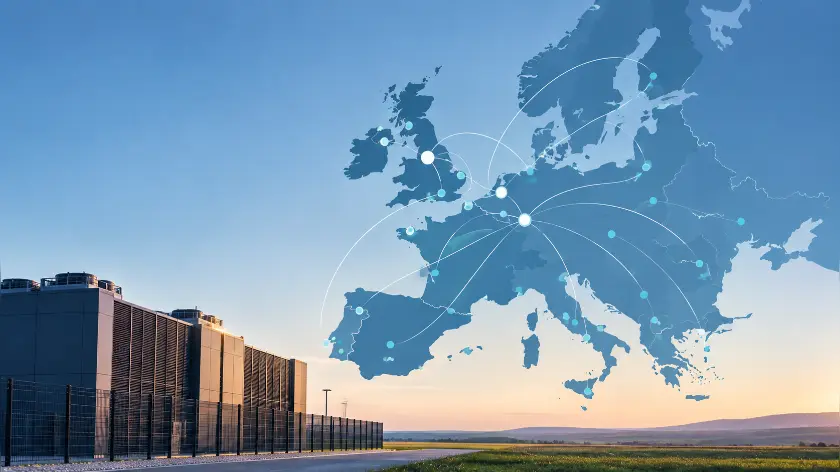
To bypass congested legacy transmission lines, data centre developers are looking far beyond the traditional FLAP-D hubs—Frankfurt, London, Amsterdam, Paris, and Dublin. New capacity in the 2026–2028 pipeline is now located an average of 175 kilometres from major EMEA hub cities, a sharp leap from the average distance of just 46 kilometres for projects delivered between 2022 and 2025. This decentralized stampede is redirecting billions of euros into secondary markets, greenfield developments, and entirely unconventional locations, reshaping the geography of European digital connectivity.
Detailed Chronology: The Anatomy of a Continental Bottleneck
The current crisis has been years in the making, accelerated by the explosive computational demands of generative AI and large-scale machine learning models.
The FLAP-D Expansion and Its Limits
Since 2019, combined live capacity across the FLAP-D markets has more than doubled, surging from 1.8GW to approximately 3.8GW. However, this rapid growth has severely outpaced regional transmission infrastructure. Concurrently sluggish grid connection queues in major metropolitan areas have turned the traditional hubs into slow, unpredictable routes for deployable capacity.
Martin Jensen, EMEA Division President for Data Centres at JLL, underscored this industry-wide pivot:
"These requirements are accelerating investment into secondary markets, greenfield developments and entirely new locations."
Regulatory and Grid Backlashes (Late 2025 – Early 2026)
The breaking point for traditional hubs became undeniable through a wave of regulatory restrictions across Northern Europe:

- December 2025: Ireland’s Commission for the Regulation of Utilities (CRU) introduced a stringent tiered grid connection framework. New power allocations in the critical Dublin data centre cluster were effectively stalled, with fresh capacity not anticipated before 2027.
- March 2026: Denmark’s national grid operator, Energinet, took unprecedented action by pausing all new large-scale grid connection agreements. The move came after receiving roughly 60GW in connection requests—nearly nine times Denmark’s total peak electricity demand of approximately 7GW.
- March 2026: The European Union introduced its comprehensive Data Centre Energy Efficiency Package, establishing rigorous compliance benchmarks that will test whether the migration to secondary markets becomes a permanent structural policy or requires deep state-backed incentives in core hubs.
Supporting Context & Metrics: The Flight to Secondary and Emerging Markets
With traditional avenues blocked, capital and infrastructure developers are rewriting the map of European digital real estate. Cumulative investments forecasted by the European Data Centre Association (EUDCA) stand at a staggering €176 billion between 2026 and 2031, a substantial portion of which is now targeting unexpected regions.
Spain: The Epicentre of the Redistribution Wave
Spain has firmly established itself as the standout secondary market, combining abundant renewable energy potential with proactive regional governments.
- Amazon Web Services (AWS): Committed €33.7 billion through 2035 to expand its Aragón cloud region, spreading operations across Teruel, Huesca, and Zaragoza. Microsoft has similarly pursued dedicated data centre campus projects in the same territory.
- Blackstone: Pledged an additional $5 billion to expand its Aragón project, building upon an initial $8.75 billion commitment. Approximately 20 distinct data centre projects are currently under evaluation in the region.
- Bain Capital-Backed Hscale: Secured a hyperscale contract valued at over $1 billion for capacity at its Spanish sites, alongside parallel developments in Milan, London, Frankfurt, and Zaragoza.
- July 2026 Announcements: Ferrovial announced a €1 billion campus in Alcobendas, while Rubix Data Centers unveiled plans for a €1 billion AI campus in Catalonia, slated for a former chemical industrial site.
Italy, the Nordics, and the Baltics
- Italy: Lombardy is experiencing a major hyperscale influx. QTS proposed a massive 220MW campus near Milan, valued at up to €2.3 billion.
- Finland & Norway: Pure Data Centres committed an initial €1.5 billion to a Finnish AI campus designed to scale beyond 550MW. Meanwhile, Nscale and Nordkraft formed a strategic joint venture to operate an advanced AI campus in Narvik, Norway, tapping into localized hydroelectric power.
- Portugal: AtlasEdge launched the inaugural data centre on its 30MW Lisbon campus, capitalizing on Portugal’s robust subsea cable landing stations and renewable energy matrix.
- Croatia: In a striking outlier development, Pantheon Atlas secured approval from national grid operator HOPS in July 2026 for a colossal 1GW AI campus in Topusko. Backed by 500MW of on-site solar generation and 8,000MWh of battery storage, project partners have valued the investment at up to €50 billion—making it Croatia’s largest-ever private investment, though initial company filings cited a more conservative $14.1 billion. Construction is slated to commence in early 2027.
The Exception: France’s Nuclear Advantage
While most core markets struggle, France is actively bucking the trend. Paris delivered 72.5MW of new capacity in the first half of 2026 alone, outstripping its full-year projections. JLL attributes this anomalous success directly to France’s robust, nuclear-backed electrical grid and Electricité de France’s (EDF) proactive grid-ready infrastructure pipeline.
Official Statements and Industry Insights
The structural shift from permits to power has fundamentally altered executive strategy across the telecommunications and real estate sectors.
Prominent digital infrastructure investor Marc Ganzi has repeatedly emphasized that secondary and tertiary markets possessing strong, localized renewable resources are attracting unprecedented institutional interest as a direct byproduct of grid scarcity.
However, growth does not come without friction. A comprehensive report published by BCS Consultancy revealed that 93% of respondents expect continued data centre expansion across Europe, but issued a stark warning: securing land permits and power reservations is "no longer enough" on its own. Persistent skills shortages, specialized equipment bottlenecks, and global supply chain volatility continue to compound delivery timelines.
Recognizing these compounding pressures, innovation is emerging at the micro-level. Operators are actively engineering ways around legacy infrastructure. For instance, Pure Data Centres and AVK are currently developing Europe’s first dedicated data centre microgrid at a Dublin campus, aiming to supply localized power generation and storage without placing additional strain on the national grid transmission lines.
Future Outlook
As the industry prepares for landmark gatherings like the 25th-anniversary edition of Capacity Europe 2026—uniting over 3,500 global connectivity and digital infrastructure decision-makers this October—the trajectory of the sector is clear.
The era of hyper-concentrated data hubs in Frankfurt, London, and Amsterdam is giving way to a decentralized, multi-node continental grid. Developers who successfully navigate the new frontier of secondary markets, harness independent microgrids, and align with nuclear- or renewable-backed energy corridors will capture the next wave of AI-driven growth. Those tethered exclusively to congested legacy hubs risk facing long-term operational paralysis in a power-constrained digital economy.