Executive Overview
In a significant development for cloud-based data engineering and analytics professionals, Amazon Web Services (AWS) has officially announced the general availability of AWS Glue 6.0. This milestone release represents a fundamental overhaul of AWS’s premier serverless data integration and extract, transform, and load (ETL) service. Most notably, AWS Glue 6.0 introduces a striking 30% price reduction compared to previous iterations, signaling an aggressive push by AWS to deliver greater cost efficiency to organizations struggling with escalating data storage and processing expenditures.
Beyond cost optimization, AWS Glue 6.0 is engineered on a thoroughly modernized technological stack. It features native support for Apache Spark 4.1, Python 3.13, and Scala 2.13, delivering substantial performance gains across complex data pipelines. Furthermore, this release establishes AWS Glue as home to the most comprehensive implementation of Apache Iceberg v3 available on any fully serverless managed Spark service. By integrating cutting-edge data lakehouse capabilities—such as the innovative VARIANT data type with shredding support—AWS Glue 6.0 seeks to redefine how enterprises handle semi-structured data, real-time event streaming, and large-scale analytics at scale without incurring prohibitive computational overhead.
Detailed Chronology: The Evolution to AWS Glue 6.0
The release of AWS Glue 6.0 does not occur in a vacuum; it is the culmination of years of iterative improvements in serverless data processing, open-source table formats, and runtime efficiency. To understand the significance of this version, it is helpful to trace the technical trajectory of modern data architectures.
The Rise of Modern Lakehouse Architectures
Over the past half-decade, the data management paradigm has decisively shifted from rigid, proprietary data warehouses toward open table formats like Apache Iceberg, Delta Lake, and Apache Hudi. Organizations increasingly demand the ability to run ACID-compliant transactions, time-travel queries, and schema evolution directly on top of low-cost cloud object storage like Amazon Simple Storage Service (Amazon S3).
However, managing these open formats at scale historically required deep systems engineering expertise. AWS Glue bridged this gap by offering serverless orchestration and processing. Yet, as datasets ballooned into petabyte scales, engineers faced persistent challenges regarding the overhead of parsing complex, semi-structured data—such as JSON logs and nested event streams—and the performance penalties associated with traditional string-based column storage.

The Technological Leap: Apache Spark 4.1 and Iceberg v3
AWS Glue 6.0 addresses these operational friction points head-on by updating its core execution engine to Apache Spark 4.1, combined with the Apache Iceberg 1.11.0 specification (delivering full v3 features).
- The
VARIANTData Type Innovation: At the heart of AWS Glue 6.0 is the introduction of theVARIANTdata type, complete with shredding support. In legacy systems, storing semi-structured JSON or application logs often required either flattening the schema—which leads to messy, wide tables and redundant data storage—or storing data as raw strings, which severely degrades query read performance due to the computational cost of runtime parsing. TheVARIANTdata type solves this paradox. By intelligently shredding semi-structured data upon ingestion, AWS Glue 6.0 allows data teams to query nested JSON and event data natively, achieving query read speeds that rival or exceed traditional structured columns while completely eliminating the need for custom parsing scripts or pipeline maintenance when upstream schemas change. - Modernized Runtime Infrastructure: Built upon Apache Spark 4.1, Python 3.13, and Scala 2.13, Glue 6.0 leverages the latest compiler optimizations, vectorized execution paths, and memory management enhancements inherent in modern big-data frameworks. This ensures that existing workloads execute faster with fewer compute resources, directly translating into lower execution times and reduced billing seconds.
- Real-Time Streaming Enhancements: AWS Glue 6.0 further extends its utility into operational analytics by enabling real-time streaming pipelines with single-digit millisecond latency, positioning the service as a unified engine for both batch ETL and low-latency streaming workloads.
Supporting Context & Metrics: Cost, Performance, and Architecture
To fully grasp the impact of AWS Glue 6.0, one must analyze the intersection of its economic model and its underlying technical performance metrics.
Financial Implications: The 30% Price Reduction
In an economic climate where corporate IT budgets face intense scrutiny, cloud providers are increasingly tasked with demonstrating tangible financial value. The 30% price reduction across AWS Glue 6.0 represents a dramatic recalibration of serverless analytics economics.
Historically, while serverless architectures eliminated the burden of infrastructure provisioning and capacity planning, enterprises occasionally voiced concerns over the unpredictable cost scaling of large ETL jobs. By slashing base pricing by nearly a third while simultaneously boosting performance (thus reducing the total duration of job execution), AWS has effectively compounded the cost savings. Jobs that run faster and cost less per second yield a compounding reduction in monthly cloud expenditure.
[Legacy Glue Version]
- Higher per-second cost
- Slower execution time (older Spark runtime)
- Heavy custom parsing for semi-structured data
= High Total Cost of Ownership (TCO)

[AWS Glue 6.0]
- 30% lower per-second pricing
- Accelerated execution (Apache Spark 4.1 & Python 3.13)
- Native VARIANT type shredding (No custom parsing code)
= Minimized TCO & Maximum Pipeline Efficiency
Serverless Operation and Pricing Structure
The pricing architecture of AWS Glue remains transparently aligned with consumption:
- Crawlers and ETL Jobs: Billed on an hourly rate, calculated on a per-second basis, ensuring that users only pay for the exact compute duration required to discover metadata or process data transformations.
- AWS Glue Data Catalog: Billed via a simplified monthly fee focused on storing and accessing metadata. To encourage adoption and support smaller workloads, AWS maintains a generous free tier: the first one million objects stored and the first one million accesses are completely free.
Seamless Migration and Adoption Pathways
A frequent barrier to adopting major software upgrades is the fear of breaking API compatibility or rewriting legacy codebases. AWS has architected Glue 6.0 to be frictionless:

- Zero API Changes: Developers can invoke the new version using the established
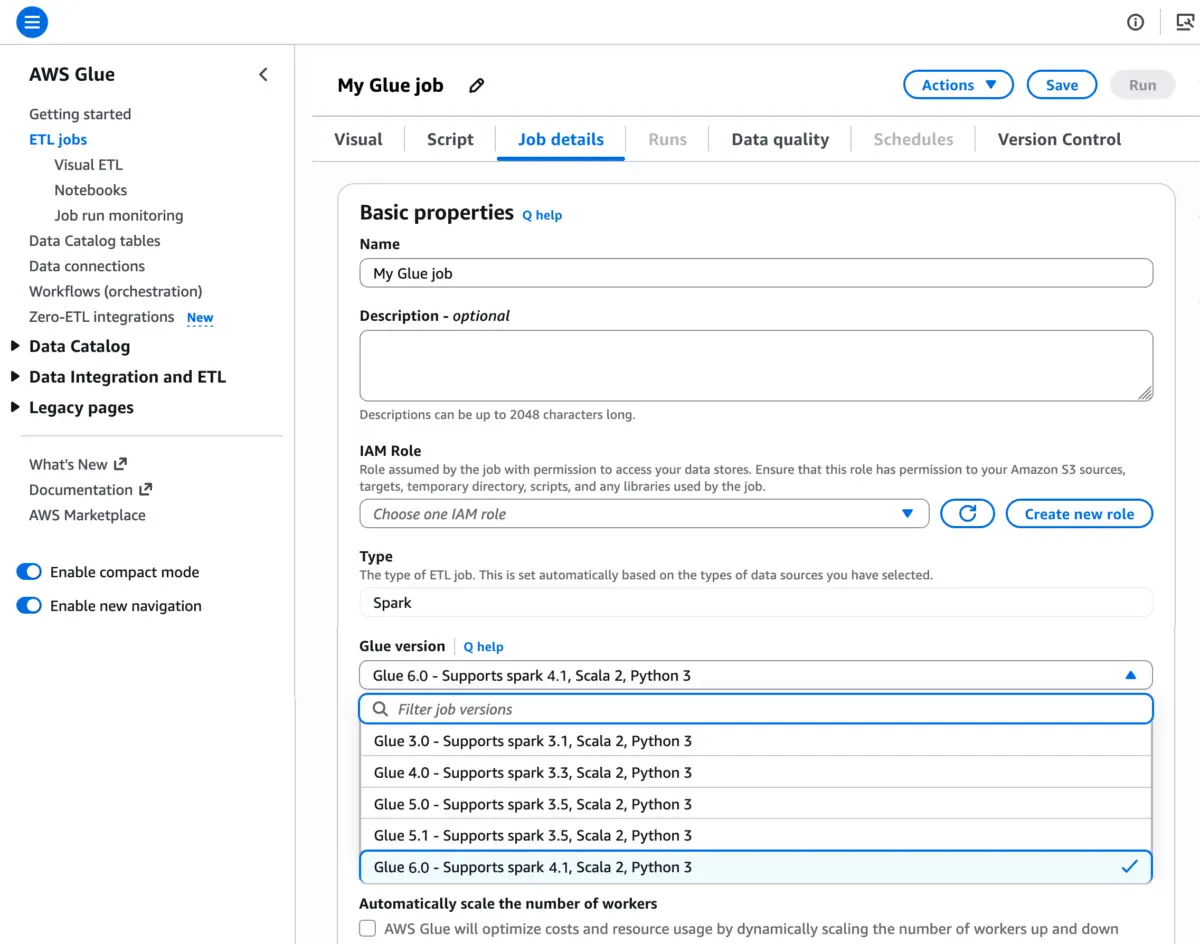
--glue-versionparameter withincreate-joborupdate-jobAPIs via the AWS CLI, AWS SDKs, or infrastructure-as-code tools. - Console Integration: Within the AWS Glue Studio console, updating a job is as simple as navigating to the Job Details tab and selecting
Glue 6.0 – Supports Spark 4.1, Scala 2, Python 3. - Notebook and Interactive Support: Data scientists and engineers utilizing Jupyter notebooks or AWS Glue Studio notebooks can instantiate a Glue 6.0 session instantly by specifying
6.0in the%glue_versionmagic command. - Automated Upgrade Agents: For organizations managing hundreds or thousands of legacy jobs, AWS provides the Spark upgrade agent within AWS Glue Studio, alongside automated upgrade features designed to streamline mass migration without manual intervention.
Official Statements and Industry Perspective
While official announcements from cloud hyperscalers often emphasize technical specifications, the overarching narrative surrounding AWS Glue 6.0 centers on developer productivity, data democratization, and open-source alignment.
Industry analysts have noted that by embracing Apache Iceberg v3 so comprehensively, AWS is signaling a decisive commitment to open table formats, ensuring that customers avoid vendor lock-in while capitalizing on AWS’s proprietary scale and serverless efficiency. The introduction of the VARIANT type is viewed by data architects as a watershed moment for telemetry, log analytics, and IoT data processing, where rigid schemas have traditionally stifled agility.
Furthermore, the accessibility of AWS Glue 6.0 is being amplified by modern artificial intelligence tooling. AWS has integrated support for the AWS MCP Server and associated plugins, allowing developers to query documentation, check regional availability, investigate troubleshooting logs, and invoke APIs using their preferred AI coding assistants. This fusion of advanced serverless data processing with AI-driven developer workflows underscores AWS’s vision for the future of cloud engineering.
Future Outlook: The Next Generation of Data Lakehouses
The release of AWS Glue 6.0 establishes a new benchmark for what enterprises should expect from managed data integration services. As organizations ingest increasingly complex, high-velocity data streams from modern web applications, IoT devices, and multi-cloud environments, the demand for zero-administration, high-performance ETL infrastructure will only intensify.
Looking ahead, we can anticipate several evolutionary trends catalyzed by this release:
- Widespread Adoption of Open Table Formats: With native, fully optimized support for Iceberg v3 features, enterprises will increasingly migrate legacy proprietary formats to open data lakes, fostering greater interoperability between different compute engines (such as Amazon Athena, Amazon EMR, and third-party analytics tools).
- AI-Driven Pipeline Maintenance: As AI coding agents and tools like the AWS MCP Server become deeply embedded in developer workflows, the friction of authoring, upgrading, and debugging complex PySpark and Scala transformations will plummet, empowering data analysts and software engineers alike to build robust data products with unprecedented speed.
- Redefining Cost-Performance Benchmarks: The 30% price reduction introduced in Glue 6.0 will likely set a new competitive baseline across the cloud computing industry, compelling other providers to optimize their underlying runtime engines and pass those savings down to consumers.
In conclusion, AWS Glue 6.0 is much more than a routine version increment. It is a strategically timed, performance-focused, and cost-optimized platform that equips modern enterprises with the tools necessary to tame data sprawl, accelerate query performance, and scale analytics operations efficiently into the future.