Executive Overview
In the fast-evolving landscape of B2B artificial intelligence, a quiet realization has swept through boardrooms and engineering squads alike: autonomous agents do not deploy themselves. While tech titans like Palantir pioneered the concept of the Forward Deployed Engineer (FDE) over two decades ago—and modern AI pioneers like OpenAI have scrambled to assemble similar units—the fundamental bottleneck of enterprise AI adoption remains human translation. Software can generate code or process documents, but bridging the chasm between raw technological capability and complex industry workflows requires deep, native domain expertise.
Enter Harvey, the legal AI behemoth currently servicing over 60% of the Am Law 100, boasting a customer base exceeding 1,400 entities across 60 countries, and empowering over 100,000 lawyers on its platform. Backed by an astronomical valuation of $11 billion secured in March, Harvey is executing a radical deployment strategy that diverges sharply from traditional software-as-a-service (SaaS) playbooks.
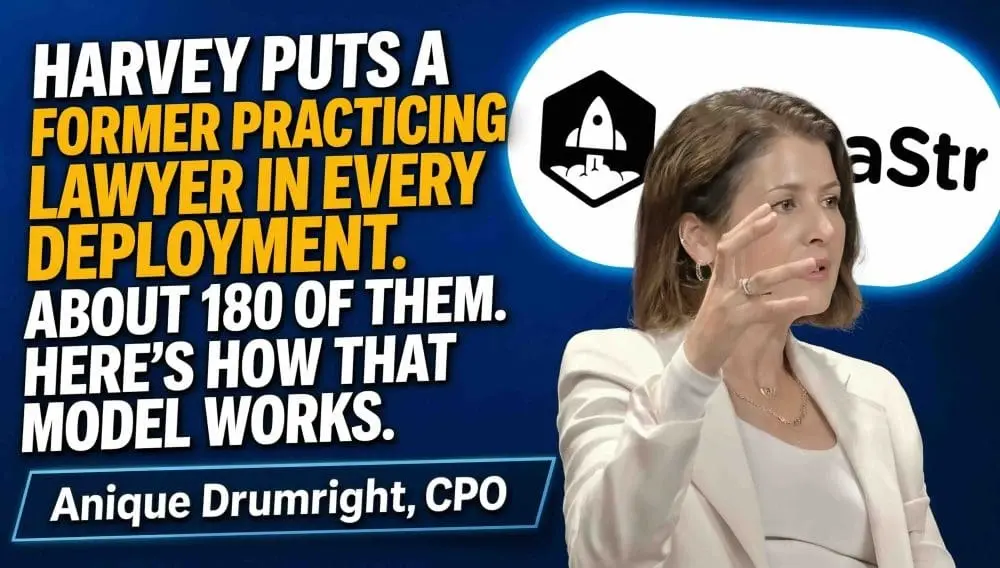
Rather than relying on generic technical solutions architects or forcing clients to supply their own change-management resources, Harvey embeds former practicing attorneys—dubbed "Legal Engineers"—into nearly every customer deployment. With roughly 180 of these specialists on the payroll, backed by lucrative $220,000 to $320,000 OTE compensation structures, Harvey is treating domain expertise not as an afterthought or a low-margin services drag, but as its primary growth and product engine.
This investigative report breaks down the anatomy of Harvey’s deployment model, examining why hiring elite legal talent to drive software adoption is rewriting the rules of vertical AI.
Detailed Chronology & Structural Evolution: From Practice to Product
The journey of Harvey’s deployment strategy is rooted in the uncompromising nature of the legal profession. As Anique Drumright, Harvey’s Chief Product Officer, detailed on stage at SaaStr AI, the company’s operational framework is built on a crucial distinction: while bespoke technical FDE "pods"—consisting of product managers, software engineers, and lawyers—are reserved for select enterprise accounts, every customer gets a dedicated Legal Engineer.
The Anatomy of the Legal Engineer
In standard B2B SaaS deployments, companies typically deploy a "solutions engineer." This is typically a bright software generalist who spends the first six to nine months learning the customer’s industry on the job. In most verticals—marketing tech, CRM, or data analytics—this ramp-up period is acceptable.
In Big Law, however, it is fatal. A litigation partner can sniff out an outsider within the first five minutes of a discovery conversation. If a vendor lacks native fluency in procedural nuances, risk management, and matter lifecycles, the software is dead on arrival.
To bypass this barrier, Harvey set an uncompromising hiring bar: candidates must possess a Juris Doctor (JD) or equivalent, paired with a minimum of three to eight years of hands-on practice at top-tier firms, in-house corporate legal departments, or specialized advisory practices.
Segmenting the Function
Rather than blending pre-sales, onboarding, and customer success into a single ambiguous "implementation" bucket, Harvey deliberately fragments legal engineering into three distinct, publicly defined functional pillars:
- Pre-Sales Legal Engineering: Focused on technical validation, proof-of-concept design, and initial discovery calls, operating strictly as a customer acquisition and sales acceleration cost.
- Post-Sales Product Specialization: Dedicated to driving deep adoption, sitting directly with practice groups to construct production-ready agents on live matters rather than simulated training exercises. This is treated as a core retention and expansion revenue function.
- Custom Solutions: Handling bespoke integrations, highly complex workflow automation, and custom LLM orchestration as a specialized professional services cost.
By separating these functions, Harvey maintains strict visibility into gross margins while deploying specialized human capital where it yields the highest return.
Supporting Context & Metrics: The Economics of Human-in-the-Loop AI
Scaling a team of 180 former practicing attorneys is an intentional, highly expensive structural bet. Analyzing the underlying metrics illuminates the financial reality of Harvey’s operational model.
Compensation and Capital Allocation
According to public listings for Harvey’s Product Specialist roles, compensation ranges between $220,000 and $320,000 OTE (On-Target Earnings), structured on a 75/25 base-to-variable split, augmented by significant equity grants.
This compensation package is deliberately calibrated to compete directly with mid-level associate salaries at top-tier law firms. A company cannot hope to hire a seasoned corporate or litigation attorney by offering standard technical support wages. Consequently, Harvey carries a multi-million-dollar operational line item dedicated entirely to deploying human domain experts alongside its software.
When Harvey secured its massive funding round at an $11-billion valuation, a significant portion of the stated use of proceeds was explicitly earmarked to expand these embedded legal engineering teams globally and scale the underlying agent infrastructure.
The Shift in Industry Adoption Rates
According to data presented by Harvey, overall AI adoption rates across law firms and corporate legal departments surged from 14% to 43% in just two years. In an industry historically characterized by extreme conservatism, billable-hour anxieties, and deep skepticism toward emerging technology, this acceleration cannot be attributed to generic software UI improvements alone. It is the direct result of peer-to-peer credibility—lawyers talking to lawyers about how to safely automate workflows.
Official Statements and Industry Insights
The philosophy underpinning Harvey’s approach was laid bare during Anique Drumright’s address at SaaStr AI. Emphasizing the psychological barrier of software adoption in high-stakes fields, Drumright highlighted that the primary obstacle to enterprise AI is rarely technical capability; it is trust.
"The legal engineer asks the questions a practicing lawyer would ask," Drumright noted during her presentation, "…which surfaces the workflows a software person wouldn’t know to ask about, and the adoption barriers a customer wouldn’t volunteer to a vendor."
By placing professionals who have spent a decade in the trenches of corporate litigation, M&A, and regulatory compliance directly across the table from firm partners, Harvey disarms the natural resistance of the legal buyer.
Furthermore, Harvey’s product feedback loop operates entirely free of traditional corporate translation loss. In a typical B2B software firm, a customer success manager (CSM) hears a complaint, relays it to a product manager (PM), who interprets it through a technical lens, often resulting in a feature that misses the mark. At Harvey, the person gathering product requirements is a former practitioner who has lived the exact pain point they are now helping to automate.
Future Outlook: Scaling the Unscalable via Certification
As Harvey looks toward capturing the remaining 57% of the unaddressed legal AI market, the company faces a fundamental economic ceiling: there are only so many elite lawyers in the world, and Harvey cannot hire all of them.
The Rise of the "Certified Legal Engineer"
To decouple its deployment model from its own headcount growth, Harvey launched the Harvey Academy, featuring a formalized, self-paced Certified Legal Engineer credential complete with shareable digital badges.
By defining the formal boundaries of this new hybrid profession—which marries legal judgment with technical fluency—Harvey is effectively standardizing the industry vocabulary. Law firms, corporate legal departments, and third-party implementers are training their internal staff on Harvey’s specific paradigm.
This maneuver transforms a proprietary deployment cost into an open industry standard. The buyer’s own personnel become equipped to drive adoption internally, insulating Harvey from the linear constraints of human-heavy service delivery while cementing its platform as the infrastructural standard for modern law.
Implications for the Broader B2B AI Ecosystem
Harvey’s playbook offers a vital lesson for vertical SaaS and enterprise AI companies across every high-stakes industry—whether healthcare, aerospace engineering, or complex financial services.
The era of shipping generic agents over the fence and hoping customers figure out how to integrate them into regulated, mission-critical workflows is rapidly coming to an end. The winners of the next decade of enterprise AI will not simply be the companies with the best foundational models; they will be the companies bold enough to invest heavily in the human translators required to make those models useful.
Who is the person your customer trusts to redesign their workflow, and whose payroll are they on? If the answer is the customer, adoption stalls at the pilot phase. If the answer is your own payroll—as Harvey has demonstrated across 180 deployments—you control the trajectory of the category.