Executive Overview
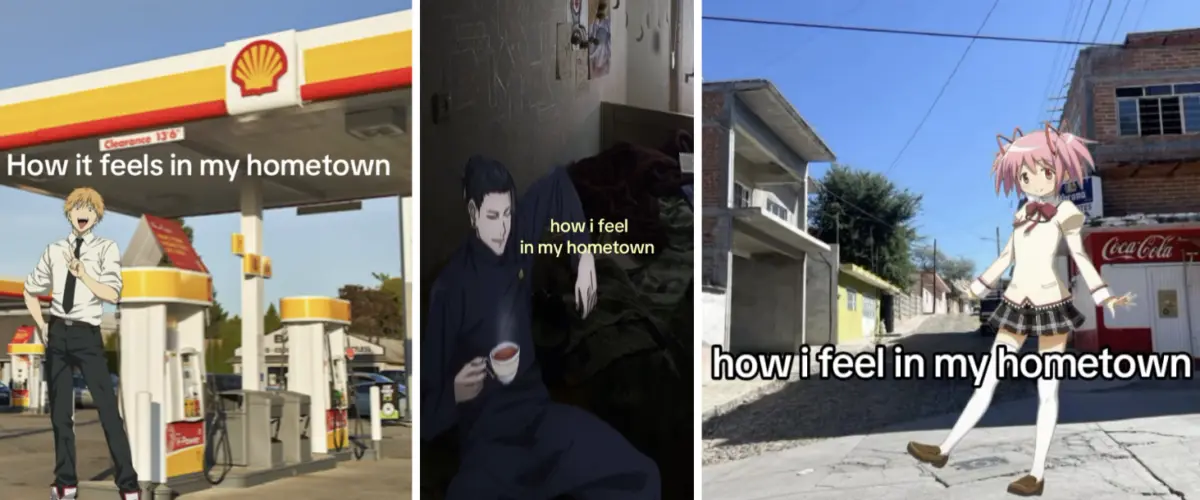
In the sprawling, hyper-personalized ecosystem of short-form video platforms, viral phenomena frequently rely on contrast, irony, and deeply specific emotional registers. The latest aesthetic wave capturing the imagination of TikTok users globally—known broadly as "How I Feel In My Hometown" (or occasionally "How It Feels In My Hometown")—operates entirely on the jarring, yet oddly resonant, juxtaposition between mundane, familiar local geography and stylized, high-energy anime character edits.
Emerging quietly in late August 2026, the trend has rapidly snowballed into a cross-cultural outlet for internet-native youth. Creators pair sweeping or starkly ordinary video clips and photographs of their hometowns—ranging from the overcast backroads of the Pacific Northwest and the rural expanses of Tennessee to suburban strip malls in Orange County and industrial quarters in Warsaw—with synchronized edits of fictional characters from beloved franchises like Jujutsu Kaisen, Chainsaw Man, My Dress-Up Darling, and Nana.
The overarching text prompt, stamped plainly across the screen as "how i feel in my hometown," serves as an emotional shorthand. It encapsulates a complex cocktail of adolescent and young adult alienation: the profound boredom of returning to a place where time seems to stand still, the stark contrast between vibrant internal fantasies and gray local realities, and an ironic, self-aware nostalgia. Far from a localized meme, this trend has evolved into a digital canvas for global youth to project their alienation onto the landscapes that raised them, filtering the mundane through the hyper-stylized lens of Japanese animation.
Detailed Chronology: From Ambiguous Origins to Algorithmic Velocity
The lifecycle of internet memes often resists pinpointing a single genesis, and the "How I Feel In My Hometown" trend is no exception. Its exact point of origin remains shrouded in the algorithmic ether, with no single creator claiming ownership of the initial concept. However, digital anthropologists and trend-trackers have mapped its explosive ascent across late summer and mid-September 2026, highlighting a swift transition from obscure niche experiment to mainstream FYP (For You Page) staple.
The Spark: Late August 2026
The earliest notable iteration of the trend surfaced on August 30th, 2026. TikTok user @xxlastunicorncat uploaded a video featuring stylized edits of the character Marin Kitagawa from the romantic comedy-drama anime My Dress-Up Darling. The visual backdrop, however, was staunchly grounded in the geography of the American Midwest and Pacific Northwest—gray skies, nondescript highways, and quiet suburban sprawl.
The juxtaposition struck an immediate chord. Within three weeks of posting, the video amassed over 317,600 views and garnered 86,100 likes. It provided the structural blueprint that subsequent creators would rapidly adopt: a recognizable character edit coupled with local, geographically specific scenery, anchored by the uniform caption.
The Rapid Expansion: Mid-September 2026
As September progressed, the trend shed its nascent status and entered a phase of exponential growth, diversifying both geographically and culturally.
- September 11th, 2026: TikTok user
@rosstheboss28localized the trend for rural Tennessee, setting an edit of the chaotic dark-fantasy series Chainsaw Man against dusty backroads and local storefronts. The post pulled in over 395,800 views and 109,400 likes in roughly a week. - September 12th, 2026: Expanding beyond North America, user
@crux_x5introduced a European and international flavor to the format, utilizing Suguru Geto from Jujutsu Kaisen. The clip cleared 434,600 views in under a week. - September 14th, 2026: Pushing deep into regional American subcultures, user
@jiminiemochioppapaired a Jujutsu Kaisen edit with the sun-baked landscapes of South Texas, generating a massive response of 598,300 views and 188,100 likes in just four days. - September 15th, 2026: The trend transcended traditional anime to incorporate indie web-animations and multimedia franchises. User
@maffichuuposted an Alien Stage edit, proving that the structural formula could comfortably house diverse fandom aesthetics while maintaining its core emotional thesis.
Supporting Context & Metrics: Analyzing the Appeal
To understand why "How I Feel In My Hometown" resonated so deeply across diverse demographics, one must examine the psychological framework underpinning the content.
The Psychology of Spatial Alienation
For Gen Z and younger Millennials, the hometown often occupies a paradoxical psychological space. It is simultaneously a site of deep, foundational comfort and a symbol of stagnation. Returning to or remaining in a hometown can evoke a distinct sense of "dissociation"—the feeling of being a main character trapped in a setting that no longer fits one’s evolving identity.
By superimposing hyper-expressive, often dramatic anime characters—such as the brooding figures of Jujutsu Kaisen or the melancholic protagonists of Nana—onto unglamorous backdrops like Warsaw housing blocks, Serbian street corners, or Texas strip malls, creators externalize this internal dissonance. The underlying message is one of dramatic irony: I am sitting in a suburban parking lot eating barbecue ribs, but internally, I am experiencing the weight of an epic narrative.
Quantitative Engagement Metrics
Platform metrics highlight the high engagement rates associated with the trend. Across the sampled anchor videos from mid-September 2026, engagement ratios consistently outperformed baseline platform averages for the respective accounts:
- High View-to-Like Ratios: Videos utilizing the format frequently saw view counts scale from 300,000 to nearly 600,000 within days, with like-to-view ratios often exceeding 25% (e.g.,
@jiminiemochioppa‘s South Texas edit converting 598k views into 188k likes). - Geographic Diversity: Hashtag tracking reveals a truly international footprint. While starting prominently in North America (#northwest, #midwest, #tennessee, #texas), the trend quickly localized globally, incorporating tags for Warsaw (#warsaw), Serbia (#serbia), and various European urban centers.
- Fandom Cross-Pollination: The trend has successfully bridged disparate anime subcultures. While Jujutsu Kaisen dominates share-of-voice, contributions span historical shojo classics like Revolutionary Girl Utena and The Rose of Versailles (#ladyoscar), psychological dramas like Nana, and magical girl deconstructions like Puella Magi Madoka Magica.
Official Statements & Creator Perspectives
While formal corporate entities or streaming platforms have yet to issue structured press releases regarding the trend—as is typical for organic, user-generated internet phenomena—cultural commentators and prominent creators have weighed in on why the format works so effectively.
In community discussions across TikTok, Reddit, and X (formerly Twitter), creators frequently point to the therapeutic nature of self-deprecation mixed with aesthetic self-expression.
"When you grow up in a small town or a place where nothing ever happens, you live a lot of your life inside your head or through media like anime," notes one prominent community creator who participated in the trend using an Ouran High School Host Club backdrop in rural Texas. "Making these edits isn’t just about showing off where you live; it’s about acknowledging how funny and strange it is to carry these massive, dramatic fictional worlds inside your head while you’re just standing outside a local gas station."
Sociologists specializing in digital media note that the "How I Feel In My Hometown" trend represents a mature phase of internet irony. Rather than mocking hometowns through outright satire or glorifying them through rose-tinted nostalgia, modern youth culture uses surreal juxtaposition to validate complex, contradictory feelings of belonging and displacement.
Future Outlook: The Evolution of Localized Memetics
As the "How I Feel In My Hometown" trend continues its trajectory through the algorithmic pipelines of late 2026, several indicators point to its ongoing evolution and eventual assimilation into broader internet culture.
1. Saturation and Subversion
As with any viral video format, peak saturation inevitably breeds self-parody. Early adopters have already begun introducing hyper-ironic variations—pairing intensely dramatic anime death scenes or comedic outtakes with absurdly mundane or hyper-specific local landmarks (such as a local drainage ditch or a single flickering streetlamp). This self-referential humor ensures the trend’s longevity by keeping the barrier to entry fresh and culturally fluid.
2. Commercial and Brand Integration
Predictably, lifestyle brands and regional tourism boards are beginning to monitor the spatial components of the trend. While corporate attempts to co-opt organic youth memes often risk "cringe," the localized nature of the format offers a unique template for regional marketing. Small businesses and local creators have already begun leveraging the trend to highlight overlooked cultural pockets, transforming geographic obscurity into an aesthetic badge of honor.
3. The Enduring Legacy of Spatial-Emotional Memes
Ultimately, "How I Feel In My Hometown" taps into a universal human experience: the friction between our internal emotional landscapes and the physical environments we inhabit. By bridging the gap between niche Japanese animation and local geography, TikTok users have forged a remarkably versatile language for modern nostalgia. Whether the trend fades into the archives of internet history or evolves into a permanent template for digital storytelling, it has left an indelible mark on how a new generation maps, critiques, and romanticizes the places they call home.