
Executive Overview
The global personal computer industry is bracing for a turbulent transition as it looks ahead to 2027. While recent market cycles have been defined primarily by supply chain bottlenecks, chip shortages, and logistical gridlock, a new and more complex challenge is taking center stage: soaring component costs and shifting consumer demand dynamics.
According to a comprehensive industry report released by market intelligence firm TrendForce, global notebook shipments are projected to contract by a margin ranging from low-single-digit to high-single-digit percentages in 2027. This anticipated downturn is not merely a byproduct of waning consumer interest, but rather the culmination of an intricate economic squeeze. Manufacturers—often referred to as OEMs (Original Equipment Manufacturers)—are facing aggressive cost pressures driven primarily by sustained high prices for core silicon components, specifically central processing units (CPUs) and dynamic random-access memory (DRAM).
At the heart of the issue is a harsh mathematical reality for hardware brands: core components—namely CPUs, DRAM, and solid-state drives (SSDs)—accounted for a staggering 68% of the total bill of materials (BOM) for a mainstream $900 laptop during the third quarter of 2026. As low-cost component inventories dwindle and cheap stockpiles are exhausted, brands can no longer shield themselves or consumers from the true cost of production.
Consequently, industry leaders face an unpalatable trilemma. They must choose between passing increased costs directly to consumers via higher retail prices (risking a deeper slump in demand), absorbing the financial hits at the expense of their own gross profit margins, or downgrading hardware specifications to maintain price points—a move that risks alienating increasingly sophisticated tech consumers. Adding to this complex operational landscape are shifting geographic production footprints, with manufacturers seeking refuge in established supply chains within mainland China to mitigate overhead expenses amid a volatile global economic climate.
Detailed Chronology: From 2026’s Artificial Boom to 2027’s Reality Check
To fully understand the trajectory of the notebook market heading into 2027, one must examine the unique market dynamics that characterized the preceding year.

The 2026 Buying Rush and Inventory Depletion
Throughout 2026, the global laptop market experienced a period of relative resilience, artificially propped up by a convergence of favorable factors. Supply chains had largely recovered from post-pandemic disruptions, and a steady availability of improved CPUs allowed manufacturers to ramp up production. Crucially, anticipating future economic headwinds and potential cost escalations, brands and enterprise buyers engaged in aggressive early purchasing.
This wave of early procurement effectively pulled forward replacement demand that would have naturally materialized in late 2026 and throughout 2027. Consumers and corporate IT departments alike upgraded their machines ahead of schedule, temporarily inflating shipment figures.
However, this strategy came with an expiration date. By the close of 2026, the cushion of low-cost component inventories—acquired under older, cheaper contract pricing—was thoroughly depleted. Brands could no longer rely on legacy stockpiles to buffer their profit margins. As they stepped into new contract negotiations for silicon and memory, they were greeted by significantly higher spot and contract prices for essential hardware components.
The Shift from Supply Constraints to Cost-Driven Demand Destruction
As the industry pivots into 2027, the nature of the primary risk facing the market has fundamentally transformed. In previous years, the narrative was dominated by supply constraints—the inability to manufacture enough units due to factory shutdowns, logistics failures, or raw material shortages. In 2027, the bottleneck is economic.
TrendForce’s latest research indicates that the market is transitioning into an era where high costs dictate consumer behavior. If component prices remain stubbornly high, brands will have no choice but to adjust their pricing strategies. The baseline projection currently sits at a low-single-digit percentage decline in shipments. However, if macroeconomic conditions force brands to aggressively pass these costs downstream to everyday shoppers and enterprise clients, the resulting sticker shock is expected to extend replacement cycles significantly. When laptops become noticeably more expensive, consumers tend to hold onto their existing devices for an extra year or two, driving the projected full-year shipment decline into the high-single-digit range.
Supporting Context & Metrics: Inside the Bill of Materials
The vulnerability of the modern notebook ecosystem is best illustrated by breaking down the financial anatomy of a standard device.
The Silicon Dominance
In the third quarter of 2026, an analysis of a mainstream notebook—peged at a Manufacturer’s Suggested Retail Price (MSRP) of $900—revealed a striking statistic: 68% of the total bill of materials was consumed by just three categories of components:
- CPUs (Central Processing Units): The computational engines driving modern operating systems and applications.
- DRAM (Dynamic Random-Access Memory): Essential for multitasking and overall system responsiveness.
- SSDs (Solid-State Drives): High-speed flash storage replacing traditional mechanical hard drives.
When nearly seven out of every ten dollars spent on raw hardware parts goes exclusively toward processing, memory, and storage, the room for operational error or cost absorption by the manufacturer is razor-thin.
The Diverging Fortunes of Memory and Storage
Compounding the issue is the disparate outlook for different types of memory technologies, heavily influenced by broader macroeconomic trends in the technology sector:
- The DRAM Crunch: The explosive global buildout of artificial intelligence (AI) infrastructure—spanning massive data centers, specialized training clusters, and inference farms—has placed unprecedented demands on the semiconductor industry. High-bandwidth memory (HBM) and advanced server-grade DRAM have absorbed immense fab capacity. Consequently, PC DRAM faces a severe risk of constrained supply growth throughout 2027, keeping prices elevated and keeping pressure squarely on notebook manufacturers.
- The NAND Flash Respite: Conversely, the storage landscape offers a glimmer of hope. TrendForce anticipates that NAND Flash supply constraints will begin to ease significantly by the second half of 2027 as new manufacturing capacity comes online. This anticipated normalization in flash storage pricing may offer slight relief to SSD costs, though it may not be enough on its own to offset systemic increases in CPU and DRAM pricing.
Official Industry Analysis and Strategic Dilemmas
Faced with this intricate web of economic pressures, PC brands are navigating a series of difficult strategic trade-offs. According to TrendForce, brands in 2027 will find it virtually impossible to simultaneously maintain three critical pillars of their business model: pricing stability, high hardware specifications, and robust profit margins.

+-------------------------------------------------------------+
               THE 2027 PC MANUFACTURER'S TRILEMMA
+-------------------------------------------------------------+
       [ Pricing Stability ]        [ High Specifications ]
                                           /
                                          /
                   v                      v
                [ BRAND PROFIT MARGINS / SURVIVAL ]
                           ^
                          /
                         /
                        /
       [ Passing Costs to Consumer -> Demand Drops ]
Manufacturers must pull one of three levers, each carrying distinct and severe business risks:
- Pass Costs to Consumers (The Margin Protection Strategy):
By raising retail prices to fully reflect the rising cost of CPUs and DRAM, brands can protect their gross margins. However, this strategy risks triggering severe demand destruction. In a competitive consumer market, higher price points often deter discretionary buyers and push corporate procurement officers to delay fleet upgrades. - Absorb Cost Increases (The Volume Protection Strategy):
Brands can choose to keep retail prices steady, absorbing the higher component costs internally to maintain sales volume. The fatal flaw in this approach is the devastating impact it has on corporate profitability. Sustained margin compression can quickly trigger negative investor reactions, squeezing research and development (R&D) budgets for future product cycles. - Downgrade Hardware Specifications (The Value Engineering Strategy):
To keep prices flat while protecting margins, manufacturers may substitute higher-end components with cheaper, lower-tier alternatives—such as reducing baseline RAM configurations, utilizing slower storage speeds, or opting for entry-level processors. While this preserves price points, it degrades the user experience and leaves products less competitive in an increasingly demanding software landscape.
The Geographic Shift: Production Realignment in Mainland China
Amid these cost-cutting measures, supply chain strategists are also re-evaluating where their products are assembled. Geopolitical trade tensions and shifting tariff policies have long kept manufacturing executives on edge. However, TrendForce notes that barring any sudden, dramatic escalations in global tariff pressures, notebook brands are increasingly incentivized to lean back into established, cost-efficient manufacturing hubs.
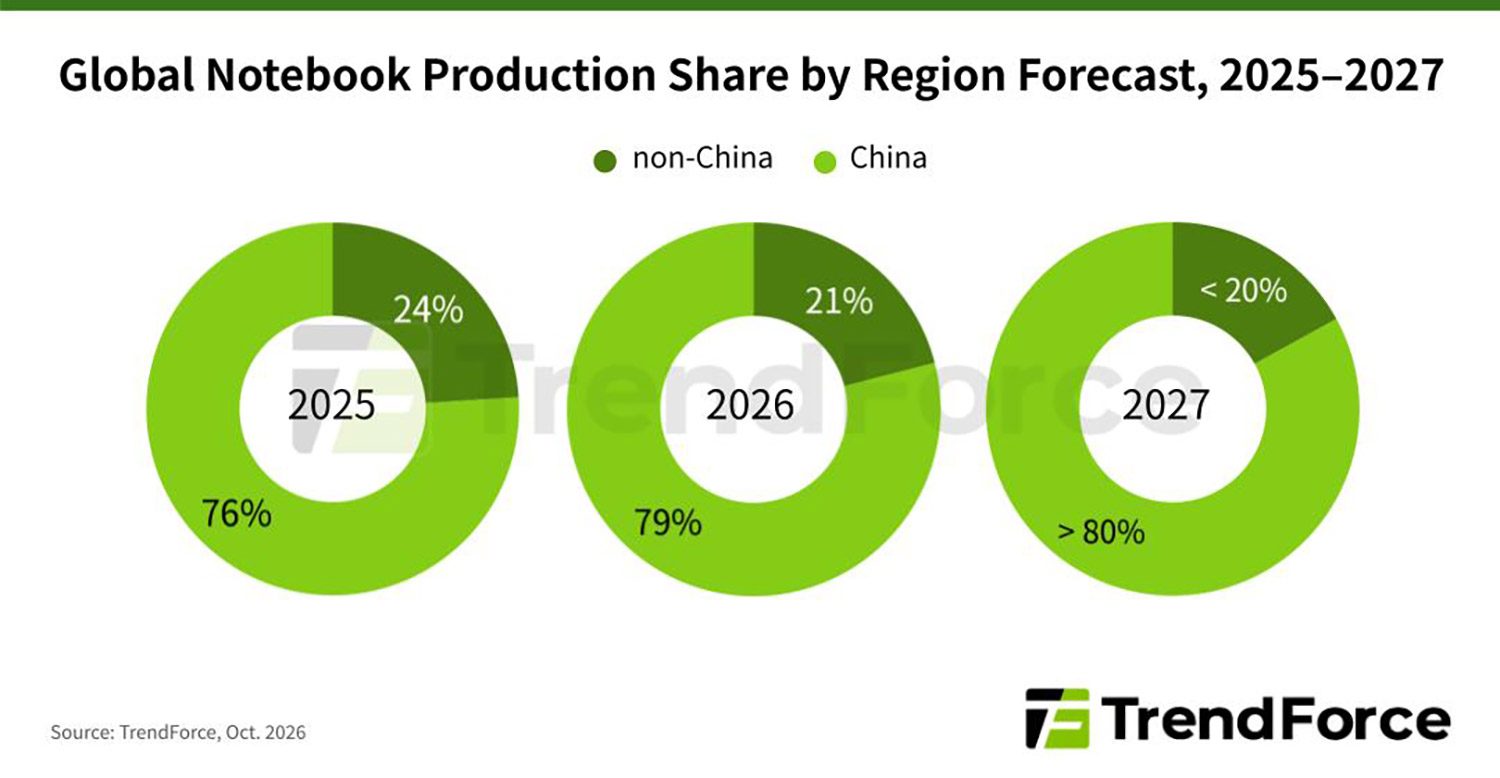
Statistics from the industry report highlight this subtle but important migration: China’s share of global notebook production stood at 76% in 2025. Driven by a collective need to shave every possible fraction of a cent off assembly overheads, that share ticked upward to 79% in 2026, and is projected to comfortably exceed 80% throughout 2027. By consolidating production within deeply integrated regional ecosystems, brands hope to claw back some of the margin lost to soaring silicon costs.
Future Outlook: Navigating the 2027 Landscape
As the personal computing industry steps deeper into this critical window, the stakes could not be higher for both hardware manufacturers and consumers. The era of cheap, readily accessible high-performance computing hardware—bolstered by post-pandemic inventory corrections and aggressive market discounting—has officially drawn to a close.
For enterprise buyers, the calculus for hardware lifecycle management must change. Organizations looking to refresh their employee fleets will need to carefully budget for potential price increases or plan for extended replacement cycles. Waiting for hardware prices to drop significantly in the near term appears to be an increasingly unrealistic gamble, given the structural nature of AI-driven memory demand and sustained silicon pricing.

For everyday consumers, the market of 2027 will demand careful purchasing decisions. Buyers shopping in the mainstream price brackets may find themselves forced to weigh the value of incremental upgrades against noticeably higher price tags, or settle for machines with trimmed-down specifications.
Ultimately, the trajectory of the 2027 notebook market will serve as a masterclass in modern supply chain economics. How individual brands choose to navigate the delicate balance between consumer pricing, product quality, and corporate profitability will determine market leadership for the remainder of the decade. As low-cost inventories evaporate and the true weight of component costs takes hold, resilience, agility, and strategic foresight will be the ultimate currencies of survival in the global PC ecosystem.