Executive Overview
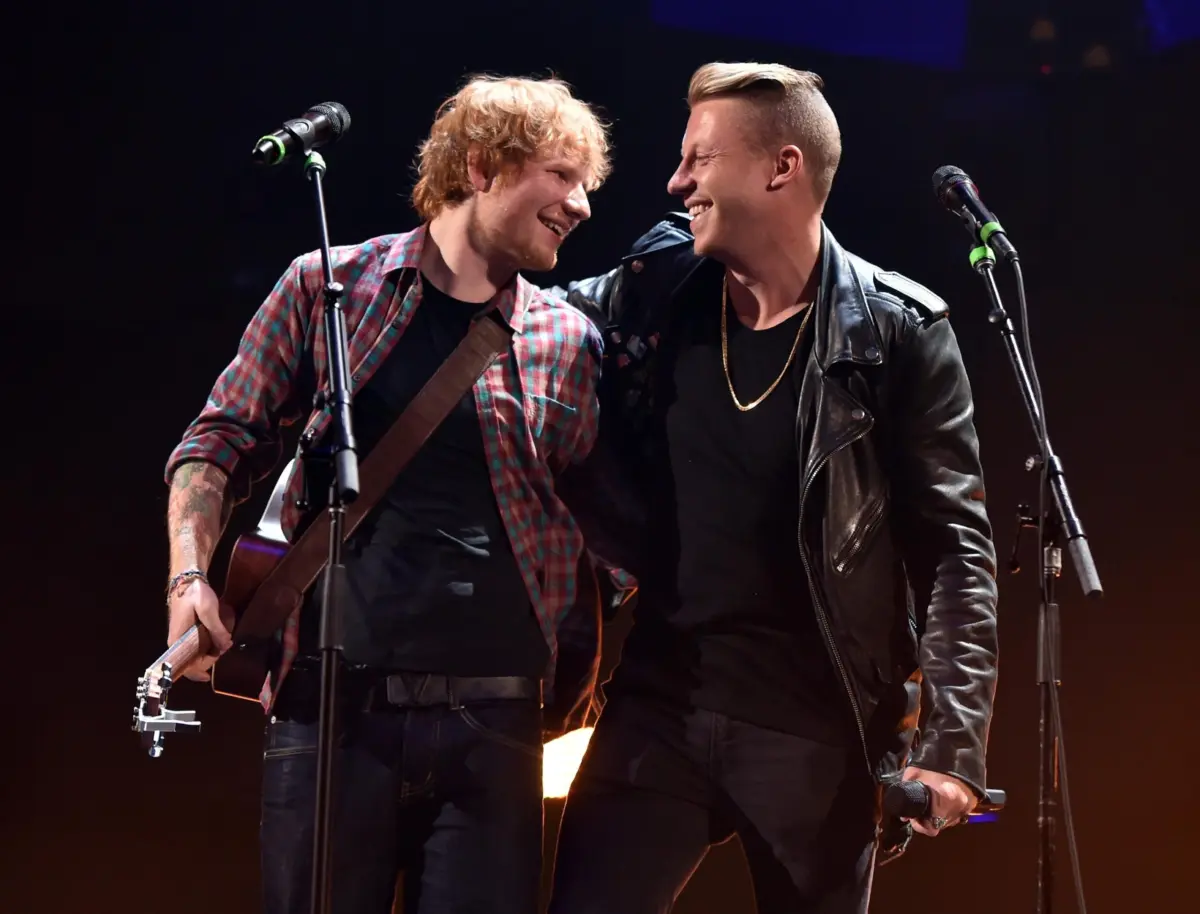
What began as a routine pop music tour has rapidly disintegrated into a sprawling, high-stakes cultural flashpoint, exposing deep ideological fractures within contemporary American society. Ed Sheeran’s blockbuster 59-date "Loop Tour"—an international triumph expected to draw millions of fans—has instead become the epicenter of a fierce debate concerning free speech, corporate accountability, antisemitism, and shifting generational perspectives on the Israeli-Palestinian conflict.
The crisis ignited when rapper Benjamin Hammond Haggerty, professionally known as Macklemore, was abruptly dropped from the remainder of the tour. Macklemore, serving as an opening act, had recently aligned himself with the pro-Palestinian movement, releasing protest anthems and utilizing high-profile concert stages to deliver impassioned political polemics. His dismissal was spearheaded, in part, by billionaire sports magnate Robert Kraft, owner of Gillette Stadium, who cited the rapper’s history of controversial statements and recent rhetoric as the catalyst for barring him from a scheduled performance outside Boston.
Far from quietly resolving the issue, the decision to eject Macklemore triggered an immediate, cascading institutional collapse. Within days, the remaining opening acts and Sheeran’s own backing band walked off the tour in solidarity, leaving the massive enterprise in chaos. This controversy has since transcended the music industry, transforming into a litmus test for the cultural zeitgeist. It encapsulates the complex intersections of celebrity activism, the boundaries of "cancel culture," and a profound, measurable generational pivot in how Americans view Middle Eastern geopolitics.
Detailed Chronology: From Opening Act to Tour-Wide Collapse
The unraveling of Ed Sheeran’s Loop Tour did not happen overnight; it was the culmination of a mounting series of artistic, political, and corporate escalations that played out across international headlines over several weeks.
The Catalyst: Macklemore’s Political Pivot
For months, Macklemore had been shifting his public persona away from mainstream pop-rap toward outspoken political activism. Central to this pivot was his vocal advocacy for Palestinian independence, highlighted by the release of his track "Hind’s Hall"—named in honor of the student-led occupation of Hamilton Hall at Columbia University during the 2024 campus protests. As an opening act on Sheeran’s massive 59-date tour, Macklemore frequently used his platform to air these views, introducing pro-Palestinian messaging and wartime imagery into his live sets.
The Backlash Mounts
While Macklemore’s advocacy energized certain segments of his fanbase, it drew intense condemnation from others. Critics pointed not only to the polarizing nature of the ongoing conflict in Gaza but also to the rapper’s documented past controversies, including a 2014 incident involving an offensive costume that drew widespread accusations of antisemitism—an episode for which he later issued a public apology.
The friction reached a boiling point when pop star Pink published a lengthy public critique condemning Macklemore’s on-stage rhetoric. Pink argued that his use of violent imagery and political polemics deeply frightened many Jewish fans, amplifying an already tense atmosphere surrounding the tour.
The Corporate Intervention and Robert Kraft’s Ultimatum
As public pressure mounted, venue operators began evaluating their exposure. Reports emerged that multiple concert venues threatened to cancel appearances if Macklemore remained on the bill.
The decisive blow came from billionaire sports mogul and Gillette Stadium owner Robert Kraft. Kraft, a prominent philanthropist and vocal advocate for the Jewish community, notified tour organizers that Macklemore would not be permitted to perform at his venue for the late-September Boston-area stop. Citing both the rapper’s recent political messaging and his historical controversies regarding antisemitic rhetoric, Kraft drew a hard corporate line. Shortly after Kraft’s intervention, tour organizers officially dropped Macklemore from the remainder of the 59-date itinerary.
Solidarity Walkouts and Institutional Freefall
Rather than diffusing the tension, Macklemore’s removal injected gasoline into the fire. Both Sheeran and Macklemore acknowledged the intense pressure from venues, but the decision to boot the rapper provoked an immediate internal mutiny. On a Tuesday following the announcement, the remaining opening acts on the bill, alongside Ed Sheeran’s own backing band, announced they were pulling out of the tour in protest. The mass walkout left the blockbuster tour effectively paralyzed, turning a venue booking dispute into an unprecedented industry-wide labor and ideological standoff.
Supporting Context & Metrics: Generational Shifts and the Israel-Gaza Discourse
To understand why a dispute over an opening act on a pop tour could cause such violent institutional tremors, one must examine the broader statistical and sociological landscape of American public opinion regarding Israel and Palestine.
The Millennial and Gen Z Shift
The controversy unfolded on a tour whose primary demographic—adults aged 30 to 45—holds a uniquely pivotal position in the American political landscape. Over the past decade, American millennials have grown sharply more critical of the state of Israel. This generational attitudinal shift laid the crucial groundwork for Gen Z’s high-profile campus activism, driving a profound narrative change across U.S. politics and culture.
While high-profile university protests organized by college students came to define young Americans’ disillusionment, this shift began long before Gen Z emerged as an electoral force. Data from organizations like the Pew Research Center demonstrates that Americans under 30 were already more likely to blame Israel than Hamas for the 2014 Gaza war. Throughout the mid-2010s, millennial-led social justice movements increasingly interwoven Palestinian independence with broader anti-colonialist and domestic advocacy, forging long-standing activist networks.
Polling Data: A Broadening Generational Gap
Recent polling illustrates that this transformation is no longer confined to the progressive fringe or the youngest voters. Gallup and other prominent polling institutions have recorded historic shifts in American sympathies regarding the Middle East.
- The 35–54 Demographic: Over the past two years, the sharpest statistical drop in uncritical support for Israel has occurred among Americans aged 35 to 54—precisely the core demographic that grew up listening to Macklemore and currently fills stadium tours.
- Cross-Sectional Decline: Sympathy for Israel has seen measurable declines across age brackets, including among younger conservative and Republican voters.
- The Global Perception Challenge: As Israeli Prime Minister Benjamin Netanyahu acknowledged in public remarks, international public relations—particularly regarding younger demographics—face an uphill battle in the digital age, where decentralized social media narratives frequently amplify civilian perspectives from conflict zones.
Official Statements and Institutional Responses
The fallout from the Loop Tour cancellation prompted immediate, carefully weighed statements from the principal figures involved, reflecting the high stakes of public perception.
Ed Sheeran and Tour Management
Ed Sheeran addressed the controversy via an official statement, acknowledging the immense logistical pressure placed upon the tour by individual venue operators. While attempting to maintain a neutral stance focused on the music, Sheeran’s team found themselves trapped between corporate venue mandates and the artistic autonomy of their supporting acts. The statement underscored the unprecedented nature of multiple venues issuing cancellation threats over an opening act’s political speech.
Robert Kraft and Gillette Stadium
Robert Kraft’s representatives and associated cultural figures defended the decision to bar Macklemore from Gillette Stadium, framing the move as a necessary defense against hate speech and the escalation of antisemitism. Kraft’s camp emphasized that stadium owners retain the legal and moral right to curate events in a manner that ensures public safety and aligns with community standards, explicitly pointing to Macklemore’s past controversies and inflammatory performance style as disqualifying factors.
The Artist Collective Response
The musicians and backing band members who abandoned the tour released a joint digital statement framing their departure as a defense of artistic expression and a protest against viewpoint discrimination. Their unified exit underscored a growing sentiment within certain segments of the music industry that corporate venue owners should not act as ideological gatekeepers for touring artists.
Future Outlook: The Intersection of Music, Politics, and Corporate Power
The implosion of the Loop Tour serves as a profound warning sign for the live entertainment industry. As cultural polarization deepens, the traditional separation between musical performance and geopolitical activism is rapidly dissolving.
Several critical questions emerge from this unprecedented episode:
- The Future of Venue Curation: Will major venue owners increasingly vet the political backgrounds and off-stage advocacy of touring musicians, effectively establishing ideological prerequisites for performing in large-scale arenas?
- The Price of Artist Solidarity: As backing bands and supporting acts increasingly utilize walkouts as a form of industrial protest, major international tours face heightened operational vulnerabilities. Promoters may demand stricter contractual non-disruption clauses moving forward.
- The Weaponization of "Cancel Culture": Both sides of the political spectrum now actively utilize economic levers—from boycotts and venue cancellations to artist walkouts—to enforce accountability, signaling that the culture wars have permanently entrenched themselves in the commercial live music market.
Ultimately, the Macklemore-Kraft-Sheeran debacle is much more than a messy celebrity feud. It is a microcosm of a divided nation, proving that in today’s cultural climate, no stage is large enough to outrun the geopolitical storms shaping the modern world.