Executive Overview
In a bold gambit that blurs the boundaries between traditional audiobooks, live-action role-playing (LARP), and conversational artificial intelligence, Audible has officially announced the rollout of "Interactive Stories." This innovative feature allows listeners to step out of the traditional role of passive consumers and actively "become part of the story’s world." Leveraging generative AI architecture, the platform enables real-time, spoken dialogue between users and fictional characters, creating a dynamic, branching narrative experience tailored to individual inputs.
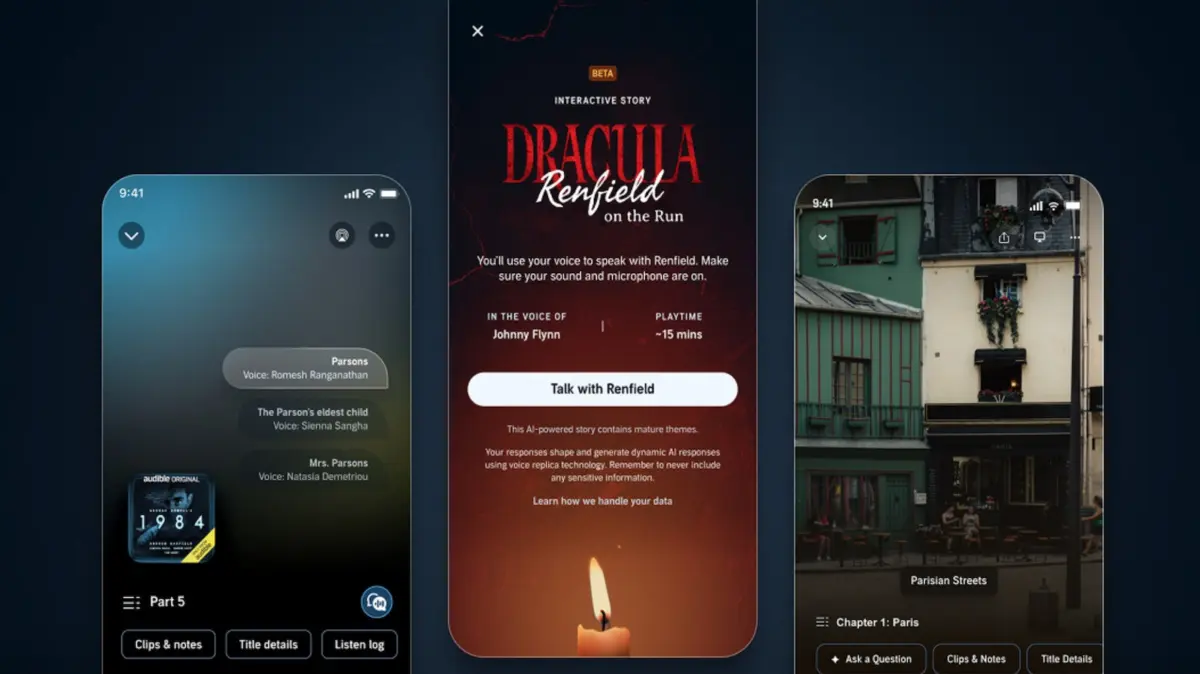
The initiative kicks off this fall with an accompanying interactive experience tied directly to the platform’s upcoming Audible Original adaptation of Bram Stoker’s gothic masterpiece, Dracula. In this inaugural beta release, listeners will interface directly with Dracula’s deeply troubled servant, R.M. Renfield. Rather than merely listening to Renfield’s descent into madness, users will receive personalized roles, specific narrative objectives, and high-stakes scenarios, responding in their own words as the AI-driven character reacts in real time.
Alongside "Interactive Stories," Audible is deploying two additional companion features designed to fundamentally alter how audiences digest long-form audio: the "Character Guide," a real-time visual roster designed to demystify complex casts, and the "Visual Explorer," which injects contextual maps, historical imagery, and visual touchstones at critical junctures in a narrative.
While corporate leadership hails these developments as a long-awaited response to the desires of modern, tech-native audiences, the integration of generative AI opens a Pandora’s box of industry-wide questions. As publishers race to adopt bleeding-edge technology to capture shrinking attention spans, questions surrounding artistic integrity, the nuances of generative AI performance reliability, and listener receptivity remain at the forefront of the cultural conversation.
Detailed Chronology: From Static Narration to Generative Dialogue
The evolution of Audible from a distributor of digitized magnetic tape into an immersive, multimedia platform has been methodical, yet this latest announcement marks its most aggressive technological pivot to date.
The Dracula Beta and the Renfield Experience
The cornerstone of this technological leap arrives this fall with the platform’s beta release of "Interactive Stories." Scheduled to debut alongside the star-studded audio adaptation of Bram Stoker’s Dracula—slated for release on October 1—the feature transforms the traditional listening experience into a cooperative digital theater.
According to platform documentation, listeners interacting with the Dracula companion experience will be funneled into the psyche of Renfield. Instead of passively hearing about his obsession with consuming flies and spiders, the user is assigned a specific role, goal, and stakes by Renfield himself. The conversational loop relies entirely on speech-to-text and generative language modeling: the listener responds using their own spoken words, and the AI character processes the input, formulating an in-character response delivered in real time.
The Exoplanet Expansion
Audible is not treating the generative AI feature as a one-off gimmick. The company has already confirmed the second installment in the "Interactive Stories" pipeline. Set within the sci-fi universe of the upcoming original audio novel Exoplanet—created in close collaboration with acclaimed author Benjamin Percy—this second interactive experience is scheduled to drop on November 5. The rapid succession of these releases indicates that Audible has built a scalable framework for integrating conversational AI across disparate genres, ranging from 19th-century epistolary horror to contemporary hard science fiction.
Real-Time Visual Integration: Character Guides and Visual Explorers
Recognizing that complex narratives often suffer in audio-only formats due to a lack of visual reference points, Audible is simultaneously rolling out structural UI enhancements.
- The Character Guide: Designed to solve the age-old audiobook dilemma of losing track of minor characters, this tool visually displays who is speaking in real-time directly within the mobile app. It populates dynamic, spoiler-free character cards that update as the plot progresses. While already introduced in a limited capacity for George Orwell’s 1984, the Character Guide is expanding to encompass the Dracula adaptation and Exoplanet.
- The Visual Explorer: Looking beyond character tracking, this upcoming tool introduces multimedia context. During pivotal narrative moments, the application will display relevant imagery, such as historical maps, architectural blueprints, or visual artifacts tied directly to the plot. The beta test for Visual Explorer will accompany The Cultural Tutor’s Grand Tour: The Story of Europe in Six Cities, transforming a historical audio tour into an illustrated, multimedia curriculum.
Supporting Context & Metrics: Navigating the Generative AI Landscape
Audible’s pivot toward generative AI does not occur in a vacuum. It reflects a desperate industry-wide race to capture the attention of younger demographics, whose media consumption habits have been irrevocably shaped by interactive gaming, algorithmic feeds, and generative technologies.
The Generational Divide in AI Perception
During the announcement of the new features, company executives explicitly framed the innovations as a direct fulfillment of market demand. However, this narrative collides with broader sociological data regarding consumer trust in artificial intelligence.
A comprehensive Pew Research Center global survey paints a more complex picture of youth sentiment toward artificial intelligence. While younger audiences are undeniably comfortable using digital tools, widespread skepticism remains regarding the reliability, ethical implications, and creative authenticity of generative AI applications. Many Gen Z and Millennial consumers express wariness over how AI models are trained and whether they dilute human artistic expression.
Audible’s bet hinges on the hypothesis that the allure of interactive agency—the chance to talk back to Dracula’s henchman or co-pilot a sci-fi thriller—will outweigh systemic skepticism regarding artificial intelligence. Whether listeners will embrace being conversational partners with large language models (LLMs) running in the background of classic literature remains the primary variable in this multi-million-dollar experiment.
Technical and Creative Hurdles
From a production standpoint, deploying generative AI within the framework of pre-scripted, high-end audio drama presents formidable hurdles:
- Character Consistency: Ensuring an AI-driven character like Renfield stays strictly in-character, maintaining the specific Victorian cadence, psychological deterioration, and tone of Stoker’s original universe without hallucinating modern slang or breaking the fourth wall, is a monumental engineering feat.
- Pacing and Immersion: Traditional audiobooks rely on the carefully measured pacing of professional voice actors and directors. Introducing user-driven branching paths risks breaking narrative momentum, transforming a taut thriller into an erratic conversational loop.
- Talent Relations: As streaming platforms experiment with AI-driven character extensions, questions loom regarding how voice actors, writers, and estate holders will be compensated for having their intellectual properties mapped into conversational models.
Official Statements and Corporate Vision
In corporate communications surrounding the launch, leadership emphasized that these tools are not intended to replace human-narrated audiobooks, but rather to expand the vocabulary of audio entertainment.
"AI is allowing us to create new interactive experiences that today’s listeners, especially younger audiences, are craving," stated Andy Tsao, Chief Product and Analytics Officer at Audible. Tsao’s comments underscore the company’s aggressive forward-looking strategy: treating audiobooks not as static digital recordings of printed books, but as foundational nodes in an expansive, interactive entertainment ecosystem.
Industry analysts note that Audible’s parent company, Amazon, has been quietly building out foundational AI capabilities across its entire product portfolio. By leveraging these internal technological synergies, Audible is positioning itself as a pioneer in conversational media—a space where books cease to be read or listened to, but are instead inhabited.
Future Outlook: The Horizon of Conversational Audio
As the October beta release for Dracula approaches, the entire publishing and audio entertainment industry will be watching closely. If "Interactive Stories" proves successful, it could permanently alter how audiobooks are commissioned, produced, and consumed.
We may soon see a publishing paradigm where every major blockbuster fiction release arrives packaged with its own dedicated conversational sandbox, allowing millions of fans to interact endlessly with their favorite literary universes long after the final chapter has been read. Conversely, if the technical limitations of generative AI result in clunky, unconvincing dialogue loops, Audible’s grand experiment may serve as a cautionary tale of technological overreach in the sacred space of storytelling.
Regardless of public reception, Audible has cast the die. The era of the purely passive audiobook is officially sharing the stage with an interactive, algorithmic frontier. For better or worse, the monsters of classic literature are waking up, and this time, they are waiting for your reply.