By Catie Owen | Regional Content & Insights Lead
Published: October 14, 2026 (Capacity Europe Special Report)
Executive Overview
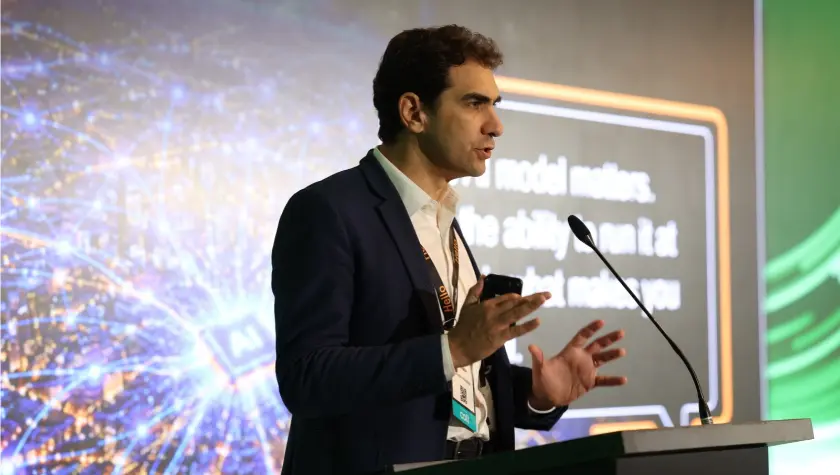
Opening the second day of the landmark 25th-anniversary edition of Capacity Europe, Orange Wholesale CEO Michael Trabbia delivered a paradigm-shifting message that fundamentally reinterprets the global artificial intelligence discourse. For the past several years, public fascination, venture capital, and corporate R&D have remained squarely focused on software sophistication, algorithmic breakthroughs, and the hyper-competitive global race for raw computing power. However, as the AI market matures into an enterprise-grade reality, Trabbia asserted that the true battleground has decisively shifted away from code and algorithms.
"The AI models matter," Trabbia told Capacity following his opening keynote. "But what really matters is the ability to use it at scale."
That capability is not virtual; it is anchored entirely in heavy physical engineering. It relies on the iron, glass, and concrete of data centres, terrestrial fibre-optic backbones, high-voltage energy systems, and high-capacity subsea cables. In short, the future of artificial intelligence depends on the foundational ecosystem that dictates how data moves, where it is processed, and how deeply it can be embedded across global economies and societies.
As the acceleration of AI adoption strains legacy networks, industry conversations have pivoted away from who builds the best model to who owns, operates, and secures the underlying infrastructure required to keep those models functioning at scale. In this hyper-connected, high-stakes environment, connectivity has officially graduated from a back-office utility to a critical geopolitical asset.
Detailed Chronology: The Evolution of the AI Infrastructure Squeeze
To understand the current bottleneck in the artificial intelligence market, one must examine the widening temporal gap between software evolution and infrastructure deployment.
The Mismatch of Innovation Cycles
New frontier AI models, foundational frameworks, and multimodal reasoning engines emerge every few weeks, creating an impression of instantaneous technological leaps. Conversely, the physical infrastructure required to power these systems moves at an entirely different, geological pace.
A modern hyperscale data centre requires anywhere from five to seven years from initial conception, land acquisition, and zoning approvals to full commercial operation. Similarly, laying new terrestrial fibre routes or deploying transoceanic subsea cable systems involves extensive multi-jurisdictional planning, environmental impact assessments, and complex supply chain coordination.
This inherent mismatch—between the hyper-rapid velocity of software development and the deliberate, capital-intensive pace of heavy engineering—has made strategic anticipation the most valuable currency in the telecommunications sector.
A New Hierarchy of Value
Because infrastructure cannot be conjured overnight, a new global hierarchy of value has rapidly formed. Governments are beginning to scrutinize data-centre developments with the same regulatory intensity once reserved for critical energy grids or defense assets. National security frameworks now intersect directly with network resilience and power availability.
"This shows how huge this industry is becoming," Trabbia emphasized during his address. "Today, the world is already spending more than USD $800 billion this year on data centres. And this will only grow to over a trillion in the coming years."
He added a stark warning for investors and operators alike: "This acceleration is huge. And when you invest that kind of money, you need to be sure of your connectivity."
This massive capital allocation also explains why regional legislative frameworks, such as Europe’s digital sovereignty agenda, are finally shifting away from abstract regulatory compliance and toward tangible, heavy investments in physical, on-continent assets.
Supporting Context & Metrics: Entering the Petabit Era
If physical infrastructure is the defining battleground of the next decade, then fibre-optic networks and subsea cables are the high-speed arteries of the global AI economy. The sheer volume of data required to train, fine-tune, and run enterprise AI agents has shattered historical capacity benchmarks.
The Petabit Paradigm
For decades, telecommunications procurement was measured in gigabits or terabits. Today, those metrics belong to a bygone era.
"We have entered the petabit era," Trabbia noted. "The cables we’re rolling out for customers are now petabit—whether they’re dark fibre or subsea cables."
Where enterprise and hyperscale customers once purchased a modest handful of fibre pairs to handle regional traffic, modern procurement strategies now involve entire, dedicated cable systems capable of supporting multi-terabit workloads. Operators are no longer merely connecting users within national borders; they are architecting continent-scale backbone networks that link major computation clusters with minimal latency.

The New Triumvirate: Capacity, Speed, and Security
Three non-negotiable requirements dominate this new model of infrastructure planning:
- Massive Capacity: Essential to support the exponential, automated traffic growth driven by autonomous AI agents, real-time video generation, and continuous machine learning feedback loops.
- Uncompromising Speed: In the AI era, latency equals economic obsolescence. If connectivity lags behind deployment, the underlying compute loses its competitive edge.
- Resilience and Security: As AI becomes deeply embedded in critical national infrastructure, financial systems, and healthcare operations, networks must be structurally immune to single points of failure.
These demands are nowhere more apparent than in the maritime domain, where subsea cable systems form the literal bridges between continental digital hubs.
Official Statements & Strategic Responses
At Capacity Europe 2026, industry leaders did not merely diagnose the infrastructure deficit; they unveiled multi-billion-dollar joint ventures designed to bridge the gap.
Orange’s Blueprint for Expansion
For Orange Wholesale, meeting the insatiable demands of the AI economy requires an aggressive, multi-layered capital expenditure strategy spanning data centres, terrestrial networks, and international subsea routes.
- Data Centre Scale-Up: Orange has established a strategic joint venture with infrastructure investment firm Morrison to develop 400 megawatts (MW) of cutting-edge data centre capacity in France, directly targeting the domestic compute needs of European enterprises.
- Terrestrial Footprint: The company remains on track to deploy 2.5 million kilometres of new fibre-optic cable by 2028, ensuring that high-speed backbones reach deep into regional industrial hubs rather than just major metropolitan areas.
- Global Subsea Investments: Alongside regional initiatives, Orange continues to spearhead major international projects, including the Via Africa system and the newly announced Pisces subsea cable.
The Pisces Project: Redefining European Connectivity
A primary announcement during Capacity Europe 2026 was Orange’s partnership with infrastructure investors Equitix and MDM to deliver the Pisces subsea cable system.
Backed in part by funding from the European Union’s Connecting Europe Facility (CEF), the approximately 3,125-kilometre Pisces system will directly connect Ireland, France, Spain, and Portugal utilizing 16 advanced fibre pairs.
This project addresses a critical vulnerability in European network architecture. As Ireland has rapidly evolved into one of Europe’s primary cloud and hyperscale data-centre capitals, its data traffic has historically relied heavily on transit routes passing through the United Kingdom. Pisces establishes a high-capacity, open-access, direct maritime route into continental Europe, enhancing path diversity, lowering latency, and bolstering overall network resilience.
Future Outlook: Europe’s Opportunity in the Sovereignty Race
For Europe, the intersection of artificial intelligence and physical infrastructure represents both a profound vulnerability and a generational economic opportunity.
The Geopolitical Risk of the "Kill Switch"
Trabbia was unequivocal when addressing the geopolitical dimensions of digital infrastructure. True digital sovereignty cannot be achieved through software policy alone; it demands absolute physical control over the assets where data and algorithms reside.
"You cannot talk about sovereignty without talking about physical infrastructure," Trabbia argued. "The first dimension is to be in control of the infrastructure where your data, your services, your AI, and digital services will be running."
He highlighted a latent risk facing modern enterprises—a scenario colloquially referred to as the "kill switch"—wherein critical cloud or AI services could theoretically be throttled or switched off by foreign governments or external stakeholders due to geopolitical friction. In such an environment, domestic and regional infrastructure ownership ceases to be a commercial preference and becomes an existential necessity.
The Power of Collaborative Ecosystems
Fortunately, Europe possesses many of the essential building blocks required to thrive in this new era: mature tier-1 telecommunications operators, established industrial fibre networks, expanding clean-energy grids, and world-class research institutions.
However, capitalizing on these assets will require a fundamental shift in how the industry approaches capital deployment. The sheer scale of investment needed to future-proof Europe’s digital backbone—scaling past the USD $1 trillion threshold globally—is simply too vast for any single operator, utility provider, or national government to bear in isolation.
Concluding his address, Trabbia issued a clear call to action for the broader telecommunications and tech ecosystem:
"When you look at the volume of infrastructure to be built, it’s also super important to adopt an ecosystem perspective. Build partnerships between all the players to build the infrastructure that will make our digital future."
As the artificial intelligence market transitions from hype to heavy lifting, the ultimate winners of the next decade will not necessarily be the creators of the cleverest algorithms. As Capacity Europe 2026 made resoundingly clear, the race to shape the AI era is a race to build the secure, high-capacity, and sovereign physical foundations upon which all intelligence ultimately rests.