Executive Overview
As federal and state prosecutors in New York edge closer to an unprecedented legal precipice, the intersection of political tension, viral culture, and artificial intelligence has generated a watershed moment for digital media integrity. New York prosecutors are widely anticipated to file an indictment against former U.S. President Donald Trump concerning a 2016 hush-money payment made to former adult film actress Stormy Daniels. If formalized, this legal action will shatter a centuries-old precedent, marking the first time in United States history that a current or former occupant of the Oval Office has faced criminal charges.
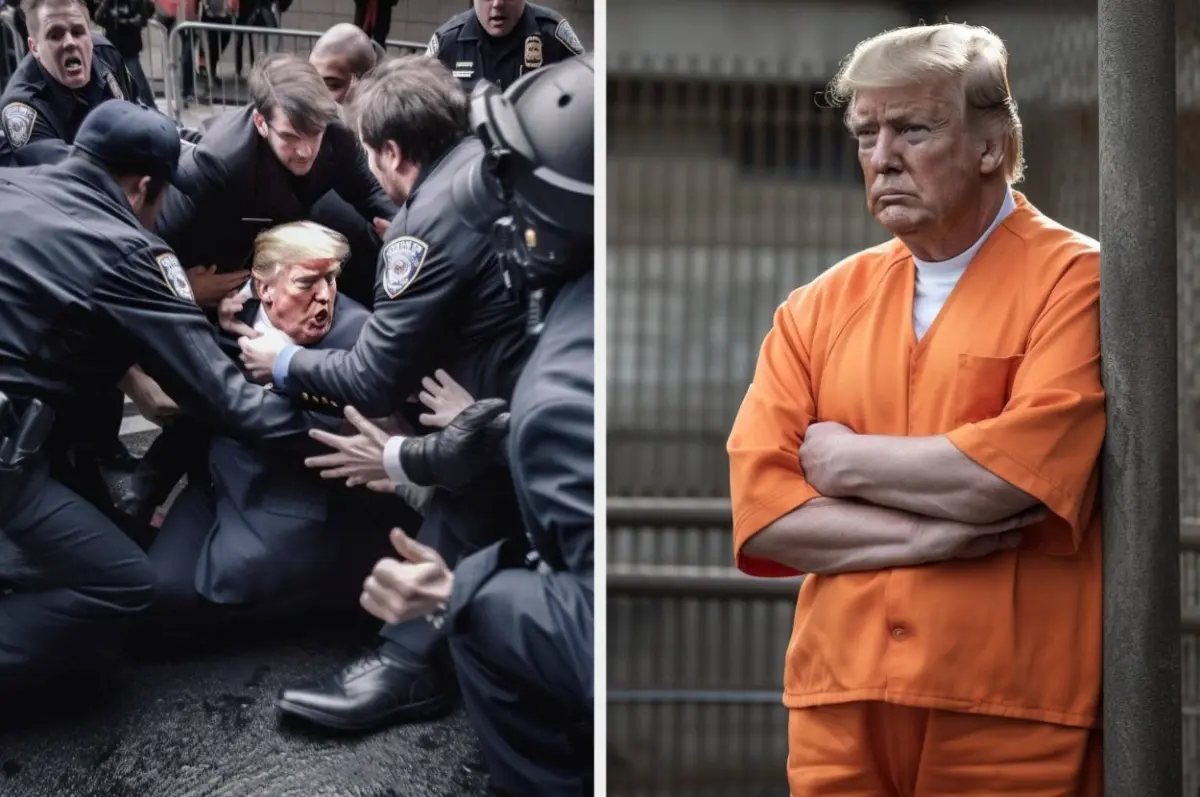
While legal analysts, politicians, and the public brace for the historic implications of a potential arraignment, the digital sphere has rapidly transformed the anticipation into speculative theater. Among those visualizing the scenario is Eliot Higgins, the 44-year-old founder of Bellingcat, the renowned open-source investigative journalism collective. Utilizing the advanced text-to-image artificial intelligence platform Midjourney, Higgins generated a hyper-realistic, fictionalized sequence of images depicting the hypothetical arrest, perp-walk, and subsequent imprisonment of Donald Trump.
Published on Twitter, the thread of roughly 50 images instantly went viral, captivating millions and igniting fierce debates over the ethical boundaries of generative AI. Within days of the stunt, Higgins reported that Midjourney had effectively banned him from the platform, while the software developers quietly instituted blocks on keywords such as "arrested." This episode transcends a mere social media curiosity; it serves as a glaring early-warning system for the societal, political, and informational hazards posed by generative artificial intelligence as it collides with high-stakes geopolitical events.
Detailed Chronology: From Prompts to Platform Ban
The sequence of events that led to a global conversation about synthetic media unfolded over a matter of days in March, mirroring the rapid, mercurial pace of modern digital culture.
The Genesis of a Viral Thread
Eliot Higgins, celebrated globally for utilizing open-source intelligence (OSINT) to track military conflicts, chemical weapons attacks, and state-sponsored assassinations, turned his investigative toolkit toward speculative fiction. Operating under the hypothesis of an imminent indictment in Manhattan, Higgins began experimenting with Midjourney’s latest iteration, which boasts unprecedented capabilities in rendering photorealistic human faces, complex lighting, and dynamic crowd scenes.
"I’ve been playing around with various prompts to see what’s possible and how complex you can make it," Higgins explained in interviews following the incident. His curiosity quickly evolved into a narrative experiment. He crafted detailed text prompts to visualize a dramatic, cinematic sequence of events: Donald Trump being forcefully detained by law enforcement on the streets of New York City outside a building bearing a striking resemblance to Trump Tower; family members, including Melania and Donald Trump Jr., reacting with exaggerated expressions of shock and despair; and surreal vignettes of the former president adjusting to life behind bars, complete with prison uniforms and institutional surroundings.
The Explosion on Social Media
On March 20, Higgins published the collection of roughly 50 images to his Twitter account, accompanied by minimal commentary framing them as an AI-generated experiment. The response was immediate and astronomical. The images garnered millions of impressions, hundreds of thousands of likes, and widespread retweets.
Because the images were generated by state-of-the-art neural networks, many casual observers failed to notice the subtle artifacts characteristic of AI generation—such as warped hands, text that dissolved into meaningless glyphs, or unnatural skin textures. Consequently, a significant fraction of social media users shared the images under the mistaken belief that they depicted real events. The viral cascade laid bare the public’s profound vulnerability to high-fidelity deepfakes, proving that hyper-realistic synthetic imagery could easily bypass digital literacy filters during moments of heightened political anxiety.
The Corporate Crackdown and Censorship
As the images ricocheted across the internet, the creators of the software tool took swift, defensive action. By Wednesday, March 21, Higgins discovered he was barred from accessing Midjourney. The platform’s developers implemented automated guardrails designed to prevent the recurrence of politically volatile deepfakes.
Midjourney did not immediately respond to formal requests for comment from major news organizations regarding the permanent or temporary nature of the ban. However, platform updates quickly revealed a zero-tolerance policy toward the generation of political figures in compromising legal scenarios. Users attempting to generate similar content found that the word "arrested" and related terms had been blacklisted from the prompt engine, signaling a frantic effort by tech companies to self-regulate before external legislative bodies intervened.
Supporting Context & Metrics: The Mechanics and Dangers of Generative AI
The Midjourney controversy surrounding the hypothetical Trump arrest is not an isolated incident; it represents a systemic stress test for global information ecosystems. Understanding the gravity of this event requires examining the underlying technologies, the metrics of their adoption, and the psychological impact of deepfakes on the general public.
The Technology: How Text-to-Image Models Work
Platforms like Midjourney, OpenAI’s DALL-E 3, and Stability AI’s Stable Diffusion operate on diffusion models. These neural networks are trained on billions of images paired with descriptive text captions sourced from the internet. By learning the statistical relationships between pixels and words, the AI can de-noise random static into coherent images that match a user’s textual prompt.
Recent iterations of these models have crossed the "uncanny valley," producing visuals that are virtually indistinguishable from professional photojournalism to the untrained eye. When applied to prominent public figures, these systems can synthesize believable scenarios that never occurred, weaponizing visual media against historical truth.
Quantitative Metrics of the Viral Event
- Scale of Deployment: Higgins utilized Midjourney v5, a model released in early 2023 known for its dramatic leaps in rendering human anatomy and realistic lighting.
- Volume of Content: Approximately 50 distinct images were compiled into a single Twitter thread, charting a complete narrative arc from street-level apprehension to incarceration.
- Reach and Engagement: The initial tweets accumulated millions of views within 48 hours, demonstrating virality velocity comparable to major breaking news events from traditional wire services.
- Platform Retaliation: Within 48 hours of the thread going viral, Midjourney updated its automated moderation filters, blacklisting terms associated with criminal justice proceedings, high-profile politicians, and sensitive geopolitical keywords.
The Psychological Impact: Illusory Truth and Confirmation Bias
Cognitive science research indicates that humans are inherently visual creatures, hardwired to process images faster than text and to imbue visual media with a high degree of intrinsic truth. When individuals encounter images that align with their preexisting political beliefs—whether they wish to see a polarizing figure held accountable or believe that figure is the victim of a political witch hunt—their critical faculties are often short-circuited by confirmation bias.
This phenomenon, known as the "illusory truth effect," is dangerously amplified by generative AI. Even when explicit disclaimers are attached to a post, the lingering emotional and visual memory of a deepfake can cement a false narrative in the public consciousness. In the context of an already fractured political landscape, synthetic media acts as an accelerant for conspiracy theories, civil unrest, and institutional distrust.
Official Statements and Industry Reactions
The intersection of artificial intelligence, political satire, and potential civil unrest prompted immediate reactions from legal experts, technology ethicists, and public relations representatives.
The Creator’s Defense
Eliot Higgins defended his project as a benign exercise in creative exploration and technological testing rather than a malicious disinformation campaign. In statements provided to digital rights researchers and journalists, Higgins emphasized that his intention was to stress-test the capabilities and limitations of modern AI models while illustrating how easily the public can be misled.
"I was just seeing how far the AI could push complex narratives," Higgins noted, pointing out that astute observers could spot visual anomalies, such as distorted police badges and nonsensical text on uniforms. Nevertheless, he acknowledged the unforeseen speed at which the images escaped his control, highlighting the profound difficulty of contextualizing synthetic media once it enters the hyper-fast bloodstream of social media algorithms.
Silence from the Tech Sector
Midjourney’s corporate leadership maintained a strict public silence following the incident, reflecting a broader industry anxiety regarding accountability. As text-to-image generators become ubiquitous, companies face a Hobson’s choice: implement draconian content moderation that stifles creative expression and political satire, or maintain a laissez-faire approach that invites state-sponsored disinformation, electoral interference, and reputational destruction.
Legal and Political Fallout
Legal scholars pointed out that while generating fictional images of a public figure does not strictly violate current U.S. copyright or defamation laws—provided it is clearly understood as satire or fiction—the downstream effects violate the spirit of election integrity laws and public safety guidelines.
Representatives for Donald Trump did not issue a formal statement regarding the specific AI images generated by Higgins, choosing instead to focus their public relations apparatus on condemning the underlying Manhattan grand jury proceedings as a politically motivated "witch hunt" orchestrated by progressive prosecutors.
Future Outlook: Navigating the Post-Truth Era
As artificial intelligence continues its exponential evolution, the incident involving the simulated arrest of Donald Trump serves as a critical historical marker. It forces a reckoning for journalism, technology developers, lawmakers, and the citizenry.
The Erosion of Photographic Evidence
For nearly two centuries, the foundational adage "seeing is believing" anchored journalism, legal evidence, and historical documentation. The proliferation of hyper-realistic generative AI permanently shatters this paradigm. In the near future, the defense of "that’s a deepfake" will likely be deployed not just by bad actors seeking to evade accountability for real misconduct, but also by legitimate figures attempting to dismiss genuine photographic and video evidence of wrongdoing.
To combat this reality, the tech industry is rapidly accelerating the development of cryptographic watermarking and provenance standards—such as those championed by the Coalition for Content Provenance and Authenticity (C2PA). These protocols embed tamper-evident metadata into digital files, allowing platforms and users to cryptographically verify whether an image was captured by a certified camera sensor or synthesized by a neural network.
Regulatory Horizons
Governments worldwide are taking notice. Regulatory frameworks, such as the European Union’s landmark Artificial Intelligence Act, are seeking to impose stringent transparency requirements on generative AI providers. Mandating that synthetic media carry clear, machine-readable watermarks and visual disclaimers will become a regulatory baseline rather than an optional feature.
Simultaneously, social media platforms face mounting pressure to overhaul their algorithmic distribution models. Algorithms designed to maximize engagement inherently favor emotionally provocative content, making deepfakes and hyper-partisan synthetic media prime beneficiaries of platform architecture. Without structural changes to how information is prioritized and displayed, technological safeguards alone will prove insufficient.
Conclusion: A Call for Digital Literacy
The spectacle of Eliot Higgins generating a virtual arrest for a former U.S. president underscores a sobering new reality: society has entered the post-truth era of synthetic media. As generative tools become more accessible, autonomous, and indistinguishable from reality, the ultimate defense against manipulation will not rest solely in corporate bans or legislative mandates.
Instead, a resilient democracy will increasingly depend on elevated levels of public digital literacy, rigorous investigative journalism, and a renewed cultural commitment to verifying information before amplification. The pixels depicting a handcuffed Donald Trump outside Trump Tower never happened in physical reality, but their reverberations have forever altered the digital battleground where the future of truth is fought.