Executive Overview
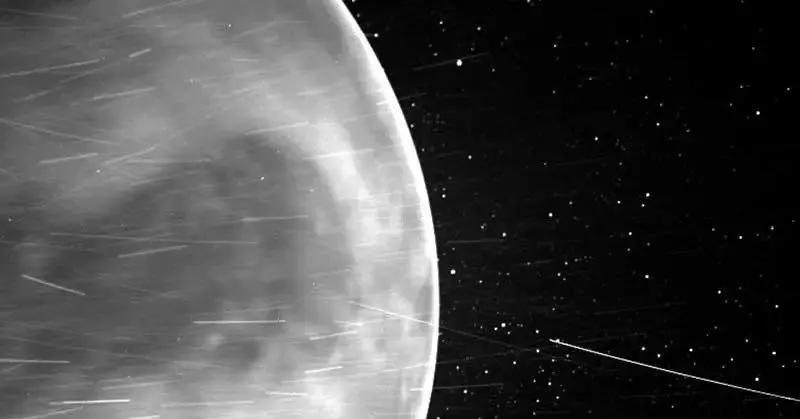
Venus has long stood as an astronomical enigma. Sharing nearly identical mass, volume, density, and bulk chemical composition with Earth—our planetary "twin"—it possesses almost all the prerequisites to be a habitable blue-and-green marble. Yet, a conspicuous absence haunts our neighboring world: Venus has no moon.
For decades, planetary scientists debated this cosmic void. Traditional hypotheses heavily leaned toward catastrophic celestial mechanics, suggesting that any primordial satellite Venus once held was obliterated by a violent, high-velocity impact with a rogue protoplanet. However, groundbreaking research led by astrophysicists at the University of California, Riverside (UCR), paints a far more intimate and terrifying picture of planetary evolution.
Rather than succumbing to a sudden, explosive execution by an external force, Venus’s theoretical moon met a slow, agonizingly protracted end. According to a study published in The Astrophysical Journal, the moon was systematically reeled inward by a lethal combination of the planet’s sluggish rotation and relentless gravitational pull. Inch by inch, over countless millennia, the satellite spiraled inward until tidal forces ripped it to pieces, leaving the planet to completely swallow the debris.
"Venus didn’t require a catastrophe to arrive at what we can see today," explains Steven Kane, an astrophysicist at UCR and the lead author of the study. "It turns out the gravity of the planet itself, combined with the rate at which it spins, naturally caused the moon to collapse on top of it."
This paradigm-shifting research not only solves a long-standing solar system mystery but also introduces a critical new variable into the modern hunt for habitable exoplanets. It suggests that a planet’s rotational velocity may serve as a death sentence for its orbiting satellites—and profoundly influence whether a world can ever support life.
Detailed Chronology: How Venus Swallowed Its Satellite
To understand how a planet can consume its own moon, one must first look at the delicate gravitational dance between rotating bodies and their satellites.
In a standard planetary system, orbital dynamics are heavily influenced by the speed at which the primary body spins. When a planet rotates rapidly relative to its moon’s orbital period, tidal friction transfers rotational energy outward. This energy boost pushes the satellite away from the planet.
Earth serves as the textbook example of this mechanism. Our planet completes a full rotation every 24 hours—a remarkably brisk pace in the context of planetary mechanics. Because of this fast spin, Earth’s gravitational bulge outpaces the Moon, pulling it forward in its orbit and causing our lunar companion to drift steadily outward at a rate of approximately 1.5 inches (3.8 centimeters) per year. Our moon is safe from being reclaimed precisely because Earth spins fast enough to push it away.
Venus, however, operates under entirely different rules.
[Venus's Slow Rotation: 243 Earth Days]
       │
       ▼
[Weakened Outward Tidal Forces]
       │
       ▼
[Gravitational Drag & Inward Spiraling]
       │
       ▼
[Roche Limit Reached: Tidal Disruption]
       │
       ▼
[Catastrophic Collapse & Planetary Consumption]
Venus holds the title of the slowest rotator in our solar system. The planet takes a staggering 243 Earth days to complete just one single rotation on its axis. Bizarrely, this rotation period is even longer than its entire orbital year around the Sun (which takes roughly 225 Earth days), meaning a day on Venus is longer than its year.
Because Venus drags through space at such a lethargic pace, the directional flow of tidal forces reverses. Instead of imparting an outward boost, the planet’s gravitational field exerts a persistent drag on any orbiting body. Without sufficient rotational speed to push a satellite outward, the gravitational interaction saps energy from the moon’s orbit, forcing it to decay.
To test this mechanical hypothesis, Kane and his research team constructed a complex, high-fidelity computer model designed to simulate gravitational and tidal interactions over geological timescales. To validate the software, the team first ran simulations of Earth and its moon, successfully recreating the historical evolution of our own lunar system.
With the model verified, the researchers introduced variables specific to Venus. They adjusted the planet’s rotation rate and simulated the presence of hypothetical moons varying wildly in mass—ranging from 0.01 to 10 times the mass of Earth’s moon.
The results were astonishingly uniform. Under the vast majority of simulated conditions, the moon did not stabilize or drift away; instead, it inexorably spiraled inward. As the satellite crossed the planet’s Roche limit—the minimum distance to which a celestial body, held together only by its own gravity, can approach a second body without being torn apart by tidal forces—the moon disintegrated into a ring of dust and rubble before raining down onto the Venusian surface.
"When I made this discovery, I was shocked," Kane recalled of the modeling phase. "I thought surely the broad range of scenarios I was exploring would lead to a variety of results. But it all went pretty much in the same direction."
In a handful of outlier simulations—such as scenarios where the researchers artificially accelerated Venus’s rotation to a brisk 10-to-12-hour day and paired it with a massive moon—the satellite managed to survive for 4.5 billion years. Yet, astrophysicists agree that these conditions are purely theoretical constructs, bearing no resemblance to the lethargic reality of our actual neighbor.
Supporting Context & Metrics: The Geologic Mask of Venus
Proving that Venus once possessed a moon is an uphill battle, largely because the planet has systematically erased the crime scene.
Unlike Mars or Earth’s Moon, which preserve ancient impact basins and geological records dating back billions of years, Venus wears a deceptive mask of extreme youth. Crater-counting analyses indicate that the vast top layer of Venusian rock is a mere few hundred million years old.
While the planet itself formed alongside the rest of the solar system approximately 4.6 billion years ago, its history has been violently rewritten. Venus is plagued by runaway greenhouse effects, crushing atmospheric pressures (roughly 92 times that of Earth at sea level), and surface temperatures hot enough to melt lead (around 900°F or 475°C). This thermal nightmare fuels relentless volcanic outgassing and tectonic resurfacing that periodically turns the planet’s crust inside out, effectively paving over any ancient surface topography.
| Planetary Metric | Earth | Venus |
|---|---|---|
| Mass | $5.97 times 10^24$ kg | $4.87 times 10^24$ kg (81.5% of Earth) |
| Diameter | 12,742 km | 12,104 km (95% of Earth) |
| Rotation Period | 23.9 Hours | 243 Earth Days (Retrograde) |
| Orbital Period (Year) | 365.25 Days | 225 Earth Days |
| Number of Moons | 1 | 0 |
| Surface Temperature | 15°C (Average) | 467°C (Average) |
If physical evidence of a swallowed moon survives today, it is buried deep within the planet’s interior or encoded in its deep mantle dynamics. On Earth, seismological surveys—measuring seismic waves reverberating through the planet—have provided invaluable clues regarding our own moon’s formation, pointing toward ancient impacts and deep structural anomalies.
Conducting similar seismic surveys on Venus remains an immense technological hurdle due to the hellish surface conditions that quickly destroy landers. However, future deep-probe missions equipped with high-temperature electronics or radar-based subsurface tomography could theoretically uncover geochemical or isotopic signatures pointing to a massive, absorbed satellite.
Official Statements & Expert Perspectives
The implications of the UCR study extend far beyond our immediate solar system neighborhood, touching upon core theories of planetary formation, orbital mechanics, and astrobiology.
Steven Kane emphasizes that the destruction of Venus’s moon was not merely a localized orbital tragedy, but a transformative event that likely dictated the planet’s modern destiny. Swallowing a massive celestial body imparts an extraordinary injection of kinetic energy and angular momentum into a planet. Such a monumental transfer would drastically alter the planet’s axial tilt, rotational speed, internal mantle convection, and volatile distribution—potentially sealing its fate as a climatic wasteland.
"The moon has definitely changed the way Earth has evolved through time, but we don’t fully know how important that role is," Kane noted in the team’s official press release.
This uncertainty fuels a wider debate within the scientific community regarding the concept of "habitability." For decades, astrobiologists modeling potentially habitable exoplanets have heavily weighted the presence of a large moon as a positive indicator. Moons are traditionally credited with stabilizing a planet’s axial tilt, preventing wild climatic swings, and generating stabilizing ocean tides that may have kickstarted biochemistry on early Earth.
However, Kane’s findings complicate this neat narrative. While a moon may offer profound long-term stability, it is far from a universal prerequisite for life—and as Venus demonstrates, a moon can easily become a liability if planetary mechanics turn predatory.
"My feeling is there are benefits to having a moon, but it isn’t required for habitability," Kane asserted. "The moon has definitely changed the way Earth has evolved through time, but we don’t fully know how important that role is."
Future Outlook: Implications for the Hunt for Exoplanets
As astronomy enters a golden age of exoplanet characterization—driven by space telescopes like NASA’s James Webb Space Telescope (JWST) and upcoming observatories designed to image Earth-like worlds directly—the UCR study delivers a sobering reality check.
When scanning distant star systems for potentially habitable terrestrial worlds, researchers frequently prioritize planets matching Earth’s size, mass, and orbital distance within the "Goldilocks zone." Yet, the new Venus model reveals that rotation speed must now be elevated to a primary diagnostic criterion.
If a rocky exoplanet is discovered orbiting a star within a habitable zone, but spectroscopic data indicates that the planet rotates sluggishly—much like Venus—astronomers must now account for the high probability that the world has undergone tidal decay, shedding or devouring any moons it may have originally formed with.
Furthermore, understanding the fate of Venusian satellites sheds light on tidal locking scenarios, where planets orbiting close to red dwarf stars have their rotations synchronized with their orbits. In these dynamic environments, gravitational torques operate with extreme efficiency, reshaping planetary systems in ways science is only beginning to comprehend.
Ultimately, Venus stands out not just as Earth’s twisted twin, but as a cautionary tale of cosmic cannibalism. By quietly drawing its moon inward and digesting it whole, the Morning Star rewrote its own history—leaving modern scientists to piece together the phantom of a lost satellite from the silent, scorching depths of a world that ate its own past.