Executive Overview
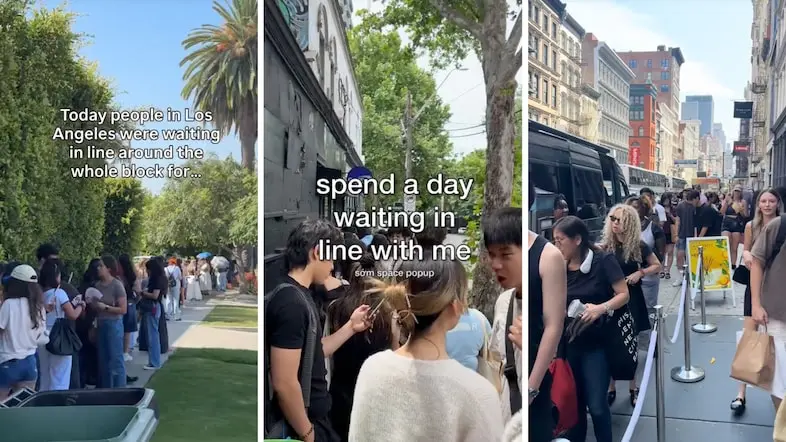
In an era defined by lightning-fast digital delivery, instant gratification, and the algorithmic promise of frictionless consumption, a counterintuitive physical phenomenon is sweeping global metropolises: the endless queue. From the bustling sidewalks of SoHo to suburban shopping centers, young consumers are willingly dedicating hours of their lives to stand in serpentine lines. They wait not for emergency supplies, scarce medical treatments, or rare ticketing drops, but for routine, everyday commodities: viral matcha lattes, branded plushies, frozen yogurt, and minimalist apparel.
This resurgence of the physical queue represents a fundamental psychological and sociological shift. Far from being a mere logistical inconvenience, waiting in line has transformed into a high-status cultural performance. Driven by the erosion of traditional "third places"—the public spaces outside of home and work where community happens—young people have repurposed the sidewalk queue as an impromptu social hub, a content-generation studio, and a tactile badge of belonging.
However, this phenomenon is not purely organic. It is increasingly fueled by sophisticated hyper-consumerist marketing, algorithmic echo chambers, and manufactured artificial scarcity. While some view the four-hour wait for a cup of artisanal tea as a tragic waste of human capital, others see it as a rare opportunity to reclaim time, foster analog human connection, and signal cultural currency. As professional line-skipping services boom on the corporate end and TikTok feeds flood with "spend the day with me in line" vlogs, we must ask: How did waiting become the ultimate activity, and what does this obsession reveal about the modern consumer psyche?
Detailed Chronology: The Evolution of the Viral Queue
To understand how standing on a concrete pavement for half a day became a coveted weekend itinerary, one must examine the intersection of post-college migration, social media validation, and the commodification of boredom.
The Post-College Pilgrimage to the Pavement
Consider the journey of Karis Hakala, a 24-year-old content creator who relocated to New York City following her college graduation. Eager to immerse herself in the city’s legendary cultural fabric, Hakala found herself joining a sprawling crowd outside the Nami Matcha pop-up in SoHo. Founded by YouTuber Ashley Alexander, the pop-up offered elaborate, aesthetically pleasing flavored iced drinks that commanded viral attention.
For Hakala, the price of admission was steep: a grueling four-hour wait. Yet, in retrospect, she views those 240 minutes as a high-yield investment. The content she generated from the queue and the pop-up itself unlocked lucrative paid collaborations and introduced her to a network of brand connections. For Hakala and thousands of peers like her, the queue served as an unexpected bridge from isolation to community—an "inspiring and motivating way to start my time in New York."
From Banal Purchases to Algorithmic Pilgrimages
Historically, waiting in line was an irritation—a friction point in the consumer journey that companies fought to eliminate through self-checkout kiosks, mobile ordering, and home delivery apps. Today, the script has flipped. Young consumers are queuing down the street for:
- Froyo shops with social media cachet.
- Warmies plushies that can otherwise be ordered online.
- Rare Beauty pop-ups.
- Tank Air apparel installations.
Even for those who do not actively film their wait, the mere presence of a crowd acts as an open invitation. Social media feeds are saturated with "spend the day with me" dispatches originating directly from the sidewalk. Entire digital archives—such as dedicated Instagram accounts tracking what New Yorkers are queuing for—now evaluate whether a given line is truly "line-worthy."
The Manufactured Illusion of Demand
Behind many of these modern queues lies an invisible machinery of hyper-consumerist engineering. Brands have quickly learned that an empty store signals failure, while a packed sidewalk signals elite desirability. Consequently, marketing agencies occasionally manufacture demand by pacing entries so slowly that a half-empty venue appears perpetually maxed-out. In some instances, brands have even utilized paid actors to seed the initial line, knowing that human psychology will naturally compel passersby to join a crowd.
Platforms like TikTok act as accelerators in this ecosystem, rapidly inflating localized businesses into global sensations before abruptly abandoning them as the algorithmic trend cycle shifts toward its next fixation.
Supporting Context & Metrics: Psychology, Class, and Time Affluence
The modern queue boom operates at the crossroads of several profound socioeconomic currents, touching on everything from time poverty to the mechanics of algorithmic homogenization.
The Psychology of the Crowd
Amir Al Jariri, a 21-year-old content creator based in Virginia, offers a pragmatic counter-perspective to the frenzy. He draws a hard line at waiting more than ten minutes for a coffee, regardless of its digital pedigree.
"If people see someone else waiting, everyone thinks it must be amazing, when in reality it’s often average or underwhelming," Jariri observes. "I really think it’s the thrill of the unknown and wanting to say you got whatever everyone else is waiting for."
This "thrill of the unknown" is amplified by an algorithmic culture. When millions of users are served the exact same viral video simultaneously, it creates a false sense of independent discovery. Consumers rush out to claim a unique local gem, only to realize that thousands of peers received the identical prompt at the exact same hour. This collective conditioning erodes niche exploration in favor of mass conformity, steering everyone toward the same feed-worthy matcha and the same viral book.
The Paradox of Time Affluence and Class Divides
The line epidemic also underscores shifting concepts of time and socioeconomic privilege. Standing in a four-hour queue for frozen yogurt or novelty beverages demands an immense surplus of disposable time. In a nation where many workers suffer from chronic "time poverty," having the luxury to stand idle for half a day functions as an unexpected status symbol. It broadcasts a message to the digital world: I have nowhere else to be, and my schedule is entirely my own.
At the same time, queues have historically divided populations along class lines. While the working and middle classes trade their leisure hours to stand on concrete, wealthier consumers routinely pay to bypass the friction entirely. From priority boarding at airports and fast-track ski passes to Disney World’s fee-based line-skipping systems, capital has always purchased velocity.
Official Statements & Industry Insights: The Business of Waiting
The commercialization of the queue has evolved far beyond theme park fast-passes into an entire shadow service industry.
Jennifer Goff, founder and owner of the Washington, D.C.-based service Skip the Line, has spent years monitoring the shifting psychology of what people are willing to endure. Launching the business in 2017, Goff witnessed firsthand how digital infrastructure transformed customer behavior. As online reservations replaced traditional first-come, first-served restaurant protocols, the nature of line-standing shifted. Demand for routine consumer goods, like waiting overnight for the latest iPhone release, has noticeably cooled.
Instead, Goff’s clients now deploy professional line-sitters for high-stakes or fiercely competitive access points:
- Congressional hearings on Capitol Hill.
- Washington Monument ticket distribution.
- Prime-position concert entry points, securing front-row proximity to the stage.
According to Goff, her team’s assignments can stretch to astonishing lengths. The longest continuous deployment for a Supreme Court hearing has spanned up to 12 hours a day across three or four consecutive days, managed through rotating shifts to protect worker welfare.
While corporate clients hire professionals to secure institutional access, everyday consumers are matching these endurance feats for pop-culture validation. Lari, a 28-year-old resident of Denver, recalls waiting nearly half a workday for a Build-a-Bear workshop during a "pay-your-age" promotional event. While the steep discount initially justified the hours spent with her niece, Lari later watched the brand normalize the pricing structure year-round.
"This is something I see happen a lot nowadays with ‘exclusive’ products or deals; they eventually come back around," Lari reflects.
Despite recognizing how brands manipulate FOMO (fear of missing out), Lari notes one arena where she will never hesitate to queue: K-pop fandom.
"A huge part of K-pop culture is to show up early to wait in line," she explains. "This is where you’re going to meet your fellow fans, exchange freebies and social handles, so, in this case, waiting in line is a whole experience in itself."
Future Outlook: Surviving the Algorithm
As we look toward the future of retail and consumer culture, the physical queue occupies a paradoxical space. On one hand, it represents the absolute apex of algorithmic manipulation—a physical manifestation of digital hype cycles designed to extract maximum attention and monetary value from impressionable youth.
On the other hand, the enduring popularity of the queue exposes a deep, unfulfilled human hunger. In an increasingly digitized, atomized society where physical community spaces are vanishing, the sidewalk line has inadvertently stepped in as a makeshift public square. When individuals are starved for authentic, offline human interaction, spending four hours chatting with strangers, bonding over shared fandoms, or recording memories with siblings may not be a waste of time at all; it may be the primary objective.
Yet, as trend cycles accelerate and the digital noise grows louder, cultural fatigue is inevitable. Consumers are slowly waking up to the reality that behind every four-hour queue lies an identical cup of average matcha. The ultimate escape from the algorithmic loop may not require abandoning social media entirely, but rather remembering a simple, liberating truth: just around the corner, there is likely an uncrowded local cafe serving an exceptional beverage—no four-hour wait required.