Executive Overview
In the fast-evolving landscape of high-performance electric vehicles, automakers constantly seek innovative ways to capture public imagination. Yet, few companies possess the theatrical flair—or the engineering audacity—to redefine the boundaries of automotive presentation quite like Tesla. In a high-octane launch event that blurred the lines between science fiction and reality, the next-generation Tesla Roadster made its grand, gravity-defying arrival. Complete with jaw-dropping vertical climbs, aerial leaps over stationary vehicles, and mid-air hovering capabilities, the showcase served as both a technological flex and a masterclass in modern marketing.
Far from being a mere concept car designed to sit quietly on an auto-show turntable, the new Roadster is engineered to challenge the very laws of physics. Borrowing aerospace engineering from its sister company, SpaceX, the vehicle integrates advanced cold-gas thrusters and suction technologies that allow it to defy traditional vehicular limitations. While skeptics may view the performance as a high-budget spectacle, the engineering reality underpinning these stunts points to a paradigm shift in how electric hypercars will perform, maneuver, and interact with the physical world.
Alongside the adrenaline-fueled demonstrations, Tesla officially opened the reservation books for the next-gen supercar, revealing a tiered pricing structure that separates traditional performance enthusiasts from those willing to invest in aerospace-derived upgrades. As the automotive industry transitions deeper into the electric era, this vehicle positions itself not just as a competitor to legacy internal combustion hypercars, but as an entirely new category of ultra-performance machine.
Detailed Chronology of the Stunt Show
The rollout of the next-generation Roadster was meticulously choreographed to transition the audience from skepticism to absolute astonishment. The event’s sequence of demonstrations systematically escalated the display of the car’s unorthodox capabilities, culminating in maneuvers previously thought impossible for production or near-production passenger vehicles.
The C-Shaped Ramp and the Impossible Hang
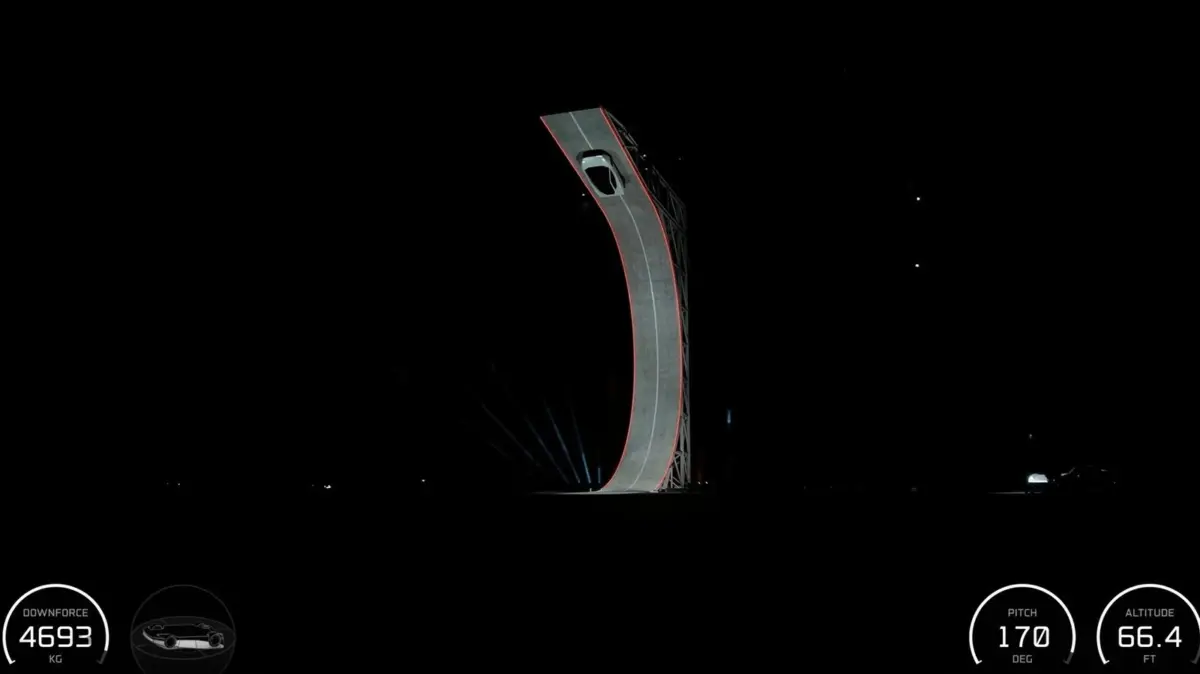
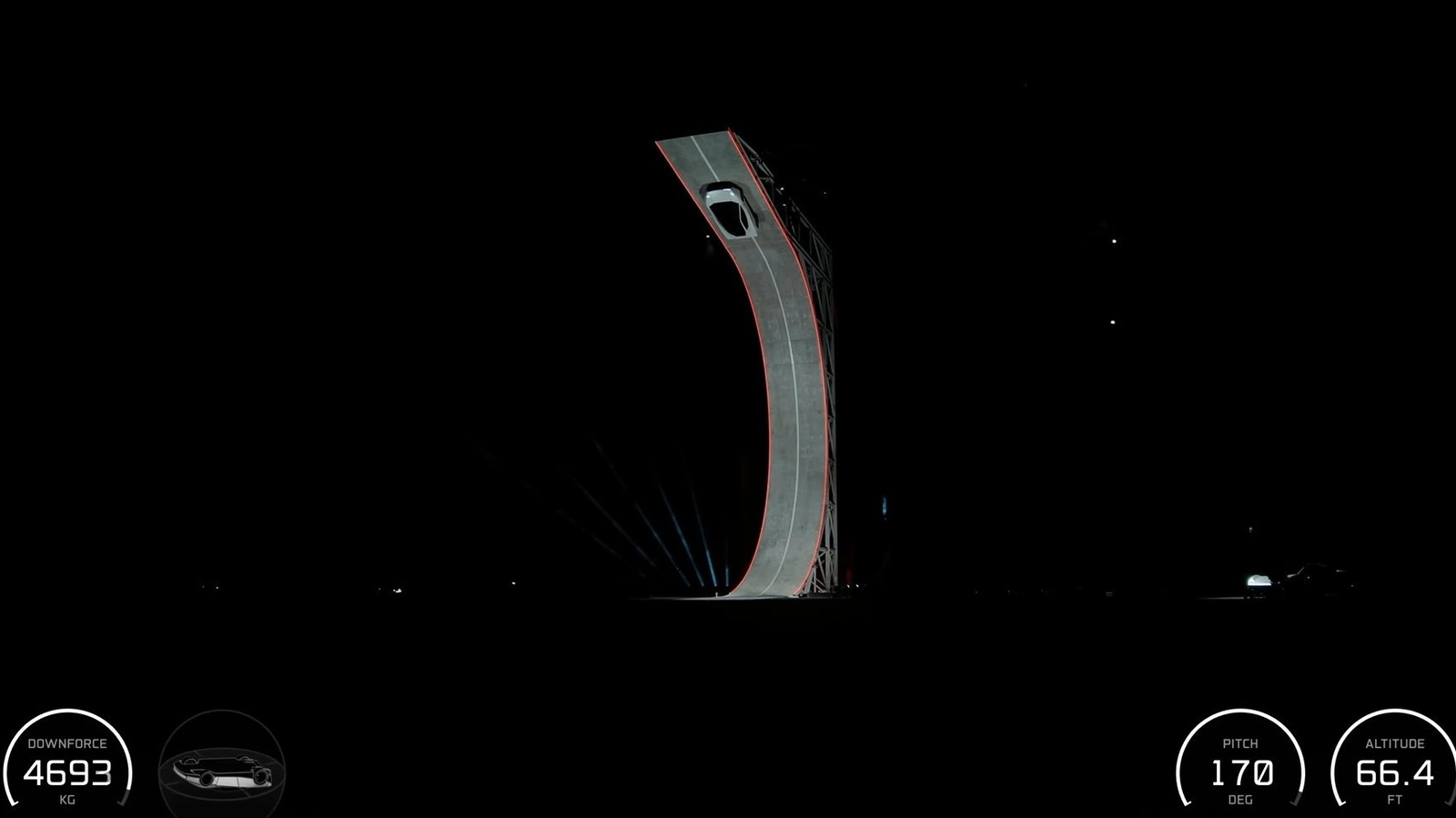
The spectacle began at the base of a towering, C-shaped structural ramp. The Roadster, sleek and menacingly low to the ground, idled momentarily before accelerating up the vertical curve. Not once, but twice, the vehicle surged up the incline, halting dramatically at the apex. Perpendicular to the ground, the car hung upside-down, seemingly suspended by invisible threads.
For engineers and physicists in the audience, this visual defied standard friction and gravity equations. The secret behind the suspension wasn’t magic, but rather specialized suction and aerodynamic sealing technologies designed to anchor the chassis against the vertical steel framework.
Defying Gravity: The SpaceX Thruster Leap
Following the second vertical halt, the Roadster demonstrated its true pièce de résistance. The vehicle launched forward off the edge of the C-shaped ramp, tumbling into a controlled mid-air roll. Rather than crashing to the pavement below, the car momentarily stabilized and safely hovered to the ground.
This breathtaking maneuver was made possible by the integration of cold-gas thrusters—propulsion architecture directly adapted from SpaceX Falcon rockets. Positioned strategically around the vehicle’s chassis, these high-pressure nitrogen thrusters provide instant directional force, effectively allowing the car to make micro-adjustments while airborne or decelerate a vertical descent through sheer thrust.
Clearing the Fleet and the Stationary Flip
Tesla did not limit the performance showcase to specialized ramps. Later in the presentation, the Roadster demonstrated its explosive acceleration and vertical clearance by rocketing over a line of Teslas parked side-by-side. The clean, effortless arc over the convoy highlighted the sheer output of the vehicle’s multi-motor electric powertrain.
The grand finale occurred near the end of the presentation from a complete standstill. Without a rolling start or a ramp, the Roadster executed a static-position jump, executing a crisp, calculated rotation in mid-air before gently hovering back down to land softly on its tires. This final stunt underscored the vehicle’s instantaneous torque delivery and the sophisticated electronic stabilization systems keeping the massive kinetic energy under absolute control.
Supporting Context & Metrics: Engineering the Impossible
To understand the mechanics behind the Roadster’s gravity-defying performance, one must examine the intersection of automotive engineering and aerospace propulsion. For decades, hypercar manufacturers have relied on downforce—aerodynamic drag designed to push a car down onto the track at high speeds—to maintain traction. Tesla, however, has bypassed traditional downforce in favor of active propulsion and reactive stabilization.
Cold-Gas Thruster Technology
The inclusion of cold-gas thrusters represents a radical departure from conventional vehicle dynamics. In aerospace applications, cold-gas thrusters operate by expelling inert gas (such as compressed nitrogen) from a pressurized tank through a nozzle to provide control authority in a vacuum or atmosphere.
Translated to the Roadster, these thrusters serve multiple functions:
- Enhanced Cornering: By firing lateral thrusters, the car can artificially push itself into a turn, dramatically increasing lateral grip beyond the limits of tire friction alone.
- Braking and Stabilization: During high-speed maneuvers or jumps, the thrusters act as dynamic stabilizers, correcting pitch, roll, and yaw in milliseconds.
- Vertical Lift and Hovering: As demonstrated during the stunt show, strategically angled downward thrusters can momentarily offset gravitational pull, softening landings or facilitating short hops.
Powertrain and Acceleration Metrics
While the specific battery capacity and raw horsepower figures of the production-ready Roadster continue to be refined, early specifications released by Tesla indicate performance benchmarks that will leave legacy hypercars in the dust. The vehicle is projected to achieve a 0 to 60 mph time of under 1.9 seconds, with quarter-mile times that challenge top-tier fuel-dragsters.
Achieving these figures requires unprecedented energy density from the battery packs and instantaneous power delivery through tri-motor (or potentially quad-motor) configurations. The addition of the SpaceX package, however, shifts the performance paradigm from mere acceleration to true three-dimensional vehicle dynamics.
Official Statements and Pricing Structure
With the conclusion of the theatrical launch, Tesla transitioned the focus from entertainment to commerce, releasing the official reservation details for the next-gen Roadster. The purchasing structure is as multifaceted as the vehicle’s engineering, divided into distinct tiers based on performance packages.
The Financial Investment
Securing a build slot for the base model requires an initial reservation fee of $5,000, with an additional $45,000 due within ten business days to fully lock in the base vehicle configuration. For everyday driving enthusiasts, this entry-level model offers staggering hypercar performance without the aerospace modifications.
However, for buyers demanding the extreme capabilities showcased during the stunt show, the financial threshold scales dramatically:
- The SpaceX Package Variant: Vehicles equipped with the cold-gas thruster systems, specialized suction technology, and hardware required for vertical stabilization carry a hefty reservation price tag of $250,000.
- The Hover-Capable Variant: The elite version of the Roadster—capable of the dramatic stationary jumps and hovering descents demonstrated at the event—will not be made available to the general public. Tesla has confirmed that this ultimate tier will be strictly invite-only, reserved for select VIP customers, brand loyalists, and top-tier automotive collectors.
Industry analysts have noted that while the $250,000 price point and invite-only structures push the Roadster into ultra-exclusive territory, the marketing value generated by the launch far exceeds traditional advertising budgets. By framing the vehicle as an engineering marvel rather than a mere consumer product, Tesla has successfully dominated the global automotive news cycle.
Future Outlook: What the Roadster Means for the Automotive Industry
The debut of the next-generation Tesla Roadster is much more than a high-profile vehicle reveal; it is a cultural and technological milestone that will reverberate across the global automotive landscape for years to come.
Pushing Competitors to Innovate
Legacy luxury and exotic brands—such as Ferrari, Lamborghini, Bugatti, and McLaren—have spent the past decade slowly and cautiously dipping their toes into electrification. Many have argued that electric vehicles lack the visceral soul, the mechanical complexity, and the raw theatricality of internal combustion engines. Tesla’s stunt show directly dismantles that argument. By introducing aerospace-grade thrusters and vertical-hover capabilities, Tesla has raised the bar for what an electric hypercar can achieve. Competitors can no longer rely on heritage and exhaust notes to differentiate their vehicles; they must now contend with physical capabilities that border on science fiction.
Regulatory and Safety Hurdles
As awe-inspiring as the Roadster’s capabilities are, they also introduce significant regulatory questions. Transport authorities worldwide maintain strict safety standards regarding pedestrian protection, vehicle emissions, structural crashworthiness, and the use of auxiliary propulsion systems on public roads.
Integrating high-pressure cold-gas thrusters onto a street-legal passenger vehicle opens up a complex web of legal and safety considerations. Can thrusters be safely deployed in congested urban environments? How will insurance companies calculate risk profiles for vehicles capable of jumping over traffic? While the production version of the Roadster may restrict certain aggressive thruster features to closed tracks or controlled environments via geofencing software, the mere presence of the technology forces regulators to begin drafting entirely new rulebooks for next-generation mobility.
The Road Ahead to Production
As Tesla begins processing reservations and finalizing manufacturing lines, the automotive world will be watching closely to see how much of the stunt-show reality makes it into the hands of everyday consumers. If Tesla can successfully deliver a production vehicle that captures even a fraction of the agility, speed, and audacity displayed on stage, the Roadster will cement its place not just as a successful product launch, but as a defining moment in the history of personal transportation. The future of driving has arrived, and it is ready to take flight.