Executive Overview
In an artificial intelligence market increasingly defined by technical commoditization and high capital burn, software startups focused on specialized human-computer interaction are searching for defensible moats. While general-purpose foundation models compete fiercely on benchmark scores and multi-modal speed, consumer-facing conversational software has struggled to strike a balance between daily utility and sustainable user retention.
Enter Tolan, an AI companion platform explicitly designed to blend productivity coaching, daily task organization, and personal emotional support. According to a report by Upstarts Media, the startup has expanded its operational runway by securing $30 million in a new funding round. The investment includes participation from prominent venture firm legacy players Union Square Ventures, Khosla Ventures, and Homebrew.
This capital influx effectively doubles Tolan’s total funding raised to date. While the startup declined to publicly disclose its official post-money valuation, market intelligence firm PitchBook estimates the company’s enterprise value at upwards of $268 million (rated with "medium confidence"), marking a significant leap from its previous $120 million valuation baseline.
+-----------------------------------------------------------------------+
|                        TOLAN AT A GLANCE                              |
+-----------------------------------------------------------------------+
| Capital Raised (Latest Round) : $30 Million                           |
| Lead/Key Investors            : Union Square Ventures, Khosla         |
|                                 Ventures, Homebrew                    |
| Estimated Valuation           : $268 Million+ (PitchBook estimate)    |
| Annual Recurring Revenue      : Double-digit millions ($10M+)         |
| Active User Base              : 250,000+ active users                 |
| Total Engagement (Past Year)  : 70 Million+ conversations             |
| Core Demographics             : 70% Women | 40% Parents               |
+-----------------------------------------------------------------------+
Tolan’s growth comes at a volatile moment for consumer AI companion apps. The consumer sector is littered with early pioneers that either alienated users through invasive hardware designs or collapsed under unsustainable compute costs and legal liabilities. By pairing a friendly visual avatar with structured administrative and emotional tools, Tolan has successfully positioned itself as a pragmatic assistant rather than a romantic surrogate or hardware gimmick. However, as tech giants pivot toward autonomous AI "agents" and regulatory scrutiny surrounding mental health AI deepens, Tolan’s next operational phase will test whether software companions can sustain long-term enterprise value.
Detailed Chronology: From Novelty Chatbots to Purpose-Driven Companions
To understand Tolan’s market positioning, one must trace the rapid evolution of consumer conversational AI over the past decade.
  2010s: Utilitarian Voice Assistants (Siri, Alexa)
    │   -- Focused on rigid, command-based task execution.
    ▼
  2022–2024: Open-Ended Generative Chatbots & Roleplay (Replika, Character.AI)
    │   -- High conversational engagement; struggled with monetization & safety.
    ▼
  2025: Market Turbulence & Hardware Missteps
    │   -- Friend pendant faces severe public backlash ("cringe", "soul-less").
    │   -- Character.AI files for bankruptcy following leadership departures.
    ▼
  2026: The Rise of Pragmatic Support Models (Tolan)
    │   -- Tolan secures $30M from USV, Khosla, and Homebrew.
    │   -- Combines emotional support with daily executive function assistance.
The Early Phase: Command-Line Utility vs. Unconstrained Roleplay
The first generation of consumer AI assistants—exemplified by Apple’s Siri and Amazon’s Alexa—focused strictly on transaction-based utility (setting timers, checking weather, controlling smart homes). These platforms lacked conversational memory, contextual awareness, and emotional intelligence.
The arrival of modern Large Language Models (LLMs) enabled a new wave of companion software, such as Replika and Character.AI. These applications prioritized open-ended, highly personal, and often romantic or fantasy-driven roleplay. While user engagement metrics spiked initially, these early platforms ran into severe operational roadblocks:
- Character.AI, once valued in the billions, suffered structural destabilization following the high-profile return of co-founder Noam Shazeer to Google. Struggling to monetize its massive compute overhead, the platform ultimately filed for bankruptcy, with its remaining operational talent and asset portfolio transitioning to Disney.
- Friend, an AI companion built into a wearable pendant worn around the neck, attempted to make AI companionship a ambient physical reality. However, the device sparked massive cultural backlash. Industry commentators and media outlets heavily criticized the product: Users on developer forums labeled it "very cringe," The New York Times described it as universally "hated," and Wired asserted the device "has no soul."
Tolan’s Emerging Middle Ground
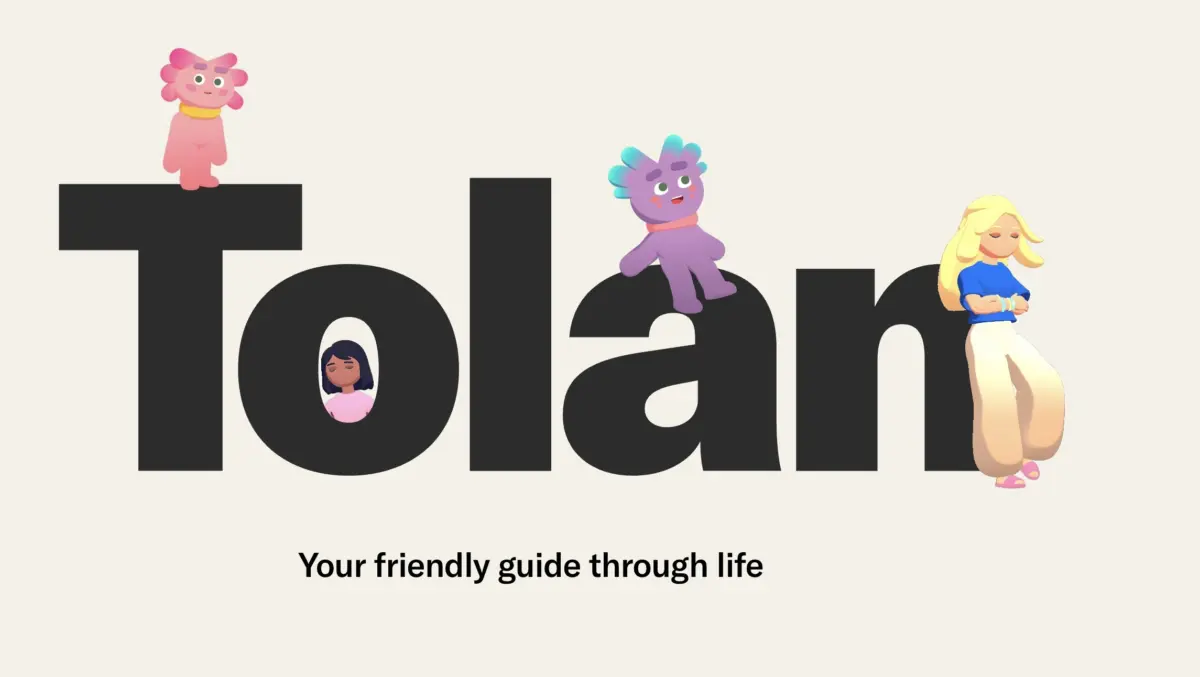
Recognizing the flaws in both pure utility tools and uncanny companion wearables, Tolan carved out a distinct middle ground. Launched as a mobile application anchored by a cartoonish, intentionally non-photorealistic avatar, Tolan avoids the "uncanny valley" trap that plagued photorealistic or wearable iterations.
Instead of presenting itself as a human substitute or a passive voice button, Tolan operates as a structured companion. It systematically prompts users through daily goal setting, task organization, personal reflection, and relationship navigation. This practical approach enabled the platform to steadily build organic momentum, culminating in its latest $30 million venture injection to accelerate product engineering and model specialization.
Supporting Context & Metrics: Unpacking Tolan’s Growth Engine
Tolan’s financial performance sets it apart from many venture-backed AI consumer applications that struggle to translate viral usage into recurring revenue.
Monetization and Revenue Trajectory
Unlike ad-supported social platforms or free-to-play novelty tools, Tolan operates a direct-to-consumer software-as-a-service (SaaS) business model:
- Tiered Memberships: Users can interact with basic features for free, but full access—including long-term conversational memory, goal tracking analytics, and proactive check-ins—requires a paid subscription.
- Financial Scale: In statements provided to Upstarts Media, Tolan confirmed that its Annual Recurring Revenue (ARR) has crossed into the "double-digit millions" (at least $10 million+). This key benchmark demonstrates real consumer willingness to pay for ongoing digital companionship and organization.
User Demographics and Behavioral Dynamics
Tolan claims an active user footprint exceeding 250,000 individuals, who together have logged over 70 million distinct conversational sessions in the past 12 months.
          TOLAN USER DEMOGRAPHIC BREAKDOWN

    [#############################     ] 70% Female Users
    [----------------------------------]
    [------------------                ] 40% Parents
    [----------------------------------]
    [*Significant Penetration*         ] Neurodivergent / Executive Support
A close analysis of Tolan’s user base reveals distinct demographic trends:

- Gender Disparity: Roughly 70% of Tolan’s active users identify as women, contrasting sharply with traditional consumer tech and gaming software demographics, which often tilt male.
- Parental Adoption: Approximately 40% of users are parents, leveraging the app to handle domestic schedules, manage family mental loads, and process parental stress.
- Neurodivergent Utility: Anecdotal evidence and user community discussions (such as active threads on Reddit’s
r/tolanworld) highlight the app’s strong popularity among neurodivergent individuals, particularly those living with ADHD or autism spectrum conditions.
For these users, Tolan functions as a digital "body double"—a non-judgmental entity that helps break down complex tasks into manageable steps, manages working memory deficits, and provides routine emotional regulation without the social friction or cognitive drain of human interaction.
Official Statements & Market Reaction
While Tolan’s leadership team kept formal commentary brief regarding the exact mechanics of its valuation, their disclosures to industry outlets paint a picture of deliberate operational discipline.
A spokesperson for Tolan emphasized that the capital expansion will be channeled directly into fundamental product stability and specialized user experience features:
"Our focus remains on building an AI companion that fits seamlessly into the daily rhythms of our users’ lives. The goal isn’t to replace human connection, but to provide a consistent, supportive presence that helps people manage executive dysfunction, organize their personal responsibilities, and work through emotional clutter."
Venture Capital Sentiment
Venture investors backing Tolan—led by Union Square Ventures, Khosla Ventures, and Homebrew—appear to be executing a strategic pivot away from raw, compute-heavy foundation models toward high-retention consumer application layers.
Analysts view the involvement of Khosla Ventures—an early backer of OpenAI—and Union Square Ventures as a strong vote of confidence in Tolan’s unit economics. Rather than burning capital on proprietary LLM pre-training from scratch, Tolan leverages specialized fine-tuning atop established foundational architectures. This allows the company to direct its capital reserves toward interface design, safety frameworks, and user retention mechanics.
       VENTURE STRATEGY SHIFT IN CONSUMER AI

   Past Focus (2023-2024)            Current Focus (2025-2026)
  ┌─────────────────────────┐       ┌─────────────────────────┐
  │ • Mass-market compute   │       │ • High retention SaaS   │
  │ • Open-ended roleplay   │  ──►  │ • Verticalized utility  │
  │ • Hardware wearables    │       │ • Grounded visual UX    │
  └─────────────────────────┘       └─────────────────────────┘
Contrast with Competitor Stumbles
Industry reaction to Tolan’s funding round has been largely colored by the high-profile stumbles of its peers:
- The Hardware Fallacy: Products like the Friend pendant demonstrated that forcing AI companions into dedicated hardware often introduces social stigma and awkward physical interactions. Tolan’s decision to remain a mobile-first software application running on standard smartphones spared it from hardware manufacturing supply chain bottlenecks and consumer rejection.
- The Business Model Trap: Character.AI proved that unmonetized, high-volume chat traffic quickly leads to financial ruin when server bills scale faster than subscription conversion rates. Tolan’s explicit focus on paid subscription tiers ensured that compute costs grew alongside clear top-line revenue.
Future Outlook, Industry Risk Analysis & Strategic Challenges
While Tolan’s $30 million funding milestone highlights its short-term success, the company operates in an environment fraught with emerging technological threats, regulatory scrutiny, and complex liability risks.
+-----------------------------------------------------------------------+
|                    TOLAN: RISK MATRIX & OUTLOOK                       |
+-----------------------------------------------------------------------+
| THREAT CATEGORY       | PRIMARY RISK FACTOR                           |
+-----------------------+-----------------------------------------------+
| Big Tech Agents       | Meta Muse & OpenAI expanding into agentic     |
|                       | personal assistants with OS-level integration.|
+-----------------------+-----------------------------------------------+
| Legal & Liability     | Mass lawsuits over AI companion interactions  |
|                       | in cases of mental health crisis/self-harm.   |
+-----------------------+-----------------------------------------------+
| Hardware Innovations  | Next-gen interactive devices (e.g., Meta's    |
|                       | charm/Tamagotchi prototypes) capturing gen-Z. |
+-----------------------+-----------------------------------------------+
| Regulatory Oversight  | Mandated disclaimers, therapy licensing rules,|
|                       | and strict data privacy regulations for mental|
|                       | health-adjacent AI applications.              |
+-----------------------+-----------------------------------------------+
1. The Threat of Big Tech’s Autonomous "AI Agents"
Tolan’s core market positioning—helping users plan, organize, and accomplish goals—places it directly in the crosshairs of major tech conglomerates. Big Tech platforms are rapidly shifting from passive text generation to proactive, tool-using AI agents:
- Meta’s "Muse" Expansion: Meta recently showcased its Muse platform, featuring an expressive digital avatar paired with agentic capabilities designed to manage schedules and automate daily logistics. Crucially, Meta has teased physical hardware integrations—such as interactive smart charms reminiscent of modern Tamagotchis—to anchor Muse within consumer ecosystems.
- OS-Level Integration: Apple and Google hold structural control over the mobile operating systems (iOS and Android) where Tolan operates. If system-level AI assistants evolve to offer emotional intelligence alongside deep system access (such as reading calendar invites, managing emails, and processing location data automatically), third-party apps like Tolan may face distribution bottlenecks.
2. Psychological Safety and Legal Exposure
The most severe existential threat facing the consumer AI companion sector centers on psychological safety, crisis intervention, and legal liability.
As AI companions become trusted confidants, users naturally express feelings of loneliness, severe depression, or acute crisis. When algorithms fail to handle these delicate moments safely, the consequences can be tragic—and legally devastating:
- Legal Precedents: A series of high-profile wrongful death lawsuits have been filed against major enterprise AI providers, including Google and OpenAI. These complaints allege that ungrounded, highly persuasive chatbot interactions fueled severe user delusions or directly facilitated tragic instances of self-harm and suicide.
- The Regulatory Dilemma: Tolan operates in a complex legal gray zone. While marketed as a general life coach and task management companion, its underlying appeal relies heavily on emotional connection and psychological support. Should regulatory bodies mandate that AI platforms offering emotional support meet formal mental health counseling standards, Tolan could face strict compliance burdens, required safety disclosures, or restricted interaction capabilities.
Strategic Imperatives for Growth
To protect its market lead and validate its $268 million valuation, Tolan must navigate several key strategic objectives:
- Deepening Agentic Capabilities: Tolan must evolve beyond simple conversational guidance. The app needs to safely automate real-world administrative tasks—such as coordinating schedules, interfacing with third-party software tools, and managing digital workflows—without breaking its friendly user persona.
- Hardening Safety Infrastructure: The platform must continue investing heavily in real-time content moderation, crisis detection systems, and strict boundaries around high-risk mental health discussions to safeguard users and insulate the business from legal liabilities.
- Sustaining Community Moats: By focusing on its core demographic strengths—particularly women, parents, and neurodivergent adults—Tolan can build a defensible, mission-driven brand equity that general-purpose assistants from Meta, Google, or OpenAI cannot easily replicate.
Tolan’s successful $30 million fundraise demonstrates that there is a real, monetizable market for empathetic consumer AI software. However, as the industry transitions from simple conversational novelties to autonomous agents, Tolan’s survival will depend on its ability to deliver genuine, day-to-day human value while successfully navigating the complex ethics of synthetic companionship.