Executive Overview
In the fast-paced ecosystem of internet culture, viral trends often emerge from the mundane frustrations of daily life. October 2026 brought a masterclass in this phenomenon with the rapid rise of the "Hope Whoever Stole My Amazon Package" meme format. Sparked by a seemingly genuine post detailing a porch pirate incident, the trend swiftly evolved into a widespread participatory joke across social media platforms, most notably X (formerly Twitter).
At its core, the meme uses a standardized phrasal template: "Hope whoever stole my Amazon package [X]," where the variable represents an absurdly specific, highly niche, or utterly ridiculous Halloween costume concept. Accompanied by a purported screenshot of an Amazon delivery history showing multiple items dropped off on the same day, users craft a clever juxtaposition between the very real modern annoyance of package theft and the surreal humor of internet-brain cosplay.
This comprehensive report explores the origins, rapid dissemination, cultural resonance, and structural mechanics of the "Stolen Amazon Package" meme. By examining specific viral iterations—ranging from obscure pop-culture references to abstract digital artifacts—we gain insight into how modern digital communities transform shared grievances into collaborative comedy.
Detailed Chronology: From Porch Pirate Grievance to Global Template
The Genesis: October 11, 2026
The phenomenon traces its roots directly to mid-October 2026, a peak period for seasonal preparations as internet users finalize their Halloween costumes. On October 11th, X user @lyssibot5000 published a post that would inadvertently launch a viral wildfire.
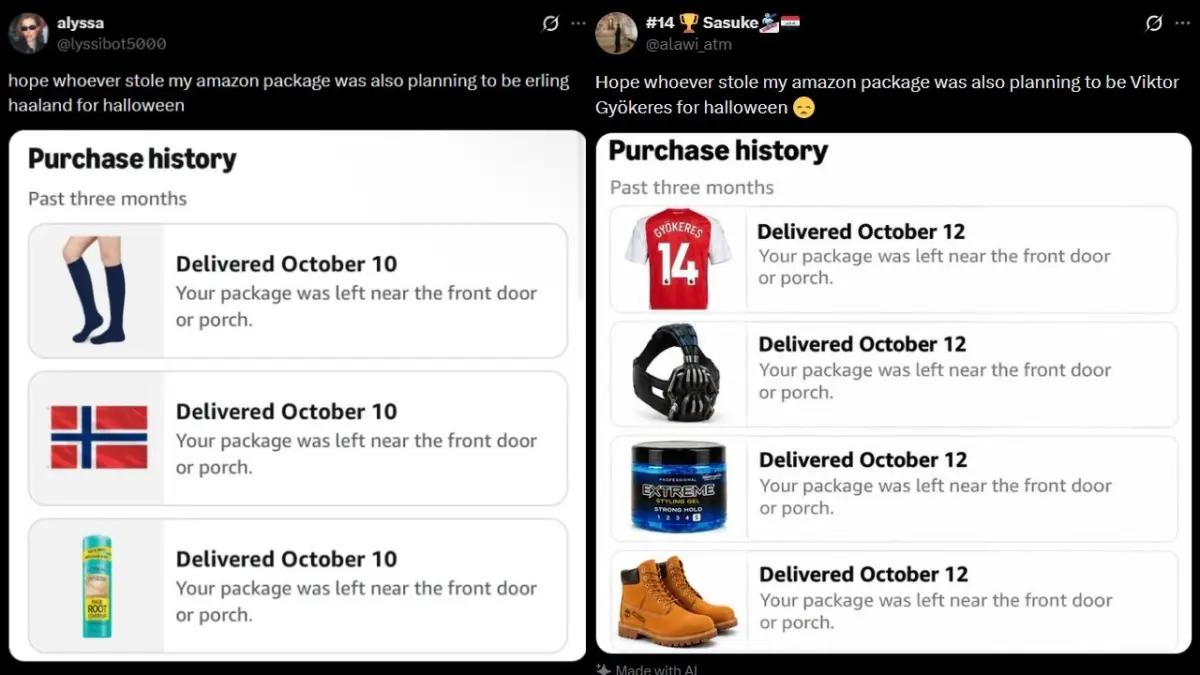
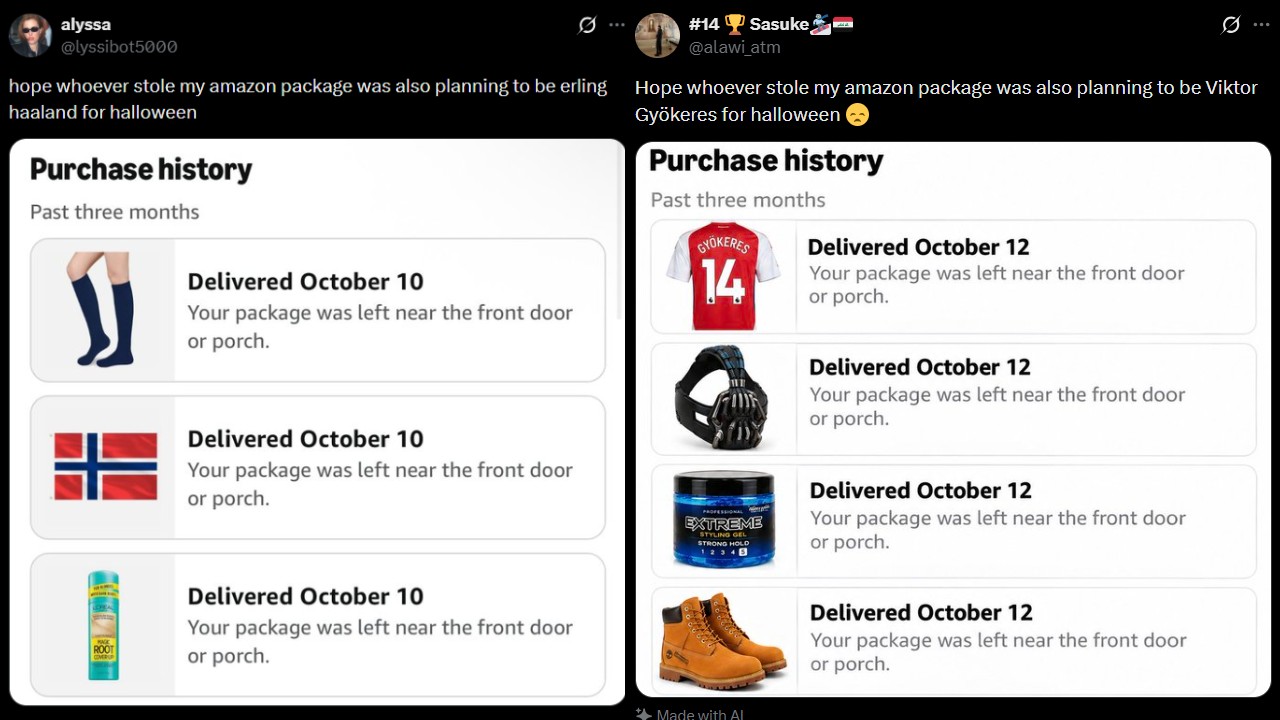
The tweet featured a screenshot of an Amazon purchase history showing three separate deliveries marked as dropped off near the front door or porch on October 10th. Accompanying the image was a deadpan caption: "hope whoever stole my amazon package was also planning to be erling haaland for halloween."
The humor hinged on the specificity of the costume—referencing the star Manchester City footballer—and the nonchalant acceptance of a petty crime transformed into an unexpected logistical matchmaking service. The post resonated immediately, capturing widespread attention by garnering over 176,000 likes and millions of impressions within its first five days online. It established the visual blueprint that subsequent creators would quickly iterate upon: the delivery confirmation screenshot paired with a punchline about an excessively niche alter ego.
The Acceleration Phase: October 14–16, 2026
Following the template established by @lyssibot5000, the meme underwent a rapid diversification process. Creators across various digital subcultures recognized the flexibility of the snowclone format, applying it to increasingly abstract, hyper-niche, and absurd concepts.
- The Pop Culture Adaptation: On October 14th, user @chaeryliv adapted the format to reference a specific album cover, writing, "i hope whoever stole my amazon package was also planning on being the yspsfagsil album cover" (referencing Olivia Rodrigo’s distinct aesthetic). The post secured over 50,000 likes in less than 48 hours.
- The Meme Meta-Layer: Later that same day, user @0NEMORETlME pushed the abstraction further, claiming they intended to dress as "why"—a reference to a viral meme featuring a woman in a plague doctor mask. This post amassed over 150,000 views, proving that the meme could reference itself recursively.
- Gaming and Spatial Humor: On October 15th, gaming culture intersected with the trend when user @SpaghettiSpace_ posted a variation claiming their stolen items were meant to assemble an in-game architectural feature: the Ascent B Site triple boxes from the tactical shooter Valorant.
- Divergent Cultural References: By October 16th, the trend had absorbed everything from professional sports figures (such as MLB players Giancarlo Stanton and baseball fan culture broadly) to historical internet micro-celebrities, esoteric television characters like Digger Rockwell, and real-world tech executives like Alexandr Wang.
Supporting Context & Metrics: Why the Format Works
To understand why the "Stolen Amazon Package" meme achieved such viral velocity, one must analyze the structural and psychological components that make it fertile ground for engagement.
1. The Relatability Anchor
Package theft—colloquially known as "porch piracy"—is a widely shared contemporary anxiety, particularly as consumers increasingly rely on online delivery services for seasonal shopping. By anchoring the joke in a universally understood moment of frustration (seeing a "Delivered" notification, only to find an empty porch), the meme immediately hooks the reader’s empathy before pulling the rug out with absurdity.
2. The Verisimilitude of the Screenshot
The inclusion of the Amazon purchase history screenshot adds a layer of deadpan realism. The interface elements—such as "Your package was left near the front door or porch" repeated multiple times—serve as a visual anchor. Even though savvy internet users know the delivery logs can be easily faked, inspected via browser developer tools, or repurposed from old orders, the aesthetic of the receipt lends the joke a mock-documentary authority.
3. The Power of the Snowclone Template
Linguistically, the snowclone "Hope whoever stole my Amazon package [X]" is a masterclass in participatory media. It provides a rigid structural constraint while offering infinite creative freedom for the variable [X]. Whether a user is a sports fanatic, a gaming enthusiast, or a connoisseur of deep-cut internet lore, the template accommodates virtually any punchline.
| Date (2026) | Creator / Handle | Subject / Variable [X] | Approximate Engagement Metrics |
|---|---|---|---|
| Oct 11 | @lyssibot5000 | Erling Haaland (Footballer) | 176,000+ likes |
| Oct 14 | @chaeryliv | Olivia Rodrigo Album Cover | 50,000+ likes |
| Oct 14 | @0NEMORETlME | "Why" Plague Doctor Meme | 150,000+ views |
| Oct 15 | @SpaghettiSpace_ | Valorant Ascent B Site Boxes | 10,000+ likes |
| Oct 14 | @gabosarchive | Lorde at the 2017 VMAs | 822,000+ views |
| Oct 13 | @suzukiplsstay | A Chicago Cubs Fan | 58,000+ views |
Official Statements and Industry Impact
While major e-commerce entities like Amazon have not released official public relations statements addressing the meme directly, consumer behavior analysts note that such organic viral trends highlight the deeply embedded nature of online retail in daily vernacular.
Furthermore, logistics observers have pointed out an ironic juxtaposition: while actual package theft remains a logistical nuisance for delivery networks and consumers alike, the internet’s ability to weaponize the grievance into collective satire turns a common crime into a bonding exercise in community humor.
Digital marketing experts emphasize that the meme’s success relies on "in-group signaling." By choosing a costume reference that only a specific subset of followers will understand—such as a precise architectural angle in a video game or a niche music video frame—the poster invites their audience into an exclusive club of comprehension.
Future Outlook: The Evolution of Seasonal Meme Culture
As Halloween approaches and internet culture continues to iterate at breakneck speed, the "Stolen Amazon Package" format serves as a prime example of how micro-trends lifecycle through social media.
- Sustainability: Snowclone templates driven by UI (User Interface) screenshots—such as fake text message threads, Spotify wrapped summaries, and delivery receipts—historically enjoy high adaptability. Because the baseline visual (the Amazon delivery confirmation) requires minimal graphic design skill to replicate, the barrier to entry remains exceptionally low.
- Cross-Platform Migration: While initiated and primarily propagated on X, variations of the meme have begun appearing on secondary platforms like TikTok and Instagram, where creators act out the hypothetical scenario of a thief opening the box to find bizarre, non-functional costume pieces (such as three stacked metal boxes or obscure sports memorabilia).
- The 2026 Holiday Season Horizon: Industry observers anticipate that as the calendar turns from October toward the winter holiday peak (Black Friday and the December gift-giving season), the template may experience a resurgence, swapping out Halloween costume components for holiday-themed grievances.
Ultimately, the "Hope Whoever Stole My Amazon Package" trend demonstrates the resilience of internet humor. By taking a modern urban annoyance and reframing it through the lens of absurd, hyper-specific fandoms, digital creators once again proved that shared laughter remains one of the web’s most effective coping mechanisms.