

Executive Overview
In the hyper-accelerated ecosystem of modern internet culture, few phenomena capture the zeitgeist quite like a hyper-specific, highly ironic participatory meme. As the autumn leaves fall and the countdown to October 31st intensifies, social media timelines inevitably flood with seasonal content. However, October 2026 birthed a uniquely absurd viral sensation that married two deeply modern anxieties: the ubiquitous dread of porch piracy and the perennial scramble for a clever Halloween costume.
The trend, colloquially anchored by the phrasal template "Hope Whoever Stole My Amazon Package [X]," began as a seemingly innocuous post on the social media platform X (formerly Twitter). It quickly snowballed into a widespread structural format characterized by users sharing fabricated or exaggerated Amazon purchase histories paired with increasingly surreal, niche, and downright impossible costume reveals.
Far from a genuine lament over stolen consumer goods, the trend functions as an elaborate exercise in deadpan absurdism. By masking meticulously curated pop-culture references, internet micro-lore, and inanimate objects behind the mundane tragedy of package theft, participants have turned a universal nuisance into a canvas for avant-garde comedy. This report provides an exhaustive journalistic examination of the meme’s origins, its rapid horizontal spread across digital platforms, the mechanics of its humor, and what its sudden rise reveals about the psychology of modern online communities.
Detailed Chronology: From a Single Porch to a Global Timeline
The Spark: Mid-October 2026
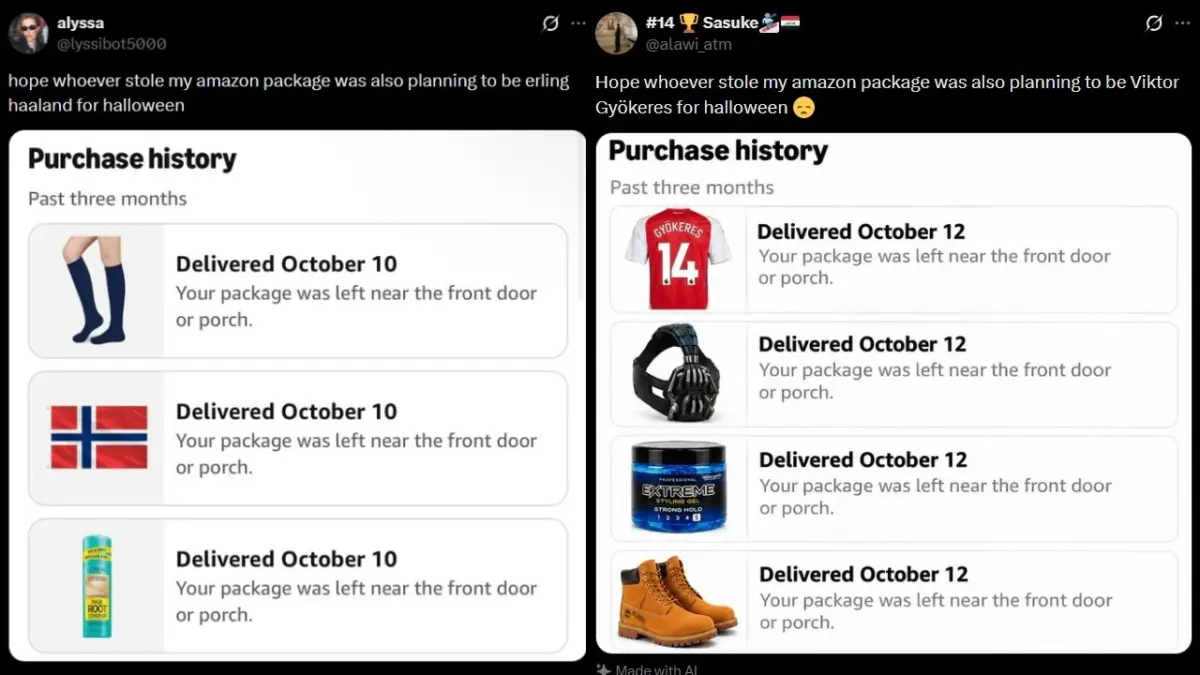
The blueprint for what would become one of autumn 2026’s defining viral formats was drafted on October 11th, 2026. X user @lyssibot5000 took to the platform to share a screenshot of their purported Amazon delivery history. The log showed multiple items delivered to their front door or porch on October 10th. Accompanying the screenshot was a deceptively casual caption that would soon be etched into internet history:
"hope whoever stole my amazon package was also planning to be erling haaland for halloween."
The juxtaposition of the mundane delivery updates—the familiar digital receipt of modern consumerism—with the highly specific, physically demanding, and culturally distinct persona of Manchester City football star Erling Haaland struck an immediate chord. The post was a masterclass in bait-and-switch comedy; viewers expected a genuine cry of frustration against package thieves, only to be met with the mental image of an opportunistic porch pirate attempting to squeeze into a professional athlete’s matchday kit or sport his signature blonde locks.
The post went viral at a blistering pace, racking up over 176,000 likes within just five days and laying the foundation for a snowclone template that others could easily replicate, distort, and elevate.
The Escalation and Diversification Phase (October 14–15, 2026)
Following the early success of the Erling Haaland blueprint, the internet did what it does best: it iterated, accelerated, and rendered the joke increasingly abstract.
On October 14th, the floodgates opened. User @chaeryliv adapted the format to target deeply online music fandoms, posting a screenshot claiming they were assembling a costume replicating the specific album cover aesthetics of Olivia Rodrigo’s You Seem Pretty Sad for a Girl So in Love. The post struck a chord with Gen Z pop culture spaces, pulling in over 50,000 likes in 48 hours.
Later that same day, the meme took a sharp turn away from conventional celebrity cosplay into the surrealist depths of internet lore. User @0NEMORETlME subverted expectations entirely by claiming their stolen package was intended to transform them into "Why"—a reference to a viral, esoteric image of a woman wearing a plague doctor mask simply captioned with the existential query, "why." This meta-layering of meme culture pushed the format past simple impersonation and into self-referential absurdity, drawing over 150,000 views in two days.
The gaming community quickly claimed the trend on October 15th. User @SpaghettiSpace_ posted a variation declaring that their stolen Amazon delivery contained the necessary components to dress up as the "Ascent B Site triple boxes" from tactical shooter Valorant. The idea of a human being attempting to disguise themselves as a static, stackable piece of in-game environmental geometry proved irresistible to gamers, earning upwards of 10,000 likes in a single day and proving that the template could house virtually any object in the physical or digital universe.
Peak Saturation and Micro-Niche Adaptations (October 16, 2026 and Beyond)
By mid-October, the meme had achieved total market saturation across X, metastasizing into an egalitarian playing field where users across disparate subcultures competed to devise the most unhinged, obscure, or physically impossible costume concepts.
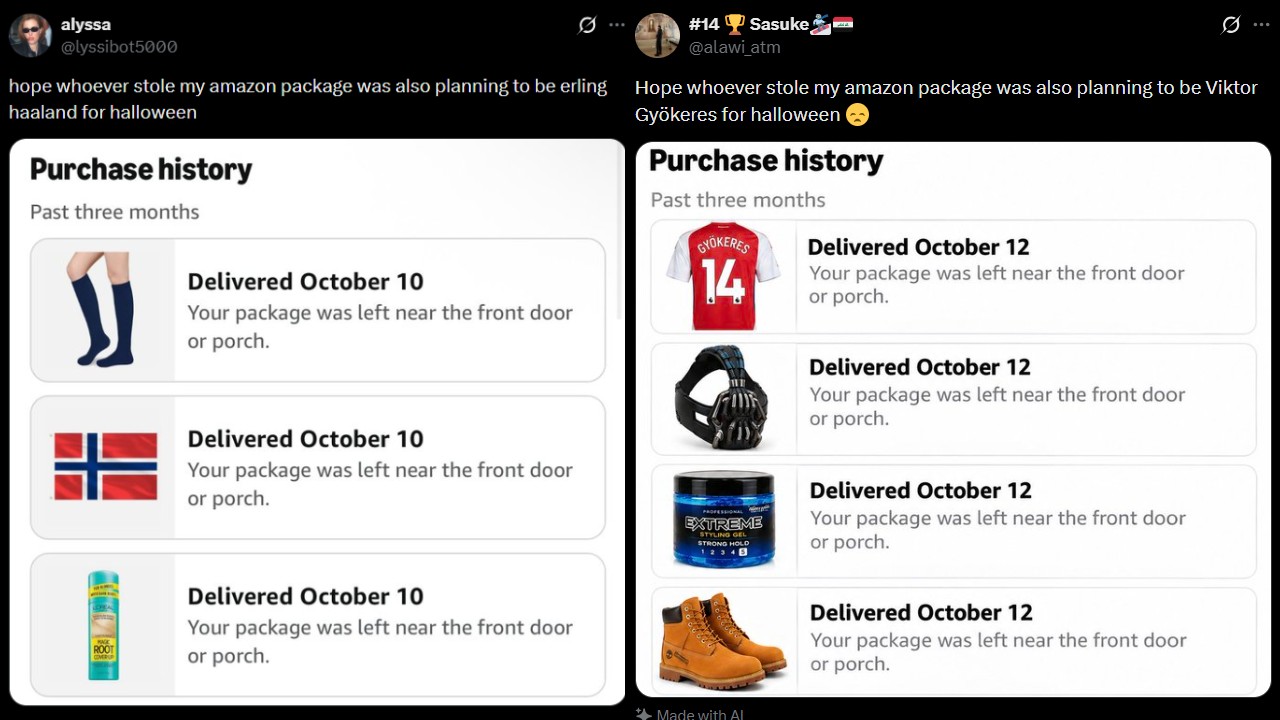
The breadth of references showcased during this peak window was staggering. Fashion historians and pop culture historians alike chuckled at @gabosarchive’s contribution on October 14th, which claimed the stolen goods were meant to recreate Lorde’s infamous 2017 MTV Video Music Awards outfit. Sports enthusiasts chimed in with entries dedicated to New York Yankees slugger Giancarlo Stanton (posted by @ricericebaby22) and long-suffering Chicago Cubs fans (@suzukiplsstay).
Tech and finance circles weren’t immune either; user @winternet subverted corporate worship by suggesting they planned to dress up as billionaire tech executive Alexandr Wang. Meanwhile, niche television and cinematic references—such as @cinephilishh’s homage to Digger Rockwell and @baddaysareover’s nod to Nene—ensured that no matter a user’s specific corner of the internet, a tailored version of the joke existed for them.
Supporting Context & Metrics: Analyzing the Mechanics of the Trend
The Psychology of Porch Pirate Anxiety
To understand why this specific meme resonated so deeply, one must examine the socio-economic backdrop against which it plays out. Porch piracy—the theft of delivered packages from residential doorsteps—has evolved from an urban nuisance into a ubiquitous modern American anxiety. With the exponential growth of e-commerce giants like Amazon, millions of households navigate the daily ritual of tracking digital packages and racing home to intercept deliveries before opportunistic thieves strike.
By hijacking this widespread, genuinely frustrating everyday grievance, the meme uses dark humor and bathos as a coping mechanism. It transforms a violation of personal property into a canvas for communal play. Instead of posting an angry ring-camera video of a hooded figure walking off with a cardboard box, users reclaim the narrative by inventing a scenario so ridiculous that the theft becomes the punchline rather than the problem.
Anatomy of a Snowclone: The Structural Blueprint
Linguistically and structurally, the "Hope Whoever Stole My Amazon Package" trend relies on a classic internet snowclone:
- The Setup: A verified-looking or convincing screenshot of an Amazon delivery confirmation ("Delivered October 10 / Your package was left near the front door or porch").
- The Delivery: The phrasal template, "Hope whoever stole my amazon package was also planning to be [X] for halloween."
- The Variable ([X]): The comedic engine of the post. The humor scales directly with how absurd, hyper-specific, mundane, or physically impossible [X] is to render as a wearable Halloween costume.
This modular design is precisely why the trend achieved such viral velocity. It required minimal digital literacy to participate—anyone with basic photo-editing skills or the ability to stage a delivery screenshot could join in—while offering infinite ceiling space for creative, high-effort joke-writing.
Official Statements and Digital Culture Commentary
While major corporate entities and public figures largely observed the trend from the sidelines rather than issuing formal press releases, cultural commentators, digital anthropologists, and meme-tracking institutions quickly recognized its significance as a defining snapshot of late-2026 internet humor.
Digital culture analysts noted that the trend represents a maturing of platform-native satire. Unlike previous generations of Halloween memes that relied on straightforward photo-sharing or direct costume evaluations, this format relies heavily on procedural realism—the dry, administrative interface of an e-commerce delivery log—to sell a completely unhinged premise.
Furthermore, social media metrics tracked by independent meme archives highlighted the unprecedented engagement-to-effort ratio displayed by the trend’s top posts. Content creators and casual users alike discovered that combining low-effort visual formats (delivery confirmation logs) with high-concept cognitive dissonance (dressing up as a Valorant map object or a specific music album cover) yielded massive algorithmic rewards, driving hundreds of thousands of impressions across the board.
Future Outlook: The Legacy of the 2026 Porch Pirate Meta
As October draws to a close and the physical reality of Halloween passes, the immediate lifecycle of the "Hope Whoever Stole My Amazon Package" meme faces the inevitable seasonal shelf-life typical of holiday-specific internet trends. Like pumpkin spice discourse or spooky-season tier lists, the format is primed to hibernate once November arrives and the collective internet consciousness pivots toward upcoming winter holidays.
However, the structural footprint left by the trend is likely to endure. The format has permanently added another modular snowclone to the digital lexicon, proving that administrative interfaces—receipts, delivery logs, tracking updates, and invoices—serve as exceptionally fertile ground for ironic, deadpan humor.
Moreover, as e-commerce continues to dominate modern life, the underlying anxieties of package delivery and porch piracy will only remain relevant. If anything, internet culture has demonstrated that no matter how frustrating or invasive modern consumer logistics become, the collective online community will invariably find a way to weaponize that frustration into surreal, self-aware comedy. When the holiday season rolls around next year, users will undoubtedly look back on October 2026 as the moment a stolen delivery log became a masterclass in digital surrealism.




