Executive Overview
The global technology and venture capital markets are experiencing a period of historic acceleration, characterized by record-breaking mega-rounds, high-stakes boardroom battles, and a bifurcated macroeconomic reality. While artificial intelligence startups are commanding unprecedented valuations—typified by a record 42 global decacorns minted in 2026 alone—the traditional enterprise software sector continues to navigate a grueling, selective market correction.
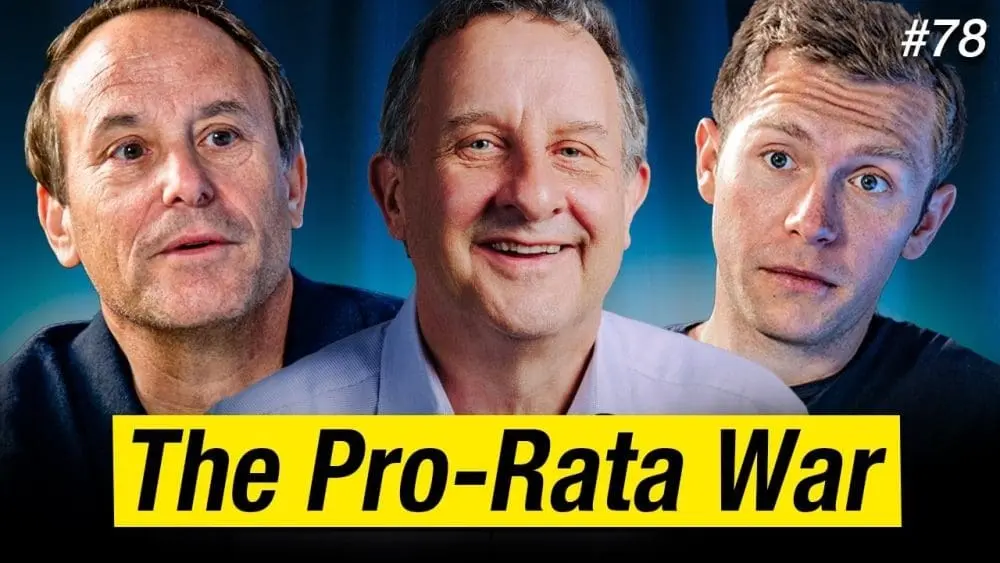
In this week’s comprehensive breakdown, industry heavyweights Harry Stebbings, Rory O’Driscoll, and Jason Lemkin dissected the market’s most compelling developments. From a high-profile legal battle in Delaware involving nuclear startup Valar Atomics and early investor Day One Ventures, to Meta’s aggressive re-entry into the frontier model race with Muse Wonder, and Nvidia’s strategic maneuvers surrounding Reflection AI, the landscape is shifting rapidly.
Simultaneously, massive pricing compressions—such as Anthropic’s 90% price cut on its Haiku 5.5 model—are fundamentally altering the unit economics of AI deployment. Yet, beneath the veneer of staggering venture rounds and soaring public tech indices, a stark truth remains: the "B2B SaaS apocalypse" has only truly ended for companies boasting over $1 billion in Annual Recurring Revenue (ARR). Below that threshold, founders and mid-market operators are facing severe consolidation, aggressive corporate buyouts (such as Bending Spoons’ sweeping layoffs at Airtable), and a challenging fundraising climate.
Detailed Chronology: Key Industry Developments
1. Valar Atomics vs. Day One Ventures: The Delaware Pro Rata Battle
The intersection of venture capital growth dynamics and early-stage governance reached a boiling point this week as nuclear energy startup Valar Atomics initiated legal action in Delaware against its earliest institutional backer, Day One Ventures.
Valar, currently securing approximately $1 billion in funding at a $6 billion valuation led by Sequoia Capital, sought waivers from early stakeholders to bypass a "spring-back" pro rata clause. While major investors complied, Day One—which injected $1 million into Valar’s seed round and $15 million into its Series A, retaining a sub-5% stake—found itself at an impasse. Valar ultimately sought a declaratory judgment in Delaware to clear its cap table for the incoming mega-round.
- Jason Lemkin’s Perspective: Lemkin argued that while the situation is nuanced, founders ultimately dictate the cap table. "Once the founder decides, you raise it once and let it go. It’s not your company and it’s not your cap table," he noted, sharing a personal anecdote about being cut out of an allocation and straining a founder relationship.
- Rory O’Driscoll’s Analysis: O’Driscoll framed the dispute through a pragmatic risk-reward lens. With Day One’s 5% stake already valued at roughly $300 million, fighting to deploy an additional $10 million to $15 million at a $6 billion valuation introduces diminishing returns. "Both people can be intellectually wrong but pragmatically right," he observed.
- Harry Stebbings’ Insight: Stebbings highlighted a broader structural shift regarding pro rata rights. Emerging micro-VC fund Neo reportedly stopped taking pro rata rights entirely this year, citing the Valar dispute as a cautionary tale of the friction generated when mega-funds demand total waivers from seed investors.
2. Meta Ships Muse Wonder, Re-entering the Frontier Model Arena
Meta’s Superintelligence Lab officially launched its first frontier models, Muse Wonder and Muse Wonder Full. Scoring comparably to Fable 5.1 and GPT-6 Astra on internal benchmarks, the base model is priced commercially at $4/$20 per million tokens via API. However, the top-tier Muse Wonder Full model remains exclusively locked inside the Muse Code ecosystem.
- Industry Takeaways: Industry observers noted that while restricting the headline model to internal apps limits immediate utility for external builders, Meta’s broader consumer application strategy signals a formidable push into the consumer AI product market. O’Driscoll emphasized the pragmatic financial logic driving Meta’s multi-billion-dollar infrastructure spend: "If we’re going to spend $100 billion, we’d better at least be able to charge for the damn thing."
3. Nvidia Sets Sights on Reflection AI
Reports surfaced that Nvidia is engaged in early discussions to either acquire or deepen its equity stake in Reflection AI. Having already deployed $800 million into the company—which last raised capital at a $25 billion pre-money valuation—Nvidia is reportedly exploring a structure that avoids heavy regulatory scrutiny, potentially executing an acqui-hire.
- Strategic Implications: O’Driscoll pointed out Nvidia’s masterclass in ecosystem control: by fostering open-source and open models, Nvidia ensures that capital flows toward its proprietary silicon rather than proprietary model wrappers. Meanwhile, Lemkin underscored the asymmetric power dynamic between hardware giants and model developers, noting that defying Nvidia’s overtures carries immense commercial risk.
4. Jev Maker TypeSafe Raises $870 Million 24 Days After Launch
Demonstrating the blistering pace of AI funding, TypeSafe—creator of the enterprise decision-making agent Jev—closed an $870 million Series A at a $7.5 billion valuation led by Andreessen Horowitz (a16z), alongside Sequoia and DCVC. Launched on September 15, TypeSafe operates with a lean team of roughly 20 employees and claims adoption by one-third of the Fortune 500.
- Market Reception: While panelists debated the staggering speed of valuation inflation—where early-stage teams command multi-billion-dollar price tags based on speculative TAMs—practitioners acknowledged Jev’s product-market fit. Lemkin, an active user of the platform, noted its high accuracy in automated decision processing, while O’Driscoll modeled a potential $4 billion revenue trajectory assuming aggressive market capture in inference-heavy enterprise workflows.
5. A Record 42 Decacorns Minted in 2026
According to PitchBook data, global venture markets have minted 42 new "decacorns" (startups valued at $10 billion or more) through the first ten months of 2026, shattering the previous annual record of 34 set in 2021.
- Macro Analysis: O’Driscoll contrasted this hyper-inflationary capital environment against historical public market trends, which have historically produced roughly 20 tech decacorns per decade. "Either this is the most transformative event since the Industrial Revolution, or we’re getting a wee bit ahead of ourselves," he remarked.
6. Isomorphic Labs Eyes $40B–$50B Valuation
DeepMind’s AI drug-discovery spinout, Isomorphic Labs, entered early discussions for a valuation ranging between $40 billion and $50 billion. This milestone arrives just five months after its $2.1 billion Series B round led by Thrive Capital.
- Investment Rationale: Panelists agreed that generative drug discovery represents a fundamental paradigm shift. By compressing the pharmaceutical R&D timeline by years, companies like Isomorphic capture immense long-term value via royalties on trillion-dollar therapeutic pipelines, easily justifying generational pricing for generational talent.
Supporting Context & Metrics
The broader macroeconomic and venture ecosystem reflects deep structural bifurcations across multiple sectors:
- Robotics Training Data: Mecka secured a $60M Series B from Sequoia, capitalizing on the booming demand for human-in-the-loop training data for humanoid robotics. With projected run-rate revenues scaling toward $300 million by year-end, data infrastructure providers are currently capturing higher immediate realization than hardware-heavy robotics manufacturers.
- Anthropic’s Pricing Deflation: The release of Haiku 5.5 introduced a 90% price cut, dropping API costs to $0.10/$0.50 per million tokens for standard workloads. This move marks a genuine inflection point in software deflation, compelling enterprises to embed LLMs across entire database rows rather than relying on selective sampling.
- Enterprise Software Consolidation: Bending Spoons initiated sweeping layoffs at Airtable following its $1.285 billion acquisition in August, mirroring its playbook with Evernote and Vimeo. Concurrently, Bumble agreed to a take-private transaction with Ithaca Holdings at $6.05 a share—a 138% premium, but a steep descent from its 2021 IPO peak of $14 billion.
Official Statements & Industry Insights
"Everyone was saying that Day One was suing their portfolio company, which was completely wrong. It is Valar that wants declaratory judgment to move on. Sequoia came in very aggressively, and everyone had to waive their pro rata…"
— Harry Stebbings"Both people can be intellectually wrong but pragmatically right."
— Rory O’Driscoll"Everyone without massive scale is living a worse apocalypse than in March or April, because no one wants to buy software. Everyone’s breathing a sigh of relief. I don’t think we should be."
— Jason Lemkin
Future Outlook
As the technology sector navigates the final stretch of 2026, the trajectory ahead is defined by a paradox of hyper-growth in artificial intelligence and rigorous financial discipline in legacy software.
- The Pro Rata Standard: The Valar Atomics lawsuit serves as a warning shot for early-stage investors. Moving forward, "spring-back" clauses and pro rata waivers will likely become heavily negotiated friction points as mega-funds increasingly dictate terms in later-stage uprounds.
- AI Commoditization vs. Application Value: With frontier model makers aggressively compressing token pricing (evidenced by Anthropic’s Haiku cuts) and hardware giants like Nvidia tightening their grip on foundational architectures, the pressure shifts entirely to application-layer builders. Companies that fail to demonstrate direct, non-discretionary enterprise utility will face aggressive consolidation.
- The Survival Threshold for SaaS: While public market indices show signs of recovery, the private markets remain unforgiving. For software companies under $1 billion in ARR, the mandate for 2027 is clear: pivot to AI-first architectures, achieve cash-flow resilience, or prepare for distressed M&A and structural restructuring.