Executive Overview
For decades, the ritual of maintaining a clean workstation, gaming rig, or precision electronics array relied on a ubiquitous office staple: the disposable compressed air canister. These aluminum or steel cylinders, packed with liquefied gas and fitted with a fragile plastic straw, have cleared millions of keyboards, fans, and circuit boards since the dawn of the personal computing era. However, they represent an inherently flawed consumer model. They are expensive over time, environmentally wasteful, prone to freezing during prolonged use, and mechanically limited by declining pressure as the canister empties.
As part of the early retail salvos ahead of Amazon’s upcoming October Prime Day event, a significant shift in desktop maintenance economics has emerged. Retailers are listing the VASSON Cordless Electric Air Duster at an aggressive promotional price of just $16.99 when buyers apply the exclusive checkout promo code "6A2S39EZ". This pricing represents a watershed moment for consumer electronics maintenance tools, marking the lowest price point yet recorded for a high-velocity, rechargeable electric blower on major e-commerce platforms.
This comprehensive investigative report examines the technological evolution of electric air dusters, analyzes the economic and environmental obsolescence of traditional canned air, provides deep performance metrics of the VASSON unit, and explores the broader market dynamics driving sub-$50 tech accessories. Whether you are an enthusiast maintaining a high-end gaming PC, a remote professional fighting perpetual desk dust, or an eco-conscious consumer seeking sustainable hardware solutions, this analysis will break down everything you need to know about this market-disrupting cleaning tool.
Detailed Chronology: The Evolution of Desktop Cleaning Tech
To understand the significance of a $17 electric air duster, one must trace the evolutionary trajectory of how humans have blown dust out of tight spaces over the past forty years.
Phase 1: The Mechanical Era (Late 20th Century)
Before chemical propellants became universally accessible, cleaning delicate mechanical and electronic equipment required manual labor. Technicians relied on rubber squeeze bulbs (often called dust blowers or blower brushes) borrowed from photographic darkrooms. While safe for electronics—generating no static discharge or chemical residue—their output was entirely dependent on human lung or hand stamina. They were utterly incapable of displacing stubborn, static-bound dust caked inside densely packed computer chassis or mechanical keyboard switches.
Phase 2: The Rise of Disposable Canned Air (1990s–2010s)
The introduction of canned compressed gas revolutionized consumer electronics maintenance. Utilizing hydrofluorocarbons (HFCs) or liquefied petroleum gases, these cans offered instant, high-pressure streams capable of obliterating debris.
However, the technology harbored severe structural liabilities:
- The Pressure Drop Phenomenon: As gas escapes, the liquid inside absorbs heat to vaporize, causing the can to rapidly chill. This thermodynamic reaction leads to a severe drop in PSI (pounds per square inch), forcing users to constantly shake or pause.
- The Liquid Discharge Hazard: Tilting the can past a certain angle causes liquid propellant to shoot out, risking chemical damage to sensitive circuit boards or freezing plastics.
- Recurring Expense: At $8 to $15 per multi-pack, frequent users could easily spend upwards of $60 to $100 annually purely on consumable air cans that ended up in landfills.
Phase 3: The Industrial-to-Consumer Pivot (Late 2010s–Present)
Advances in brushless motor technology, lithium-ion energy density, and aerodynamics allowed manufacturers to scale down industrial-grade air compressors into handheld, battery-powered form factors. Initially, these devices were prohibitively expensive, often commanding price tags between $80 and $150. They were marketed strictly to IT professionals and industrial repair shops.
By 2024 to 2026, supply chain maturity and manufacturing standardization commoditized these internal components. Today, budget-focused manufacturers like VASSON are producing units that match or exceed the performance of those early expensive models, driving the cost down to a point where purchasing a single disposable can of air is economically irrational.
Supporting Context & Metrics: Under the Hood of the VASSON Air Duster
To evaluate whether a $16.99 electric air duster is a legitimate productivity tool or a cheap gimmick, we must dissect its core specifications, aerodynamic engineering, and real-world operational capabilities.
Technical Specifications Matrix
| Feature | VASSON Cordless Electric Air Duster | Traditional Disposable Canned Air |
|---|---|---|
| Power Source | Rechargeable Lithium-Ion Battery (USB-C) | Liquefied Gas Propellant (Disposable) |
| Motor Speed | Up to 260,000 RPM (3 Adjustable Settings) | N/A (Mechanical Pressure Release) |
| Environmental Impact | Zero single-use waste; rechargeable hundreds of times | Single-use metal canisters, potential HFC emissions |
| Safety Hazards | Low risk; no chemical propellants or freezing liquids | High risk of frostbite, liquid spray, and flammability |
| Initial Cost | $16.99 (with promo code 6A2S39EZ) |
$8.00 – $15.00 per multi-pack |
| Long-Term Cost | Negligible electricity draw for charging | Recurring purchase cycle |
| Versatility | Includes 5 specialized nozzles and brush attachments | Single narrow plastic straw |
Aerodynamic Performance and Motor Dynamics
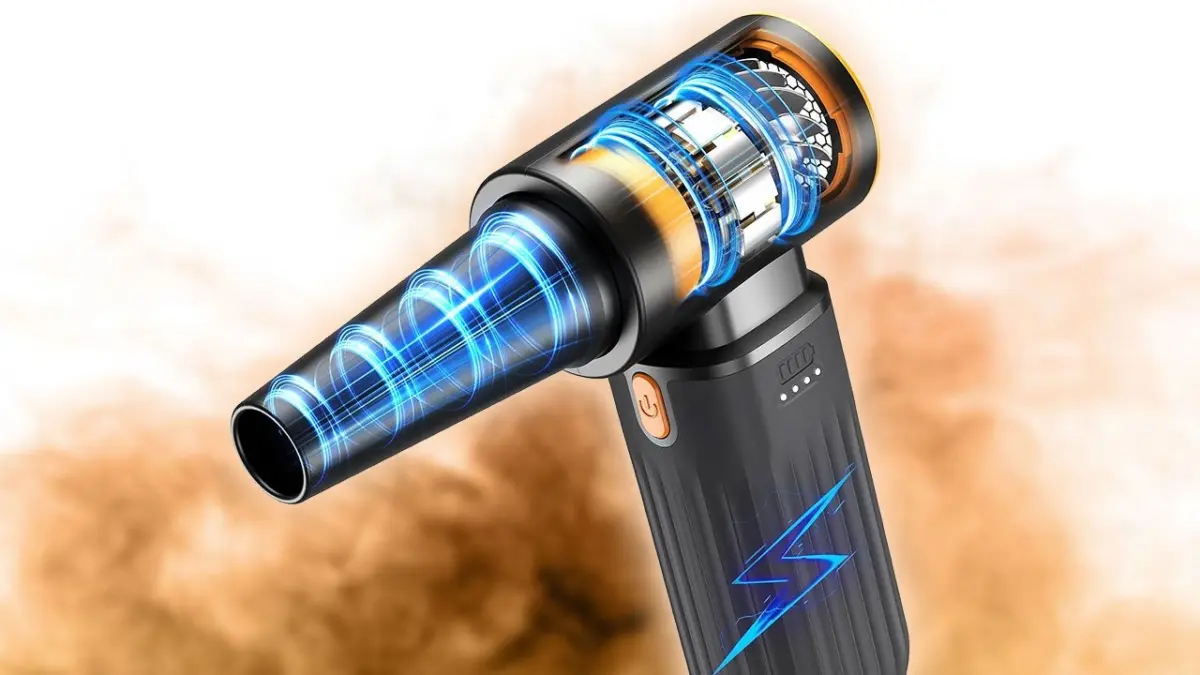
At the heart of the VASSON unit is a miniature high-performance electric motor capable of spinning up to an astonishing 260,000 RPM. While RPM figures in consumer marketing can sometimes be misleading, the practical application here is undeniable: the internal turbine impeller forces a massive volume of ambient air through a constricted exit chamber.
When forced through the included narrow funnel nozzle, this air volume translates into a high-velocity stream capable of breaking the surface tension of static electricity that binds microscopic dust particles to printed circuit boards, aluminum heatsink fins, and fan blades.

Industry analysts note that across the current wave of sub-$50 electric dusters flooding Amazon, performance baselines have largely plateaued. Most units utilize identical motor architectures and battery cells, meaning brand differentiation is primarily driven by packaging, accessory kits, and promotional discounting rather than raw performance disparities. Therefore, consumers are universally advised to purchase whichever reliable model is currently commanding the lowest price point—making the VASSON offer at $16.99 an exceptional entry point.
Ergonomics, Speeds, and Attachment Ecosystem
The VASSON unit features a streamlined, ergonomic pistol-grip design that sits comfortably in the hand during extended cleaning sessions. It incorporates a three-stage speed control system. While lower speeds can be useful for gently sweeping dust off delicate microphone pop filters or external peripherals, technical reviewers universally recommend operating the device at maximum speed for core PC maintenance tasks to ensure maximum particle displacement.
Furthermore, the hardware package includes five distinct nozzles and attachments:
- Narrow Funnel Nozzle: Engineered for high-pressure pin-point accuracy, ideal for digging debris out of mechanical keyboard switch housings and tight I/O shield crevices.
- Brush-Integrated Nozzle: Combines mechanical agitation with airflow, breaking up stubborn, sticky films of grime or pet dander stuck to desk surfaces or fan blades.
- Wide-Area (AoE) Nozzle: Designed to disperse airflow across a broader footprint, perfect for clearing flat surfaces like desk mats, laptop chassis, and large electronics vents.
- Specialized Extension Nozzles: Facilitate reaching deep inside complex tower cases without awkward hand positioning.
Charging and Versatility Beyond the Desk
Powering the device is an internal rechargeable battery pack replenished via a modern USB Type-C port. The inclusion of USB-C standardizes the charging ecosystem, allowing users to leverage existing smartphone chargers, laptop docks, or power banks. Battery endurance is rated comfortably above the threshold required for a thorough, unhurried deep-cleaning of a complex desktop tower and multiple peripherals.
Crucially, the utility of a high-powered electric blower extends far beyond the computer desk. Owners of similar handheld cordless dusters report expansive use cases across daily life:
- Kitchen Maintenance: Clearing out coffee bean residues from precision burr grinders and espresso machine drip trays.
- Pet Care: Acting as a low-heat, high-velocity mini-blowdryer for wet dogs after rainy walks.
- Yard and Automotive Work: Clearing autumn leaves from windshield cowls, blowing out car air vents, and removing dust from vehicle dashboard crevices.
- Household Cleaning: Eliminating cobwebs from crown molding, cleaning window screen meshes, and dusting faux plants.
Official Statements and Industry Perspective
Retail analysts and industry observers view promotional pricing events like Amazon’s upcoming October Prime Day as critical testing grounds for lifestyle tech accessories.
"The transition from consumable maintenance supplies to rechargeable, multi-use hardware is accelerating across every category of consumer electronics," notes a prominent retail supply chain strategist. "When a consumer can purchase a high-velocity electric air duster for less than the cost of three disposable aerosol cans, the economic calculation shifts permanently. Buyers realize they aren’t just buying a tool; they are breaking a recurring subscription to single-use waste."
Furthermore, environmental advocacy groups have long criticized traditional canned air products. Many conventional dusters utilize hydrofluorocarbons (HFCs)—potent greenhouse gases that possess global warming potentials thousands of times higher than carbon dioxide. Even variants utilizing compressed difluoroethane or liquefied petroleum gas present severe fire hazards if misused in enclosed spaces or near active electrical arcs.
Electric air dusters eliminate these chemical hazards entirely, relying purely on mechanical wind energy drawn from clean, rechargeable lithium power cells. This transition aligns with broader global corporate and consumer mandates to eliminate single-use plastics and chemical propellants from households.
Future Outlook: The End of the Disposable Aerosol Era?
As we look toward the remainder of the decade, the trajectory of desktop maintenance tools is clear. Disposable compressed air cans are rapidly following magnetic floppy disks, CD-ROMs, and wired desktop mice into obsolescence.
The convergence of falling lithium-ion battery costs, brushless motor efficiency, and aggressive e-commerce pricing strategies ensures that tools like the VASSON Electric Air Duster will become standard equipment in every home office, IT department, and gaming setup. For consumers who have spent years tolerating the frustrating pressure drops, freezing temperatures, and recurring expenses of traditional canned air, upgrading to a rechargeable electric blower is an immediate, high-yield quality-of-life improvement.
With Amazon offering the VASSON unit for an unprecedented $16.99 using promo code "6A2S39EZ" ahead of the October Prime Day rush, market demand is expected to surge. For anyone looking to modernize their cleaning kit while drastically reducing their long-term maintenance overhead, this promotional window represents the optimal moment to make the switch.