By Saf Malik
Senior Content and Insights Manager
21 September 2026
Executive Overview
In the high-stakes landscape of modern digital infrastructure, a fundamental truth has rewritten real estate economics: a site with a grid connection is not the same as a site with usable power.
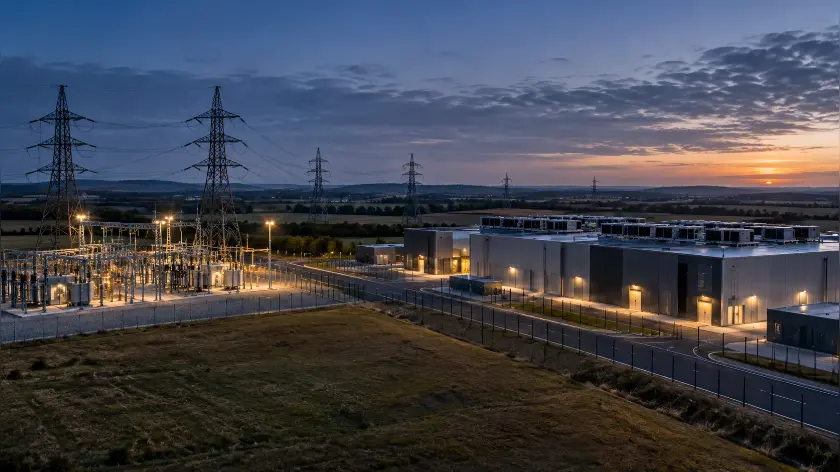
As the artificial intelligence boom, cloud computing expansion, and enterprise digitisation push global data centre demand to unprecedented heights, energy availability has eclipsed capital access as the primary bottleneck for growth. Enter "powered land"—plots of real estate characterized by secured routes to grid power, formalized capacity allocations, and, increasingly, on-site generation capabilities.
However, the term "powered" is frequently used as a blanket description for vastly different stages of development. To investors, lenders, and data centre operators, the distinction between a speculative grid application and a fully operational, investment-grade powered site can mean the difference between multi-million-dollar profitability and catastrophic delay. With interconnection queues stretching across years and regulatory frameworks tightening globally, understanding how powered land is defined, staged, and scrutinised has become an essential competency for the digital infrastructure sector.
Defining the Asset: What is "Powered Land"?
According to global law firm Linklaters, powered land is broadly defined as a plot of real estate with an established grid connection. More specifically, it is characterised by a contractual right to power—usually established via a grid connection agreement that dictates the maximum capacity, measured in megawatts (MW), that the local network operator is legally and technically bound to supply.
Yet, industry definitions vary considerably. While some definitions simply cover sites with a confirmed grid reservation prior to construction, others encompass complex ecosystems featuring:
- Pre-installed on-site substations or dedicated substation access.
- Integrated battery energy storage systems (BESS).
- Co-located power generation facilities (such as private-wire solar, wind, or natural gas microgrids).
Crucially, experts emphasize that a grid connection agreement must not be confused with a Power Purchase Agreement (PPA). As Linklaters notes, a grid connection agreement merely grants the physical and legal right to hook into a network owner’s infrastructure. A PPA, by contrast, governs the ongoing, commercial supply and pricing of energy delivered to the end-user. For developers evaluating powered land, securing the former is the indispensable baseline prerequisite.
The Scale of the Challenge: Why Powered Land Commands a Premium
Power is no longer just a utility input—it is the ultimate strategic asset. Across major global markets, energy scarcity dictates the velocity of digital expansion.
The North American Landscape
In the United States, the supply crunch is acute. According to Foley’s 2026 Data Center Development Report, an overwhelming 54% of 105 industry respondents cited energy availability and redundancy as the single greatest obstacle to successful data centre development between now and 2030. In many key US sub-markets, securing electrical interconnection routinely takes four to five years—and significantly longer if regional transmission organizations (RTOs) mandate extensive grid upgrades.
The European Bottleneck
The situation is similarly constrained across the Atlantic. The European Data Centre Association’s 2026 report reveals that 67% of data centre operators cite access to power as their single greatest operational challenge. While this represents a slight dip from 76% in the previous reporting period, the underlying pressure remains immense.
The association forecasts a staggering €176 billion in cumulative investment between 2026 and 2031. However, industry analysts warn that grid readiness—not a lack of private capital—is the primary ceiling limiting how much of that infrastructure can actually be built. Because a data centre’s long-term revenue generation depends directly on continuous, reliable usable power, financial institutions are placing unprecedented scrutiny on the underlying energy credentials of every prospective site.
Staging Readiness: Understanding the Grid Connection Lifecycle
To bring clarity to an opaque market, analytical frameworks such as the Power Land Map categorize site readiness into a progressive sequence of milestones. Navigating these stages requires a sophisticated understanding of regulatory terminology, which can vary wildly between jurisdictions:

- Initial Inquiry / Feasibility: The developer submits an informal request to the transmission or distribution system operator (TSO/DSO) to determine if regional capacity exists.
- Application & System Impact Study: A formal application is lodged, prompting the grid operator to study the network impacts and outline required infrastructure upgrades.
- Connection Offer & Reservation: The network operator issues a formal offer, and capacity is temporarily reserved or allocated subject to financial milestones and deadlines.
- Contracted Capacity: A binding Grid Connection Agreement is executed. Financial securities, milestones, and construction timetables are locked in.
- Energised / Usable Power: Physical infrastructure—such as transformers, switchgear, and lines—is built, tested, and energized, delivering ready-to-use megawatts to the plot.
Industry stakeholders note that terms like "reserved," "allocated," "contracted," and "available" carry distinct legal weights. Misinterpreting these stages during land acquisition can leave a developer holding expensive real estate incapable of drawing a single watt of enterprise-grade power.
Regulatory Interventions and Scrutiny
Recognising that speculative developers have historically clogged interconnection queues with unviable projects, regulators and grid operators worldwide are overhauling the rules of engagement.
Stricter Milestone Enforcement
In Great Britain, strict milestone rules have been implemented to purge stalled or speculative projects from connection queues, freeing up capacity for mature developments.
Dramatic Interconnection Pauses
The crisis reached a watershed moment in Denmark. On March 2, 2026, Danish national grid operator Energinet was forced to pause new grid connection agreements after cumulative data centre and industrial demand surged to approximately 60 GW—against a national peak consumption of just 7 GW.
Though Energinet lifted the pause on June 3, 2026, the market transitioned to a much stricter case-processing model. As noted by law firm Plesner, prospective customers now face rigorous efficiency requirements, stringent feasibility proofs, and higher financial commitments to secure grid space.
Supranational Guidance
At the European level, the European Commission published its European Grids Package on December 10, 2025. Designed to streamline administrative friction, the package provides non-legislative guidance to member states, pushing for faster, more transparent, and more efficient grid connection timelines to support the continent’s digital transition.
Due Diligence, Creative Workarounds, and the Future of Microgrids
When institutional lenders and corporate investors perform due diligence on powered land, the scope of scrutiny extends far beyond simple zoning permits. Investigators evaluate:
- The exact legal enforceability and transferability of the grid connection agreement.
- The financial health and build-out timelines of the regional network operator.
- The technical specifications of planned substation capacity and redundancy paths.
- The robustness of lenders’ step-in rights—ensuring that if a borrower defaults, financial institutions can seamlessly step in and maintain the continuous flow of power required to protect mission-critical data workloads.
The Rise of Alternative Power Sources
When the public grid cannot deliver in time, developers are increasingly thinking outside the box. Industrial brownfield sites are prized for carrying legacy electrical footprints that can sometimes be repurposed. Furthermore, co-located generation and private-wire networks are shifting from niche concepts to mainstream survival strategies.
A prime example is unfolding in Dublin, where Pure DC and AVK are developing what they champion as Europe’s first data centre microgrid. By integrating local generation and storage solutions, the project aims to deliver significant operational capacity without adding strain to Ireland’s constrained national grid.
Future Outlook: Defining "Investment Grade" Powered Land
As the market matures, the definition of what constitutes an "investment-grade" asset is undergoing a rapid evolution. Lenders are racing to catch up with a commercial reality where energy availability dictates enterprise valuation.
The complex interplay between regulatory bottlenecks, innovative microgrid engineering, and strict legal due diligence will take center stage at upcoming industry forums. Notably, dedicated panel sessions at the Digital Infrastructure Investment Summit—part of the landmark 25th anniversary edition of Capacity Europe in London (October 13–15, 2026)—will interrogate what "investment grade" truly means for powered land in an era of chronic energy scarcity.
For developers and investors alike, the message is unequivocal: raw land is a commodity, but verified, usable powered land is the ultimate key to unlocking the future of the digital economy.