Executive Overview
For years, skeptics and automotive analysts have tried to solve the shifting puzzle of Elon Musk’s corporate empire. Is Tesla an automaker, an energy company, or an artificial intelligence pioneer? Is SpaceX an aerospace contractor, a global internet provider, or a interplanetary transit system? According to recent market signals, strategic pivots, and a dazzling spectacle in Texas, the answer is rapidly converging into a single, monolithic reality.
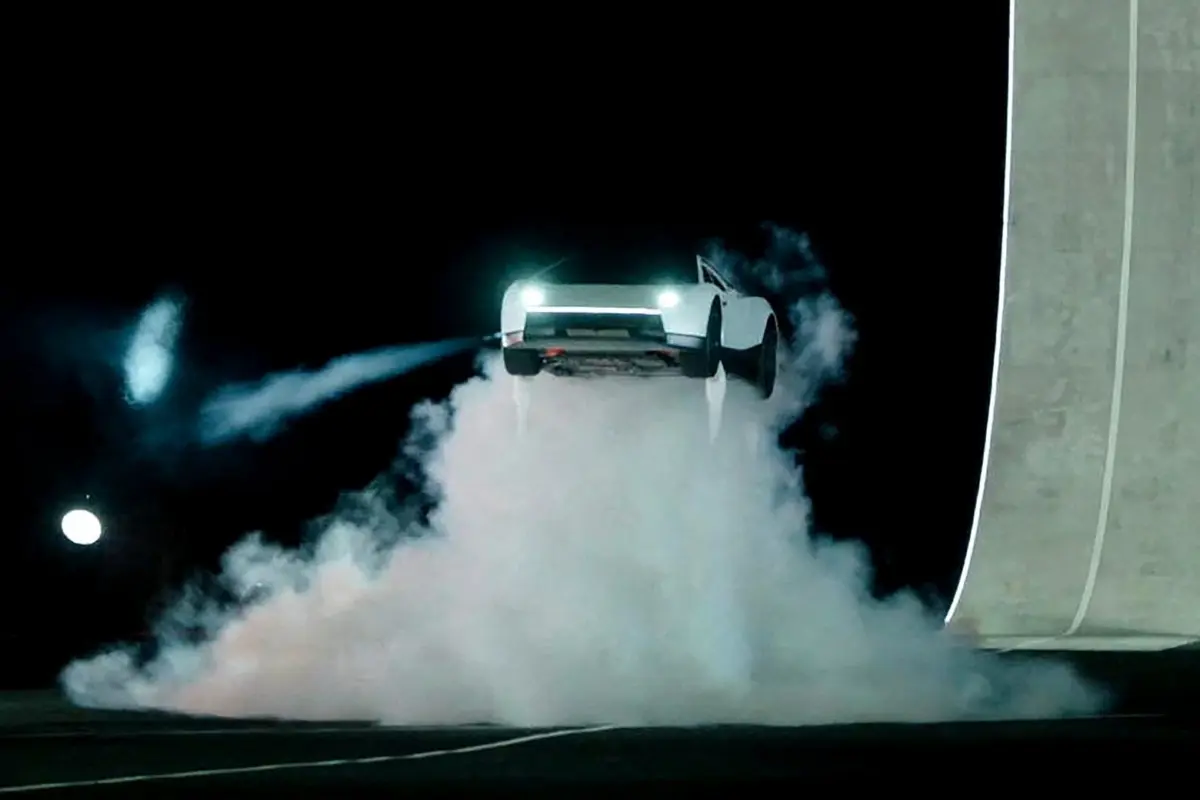
During a high-octane, livestreamed launch event in Texas, Musk debuted the long-delayed next-generation Tesla Roadster—a vehicle featuring an electric drivetrain capable of zero to sixty in 0.8 seconds and, most crucially, equipped with SpaceX-designed cold-gas thrusters that enable temporary, physics-defying bursts of flight. While the automotive press and social media rushed to dissect whether the car could genuinely fly, industry insiders recognized the vehicle for what it truly was: a Trojan horse.
The flamboyant display of aerospace technology grafted onto an electric supercar was not merely a nostalgic nod to Musk’s carnival-barker roots or a routine product rollout. Rather, it was a smoke signal. The long-anticipated sunsetting of Tesla as an independent, traditional electric vehicle manufacturer is officially underway, clearing the path for the mother of all corporate combinations: a multitrillion-dollar megamerger between Tesla and SpaceX.
As Tesla’s legacy automotive margins compress under the weight of fierce global competition, shifting government subsidies, and plateauing demand, Musk is preparing to transition the company away from consumer cars. In its place rises a hyper-valued cosmic conglomerate—one focused on autonomous Cybercabs, humanoid robotics, orbital data centers, and interplanetary infrastructure. The flying Roadster is the bridge between these worlds, marking the final chapter of Tesla the car company and the birth of a galactic mega-entity.
Detailed Chronology
The Texas Spectacle: A Masterclass in Misdirection
The unveiling of the new Roadster in Texas played out like a high-budget sci-fi action sequence. Musk took the stage, leaning into his classic showmanship by declaring, "What you see with your eyes, you will not believe!"
The vehicle itself—a striking aesthetic hybrid of a 1970s Lotus Esprit and an SR-71 Blackbird spy plane—was engineered to push the boundaries of terrestrial acceleration. Yet the main event featured a custom-built, gigantic C-shaped ramp. The Roadster ascended the curve, utilized a sophisticated downforce-generating fan system to remain clamped upside down, and then blasted free. It flipped through the air, touched down amid a cloud of compressed air, and subsequently bounded over a line of parked Tesla vehicles with another airborne roll.
While reminiscent of Musk’s 2018 PR stunt, when his original red Roadster was launched into solar orbit aboard a SpaceX Falcon Heavy rocket, this demonstration served a much more calculated purpose. By grafting SpaceX rocket technology directly onto a Tesla chassis, Musk physically and symbolically welded the two companies together on stage.
The Shift from Steering Wheels to Autonomy
Immediately following the demonstration, Musk made a telling proclamation: the new Roadster will be the last manually drivable car the company ever builds. This statement crystallizes Tesla’s strategic horizon. The immediate future belongs to the Cybercab—a dedicated robotaxi devoid of steering wheels and pedals, designed to anchor an on-demand autonomous transport fleet.
Simultaneously, the company is betting its long-term valuation on Optimus, a humanoid robot line that Musk claims will eventually drive Tesla’s market capitalization from its current $1.4 trillion to an astronomical $25 trillion. Priced at a projected $30,000 per unit, these robots are envisioned as universal laborers capable of everything from assembling Cybercabs and mowing lawns to staffing bars, caring for the elderly, and assisting in the structural colonization of the Moon and Mars.
The Financial Mechanics of a Megamerger
Wall Street has been quick to connect the dots. Prominent analysts, including Barclays’ Dan Levy, have increasingly noted that a Tesla-SpaceX merger is moving from speculative theory to a near-inevitability.
Under the anticipated structure, SpaceX would act as the acquiring entity, allowing Tesla investors to swap their shares for SpaceX stock. The resulting consolidated enterprise would command a valuation in the neighborhood of $3.5 trillion.
The financial rationale is clear. Tesla’s heavy expenditures in artificial intelligence, combined with shrinking automotive profit margins, have strained its balance sheet. By absorbing Tesla into SpaceX—an entity with unmatched capital-raising power in the public and private markets—Musk secures the financial runway necessary to fund the radical pivot toward autonomous robotaxis, humanoid robotics, and massive data-center infrastructure.
Supporting Context & Metrics
The Strains of the EV Market
To understand why Musk is eager to pivot away from traditional automotive manufacturing, one must examine the hard numbers driving Tesla’s current business model. In 2025, Tesla delivered more than 1.6 million manually drivable vehicles, generating approximately $95 billion in revenue, primarily from automotive sales alongside solar and energy storage sectors.
However, the underlying economics of mass-market EV manufacturing have soured.
- Margin Compression: Tesla has not introduced a brand-new, non-flying consumer vehicle since the Cybertruck debuted in 2019. Furthermore, the company has officially ended production of its high-margin luxury sedan (Model S) and SUV (Model X), leaving the Model 3 sedan and Model Y crossover to shoulder the entire revenue burden.
- Intensifying Competition: A massive wave of competition has emerged from Chinese automakers, particularly across European markets where political friction and Musk’s public stances have weighed on sales.
- Regulatory and Tax Headwinds: Governments have systematically phased out or eliminated the lucrative regulatory credits that historically padded Tesla’s bottom line to the tune of billions of dollars. Simultaneously, shifts in federal tax incentives have cooled the broader consumer EV market in the United States.
The Pricing Tiers of an Improbable Future
Despite the financial realities facing traditional EV production, Tesla continues to dangle futuristic carrot-and-stick propositions to its customer base. When the new Roadster was first teased in 2017, devoted buyers put down $50,000 deposits (and up to $250,000 for the limited Founder Series).
Under the newly announced architecture, Tesla has structured the Roadster across distinct trim levels with staggering price tags:
- "Performance" Trim: Retails at $50,000.
- "Thrust" Version: Commands $250,000.
- "Rocket" Trim (The "Flying" Configuration): Available only via an undisclosed, invite-only sum.
Tesla has informed reservation holders that deliveries will begin around 2028. Yet, given the historical timeline of Musk-led product rollouts, the principle of caveat emptor remains the golden rule for prospective buyers.
Official Statements & Industry Reactions
While official corporate press releases have focused on the engineering marvels of cold-gas thruster integration and downforce management, financial markets have interpreted the event through a macro-economic lens.
Wall Street analysts have pointed out that manufacturing millions of moderately priced consumer EVs is, by historical industrial standards, a grueling and low-margin business. Mainstream automotive executives have long questioned Tesla’s decision to phase out high-margin luxury segments while bypassing ultra-lucrative markets like full-sized SUVs and traditional pickup trucks.
However, Musk’s defenders and long-term investors argue that the traditional EV roadmap was always a means to an end. In this view, producing millions of consumer cars served simply to bootstrap global manufacturing expertise, supply-chain resilience, and capital reserves. The ultimate goal was never to become an electric Toyota; it was to build the industrial foundation capable of mass-producing a Cybercab every ten seconds and marching armies of Optimus units off assembly lines.
Future Outlook
As Tesla transitions into its next evolutionary phase, the horizon points toward an unprecedented convergence of terrestrial autonomy and aerospace engineering.
A combined Tesla and SpaceX entity will not merely dominate automotive and rocket transport; it aims to rewrite the infrastructure of modern technology. Beyond the terrestrial deployment of robotaxis and humanoid labor, Musk has outlined ambitious blueprints for SpaceX to launch data centers directly into orbit, harvesting uninterrupted, high-intensity solar power in the vacuum of space to fuel the relentless computational demands of artificial intelligence.
For industry observers, the Roadster event served as a nostalgic, guilty-pleasure throwback to the early days of Tesla marketing—a moment where Musk channeled his inner showman and embraced the theatricality of rocket science applied to consumer goods. Yet, beneath the spectacle of compressed-air jets and airborne rolls lies a profound corporate metamorphosis. Tesla as a standalone car company is drawing to a close, willingly dissolving into SpaceX to form a galactic mega-entity that will redefine corporate scale for generations to come.