Executive Overview
In the theater of modern tech disruption, few acts are as theatrical as an Elon Musk product unveiling. Yet, when the Tesla CEO took the stage in Texas to debut a vehicle he promised would "fly," industry veterans recognized the spectacle for what it truly was: a dazzling magic trick designed to divert attention from a monumental corporate pivot.
The long-awaited, heavily delayed new Tesla Roadster—a vehicle retrofitted with SpaceX-engineered gas thrusters capable of producing brief, airborne hops—was not merely a flashy automotive milestone. It was a Trojan horse. Beneath the hyperbole of 0-to-60 acceleration in 0.8 seconds and vertical liftoffs lies a much starker reality: traditional automobile manufacturing is no longer the primary horizon for Tesla.
As profit margins narrow, global competition intensifies, and regulatory credits dry up, Musk is signaling the twilight of Tesla as a standalone EV manufacturer. Analysts and market watchers are increasingly pointing toward an inevitable, high-stakes consolidation: the mother of all mergers, binding Tesla directly into the orbit of SpaceX. By embedding rocket science into an electric vehicle showcase, Musk is preparing public markets for a galactic corporate entity valued well north of $3.5 trillion—one that pivots decisively away from consumer cars and toward autonomous robotaxis, humanoid robotics, artificial intelligence, and space-based infrastructure.
Detailed Chronology: From the Texas Stage to the Orbit of SpaceX
The Spectacle in Texas
The evening began with signature Musk hyperbole: "What you see with your eyes, you will not believe!" On stage in Texas, Tesla rolled out its latest iteration of the Roadster—a stylistic mashup blending the geometric menace of a 1970s Lotus Esprit with the high-altitude aesthetic of an SR-71 Blackbird spy plane.
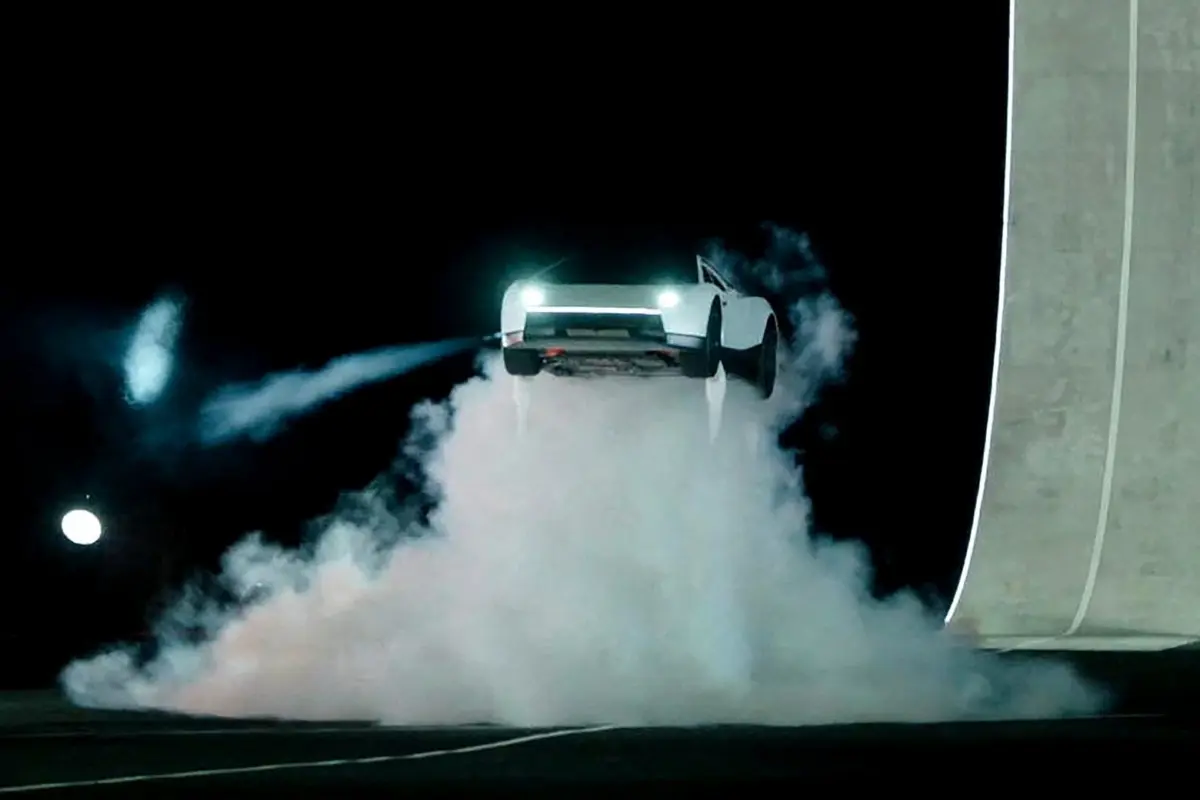
The vehicle’s spec sheet read like science fiction. Driven by an advanced electric drivetrain, it promised earth-shattering performance metrics, most notably a 0-to-60 mph time of less than a second. But the crowd’s true gasp was elicited by the promise of propulsion: the vehicle could be outfitted with SpaceX-designed cold-gas thrusters.
To demonstrate, Tesla engineers constructed a colossal C-shaped ramp. The Roadster ascended the curve, utilized a downforce-generating fan system to defy gravity while inverted, and then blasted free into a rolling, airborne hop before touching down amidst a plume of compressed air. It leapt over a line of parked Teslas with theatrical flair, instantly invoking memories of Musk’s 2018 PR masterclass when an original red Roadster was launched into a permanent solar orbit atop a Falcon Heavy rocket.
The Twilight of the Traditional EV Era
Despite the pyrotechnics, the vehicle presented in Texas was far from a conventional flying car. It was a high-performance compliance machine for a new narrative. During the event, Musk quietly dropped a bombshell: the new Roadster will be the last manually drivable car the company ever builds.
This admission marks the definitive end of Tesla’s chapter as a mass-market carmaker focused on traditional human-piloted vehicles. The horizon belongs instead to the Cybercab—a vehicle devoid of a steering wheel or pedals designed exclusively for autonomous robotaxi fleets—and Optimus, Tesla’s humanoid robot program.
According to Musk, Optimus will eventually push Tesla’s market capitalization from its current $1.4 trillion to an astronomical $25 trillion. Priced around $30,000, these robots are envisioned to relieve humanity of fundamental drudgery: assembling Cybercabs, mowing lawns, tending bars, caring for the elderly, and assisting in the eventual colonization of the moon and Mars.
The Mechanics of the Merger
Why use a consumer vehicle showcase to prominently feature aerospace technology? The answer lies in Tesla’s financial positioning. Heavy spending on artificial intelligence and autonomous systems has strained margins, stripping Tesla of its once-untouchable status as an unassailable EV juggernaut.
The Roadster extravaganza served as a structural neon sign pointing toward a Tesla-SpaceX merger. By bringing SpaceX into the fold, Musk can leverage the aerospace giant’s extraordinary capital-raising prowess on public and private markets to rescue Tesla’s shifting balance sheet. Wall Street analysts, including Barclays’ Dan Levy, have increasingly noted that such a transaction is no longer a distant theoretical concept; it is actively being whispered about as an imminent structural maneuver that could materialize before the decade’s end.
Under this projected setup, SpaceX would act as the acquiring entity, with Tesla shareholders swapping their equity for SpaceX stock. The resulting monolith would command a valuation eclipsing $3.5 trillion, granting Musk the massive financial runway required to fund data-center construction, artificial intelligence development, and futuristic projects like orbiting data hubs powered directly by solar radiation.
Supporting Context & Metrics
To understand why Musk is orchestrating this pivot, one must examine the macroeconomic headwinds facing Tesla’s traditional automotive division.
Production and Financial Realities
In 2025, Tesla delivered over 1.6 million manually drivable vehicles, generating approximately $95 billion in revenue primarily from automotive sales, alongside solar and energy storage initiatives. By all historical metrics of Detroit or Wolfsburg, this is an impressive industrial achievement. However, within the hyper-growth ethos of Silicon Valley, the legacy car business is facing diminishing returns:
- Shrinking Margins: Tesla has not introduced a clean-sheet, non-flying consumer vehicle since the Cybertruck debuted in 2019. Furthermore, the company has sunsetted production of its higher-priced luxury mainstays—the Model S sedan and Model X SUV—leaving the Model 3 and Model Y to carry the financial weight of the entire enterprise.
- Intense Global Competition: Aggressive market encroachment by Chinese EV manufacturers has heavily eroded Tesla’s European market share. This has been further exacerbated by political headwinds, including consumer backlash against Musk’s public alignments with right-wing political factions.
- The Regulatory Credit Cliff: For years, Tesla survived and thrived on billions of dollars in zero-emission regulatory credits sold to legacy automakers. As competitors ramp up their own compliant fleets, this lucrative revenue stream has dried up. Simultaneously, the rolling back or elimination of federal tax credits in the United States has suppressed overall domestic EV demand.
Reservation Models and Pre-Sales
The economic structuring of the new Roadster underscores the shift in how Tesla extracts capital from its most loyal consumer base. When the original concept was floated in 2017, believers lined up, plunking down $50,000 standard reservations (and up to $250,000 for Founder Series slots).
With the new-new Roadster, the financial tiers have scaled into absurdity:
- Performance Trim: $50,000 deposit.
- Thrust Trim: $250,000 deposit.
- Rocket Trim (The "Flying" Configuration): An undisclosed, invite-only sum.
With delivery timelines tentatively pointed toward 2028, consumers are once again reminded of the classic Musk maxim regarding lead times and deferred execution. Yet, for true believers, the cars were never the final destination; they were simply the R&D funding mechanism to build out global manufacturing lines capable of producing a Cybercab every ten seconds.
Official Statements and Industry Perspectives
Public reaction to the Texas unveiling has fractured along predictable lines between die-hard retail investors and skeptical financial analysts.
Elon Musk framed the transition during the livestream not as a retreat from automotive manufacturing, but as an elevation of purpose:
"What you see with your eyes, you will not believe! This is some crazy stuff… We are building the foundational infrastructure of human labor and interplanetary existence."
Wall Street, however, is viewing the maneuver through the lens of balance-sheet optimization and regulatory engineering. Speaking on the probability of consolidation, financial analysts note that combining SpaceX and Tesla creates a unified corporate engine capable of absorbing the immense capital burn required for artificial intelligence dominance.
Industry critics, meanwhile, point out that abandoning the affordable EV market leaves a massive vacuum that traditional and Chinese automakers are more than eager to fill. By killing off luxury models and delaying mass-market product refreshes while prioritizing speculative hardware like humanoid robots and thruster-assisted sports cars, Tesla is willingly shedding its identity as a car company to become an applied AI and aerospace conglomerate.
Future Outlook: The Galactic Mega-Entity
As Tesla transitions away from the consumer garage and toward the stars, the contours of the post-merger landscape are coming into sharper focus.
- The Consolidation Timeline: Financial markets are bracing for a formal announcement regarding a structural merger between Tesla and SpaceX. By anchoring Tesla to SpaceX’s defense and aerospace contracts, Starlink cash flows, and unmatched capital-raising power, Musk insulates his automotive operations from the brutal margin compression of the global EV market.
- Autonomous Fleets and Robotics: The human driver is officially being phased out of Tesla’s business model. Over the next five to ten years, capital expenditure will heavily favor autonomous Cybercab infrastructure and the mass deployment of Optimus labor units.
- Orbital Expansion: With concepts like space-based data centers and interplanetary transport networks moving from science fiction to active logistical planning, the combined corporate entity will transcend terrestrial economics entirely.
The Roadster showcase in Texas was many things: a nostalgic throwback to the carny-barker showmanship of early Tesla days, a masterclass in media diversion, and an impressive display of applied aerospace engineering. But above all, it was a funeral march for the traditional electric vehicle company we thought we knew. Tesla is dead; long live the galactic mega-entity.