

Executive Overview
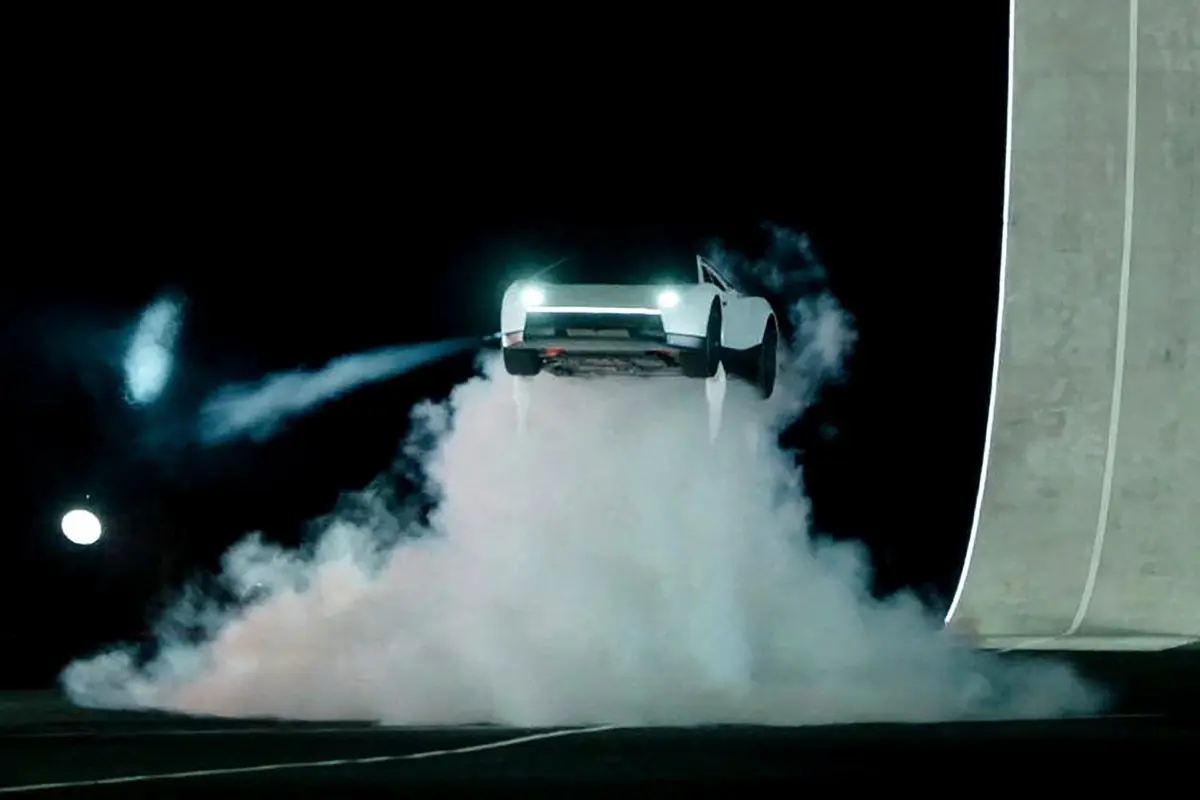
In the world of modern corporate spectacle, few figures command attention quite like Elon Musk. Speaking under the Texas evening sky, the Tesla CEO leaned into a classic piece of tech-industry showmanship to unveil a vehicle that seemed ripped straight from science fiction: the long-delayed, rocket-thruster-equipped Tesla Roadster. Promising a machine capable of accelerating from 0 to 60 mph in a breathtaking 0.8 seconds and utilizing SpaceX-derived cold-gas thrusters to achieve short bursts of actual flight, Musk left the crowd spellbound.
Yet, beneath the flash, the noise, and the theatrical plumes of compressed air, the demonstration served a deeper, highly strategic purpose. The Roadster event was not merely a long-awaited automotive update; it was a deliberate signaling mechanism.
Industry analysts and Wall Street observers are increasingly recognizing that the spectacle marks the beginning of the end for Tesla as a standalone automobile manufacturer. Instead, it paves the way for what could be the mother of all corporate combinations: a massive, multi-trillion-dollar merger uniting Tesla and SpaceX.
Facing shrinking profit margins in the traditional electric vehicle (EV) sector, rising global competition, and evaporating regulatory credits, Musk is pivoting the company away from consumer cars and toward autonomous fleets, artificial intelligence, and humanoid robotics. By embedding SpaceX technology directly into a Tesla showcase, Musk is preparing public markets for a historic consolidation—one that promises to transform the corporate landscape and redefine the limits of industrial ambition.
Detailed Chronology: From the Texas Spectacle to the Vision of Tomorrow
The Reveal: Physics-Defying Theater
The unveiling in Texas was vintage Musk. Framing the presentation with the dramatic tease, "What you see with your eyes, you will not believe!" Tesla rolled out a vehicle that aestheticized a mashup of a 1970s Lotus Esprit and the legendary SR-71 Blackbird spy plane.
To demonstrate its capabilities, Tesla engineers constructed a colossal C-shaped ramp. The Roadster ascended the incline, utilized an integrated downforce-generating fan system to remain locked upside down, and then blasted free. The car executed a brief, controlled roll—the much-anticipated "flying" element—before touching down safely amid a cloud of compressed air. It subsequently leaped over a row of parked Tesla vehicles with another airborne roll.
While the stunt was visually arresting, it paled in comparison to Musk’s 2018 masterclass in PR: launching his personal cherry-red original Roadster into a solar orbit atop a SpaceX Falcon Heavy rocket, where it continues its silent journey through the cosmos.
The Twilight of the Manually Driven Car
During the presentation, Musk dropped a monumental strategic hint: the new Roadster will be the last manually drivable vehicle Tesla ever builds.
This single declaration encapsulates the company’s existential shift. The future of Tesla’s ground transportation is not the consumer-owned sedan or SUV, but the Cybercab—a driverless, wheel-and-pedal-free vehicle designed for on-demand robotaxi fleets. Concurrently, the company is betting its long-term valuation on Optimus, a humanoid robot priced at an estimated $30,000. According to Musk, Optimus will eventually relieve humanity of mundane labor, manufacturing Cybercabs, mowing lawns, tending bars, caring for the elderly, and assisting in off-world colonization.
The Pricing and the Wait
True to form for major Musk announcements, the timeline for the Roadster stretches far into the future. Back in 2017, early believers paid $50,000 reservations (and up to $250,000 for the limited Founder Series) to secure their spots in line.
Under the new pricing structure, Tesla is asking:
- $50,000 for the "Performance" trim level.
- $250,000 for the "Thrust" version.
- An undisclosed, invite-only sum for the "Rocket" trim—the variant equipped with SpaceX rocket thrusters capable of flight.
Deliveries, according to current company projections, are slated to begin in 2028. As history has repeatedly demonstrated with Musk-led ventures, prospective buyers must abide by the golden rule of futuristic manufacturing: caveat emptor.
Supporting Context & Metrics: The Financial Pressures Behind the Pivot
To understand why Musk is orchestrating a pivot away from traditional automotive manufacturing, one must examine the shifting financial realities of Tesla’s core business model.
Production and Revenue Realities
For all its cultural cachet, Tesla remains a massive global automaker. In 2025 alone, the company delivered more than 1.6 million manually drivable vehicles, generating approximately $95 billion in revenue, supplemented by solar and energy storage operations.
+-------------------------------------------------------+
|              TESLA CORE METRICS (2025)                |
+---------------------------+---------------------------+
| Deliveries                | > 1.6 Million Vehicles    |
+---------------------------+---------------------------+
| Annual Revenue            | ~$95 Billion              |
+---------------------------+---------------------------+
| Primary Revenue Drivers   | Model 3 & Model Y         |
+---------------------------+---------------------------+
Margin Compression and Portfolio Shrinkage
Despite these robust top-line figures, Tesla’s profit margins are under severe strain. The company has not introduced an all-new, non-flying consumer vehicle since the Cybertruck debuted in 2019. Furthermore, Tesla has quietly phased out production of its high-priced luxury flagships—the Model S sedan and Model X SUV—leaving the Model 3 four-door and Model Y crossover to shoulder the entirety of the traditional automotive load.
External Market Pressures
Several macroeconomic and geopolitical headwinds have complicated Tesla’s position as the undisputed king of EVs:
- Intense Global Competition: Chinese automakers have flooded international markets with high-quality, competitively priced electric vehicles, aggressively undercutting Tesla, particularly in Europe.
- Political Backlash: Musk’s outspoken political alignments and support for right-wing factions have alienated core demographic bases in key European markets, noticeably dampening sales.
- Regulatory Windfalls Fading: For years, Tesla survived and thrived on the sale of regulatory carbon credits to legacy automakers. Governments have steadily phased out or diminished these lucrative credits.
- Weakened U.S. Demand: The rollback or elimination of federal EV tax credits has softened consumer enthusiasm across the United States.
Official Statements & Industry Analysis: The Mechanics of the Megamerger
The convergence of Tesla’s automotive plateau and SpaceX’s immense capital-raising power has fueled intense speculation across Wall Street.
Analyst Perspectives
Prominent financial voices, including Barclays analyst Dan Levy, have suggested that a consolidation between the two entities is no longer a distant theoretical exercise—it is actively being discussed as a near-term inevitability.
The mechanics of such a transaction would likely see SpaceX act as the acquiring entity, allowing Tesla investors to swap their shares for SpaceX stock. The resulting consolidated enterprise would command a staggering market valuation estimated around $3.5 trillion.
The Rationale for Unification
Why merge an electric car maker with a commercial space and launch provider? The answer lies in capital allocation and technological synergy:
- Funding the Transition: Converting Tesla’s global manufacturing footprint from consumer vehicles to autonomous Cybercabs and millions of Optimus robots requires astronomical capital expenditures. SpaceX possesses an unmatched ability to raise massive sums from the public and private equity markets.
- Artificial Intelligence and Infrastructure: Tesla is pouring billions into artificial intelligence, striving to keep pace with tech giants like OpenAI and Anthropic in data-center construction.
- Orbital Data Centers: Musk has previously floated ambitious plans for SpaceX to deploy orbital data centers powered by unfiltered solar energy—a concept that bridges Tesla’s AI ambitions with SpaceX’s launch capabilities.
Future Outlook: A Galactic Mega-Entity
Elon Musk has arrived at a pragmatic conclusion: selling millions of moderately priced consumer EVs is a low-margin, high-friction business. While automotive purists and long-time industry watchers have long questioned Tesla’s decision to abandon lucrative luxury segments or ignore traditional large SUVs and pickup trucks, Musk views the entire enterprise through a teleological lens.
To Musk, the manufacture of millions of electric vehicles—starting with the original Roadster—was never the end goal. It was a mandatory training ground designed to develop the global supply chain, manufacturing expertise, and automation capability required to pump out a Cybercab every ten seconds and march armies of Optimus robots off assembly lines.
Whether customers and investors ever strap into a rocket-thruster-equipped Roadster in 2028 is almost beside the point. The Roadster was a brilliant, nostalgic magic trick designed to distract the public while orchestrating the sunset of Tesla as we know it.
As Tesla dissolves into SpaceX to form an unprecedented galactic mega-entity, the automotive era comes to a close. In its place rises a sprawling industrial titan that threatens to make the fictional megacorporations of science fiction look modest by comparison. The brave new world of Elon Musk is no longer on the horizon—it is ready for liftoff.




