Published: February 7, 2018
Author: Rachel Leah (Enriched and Expanded Edition)
Executive Overview
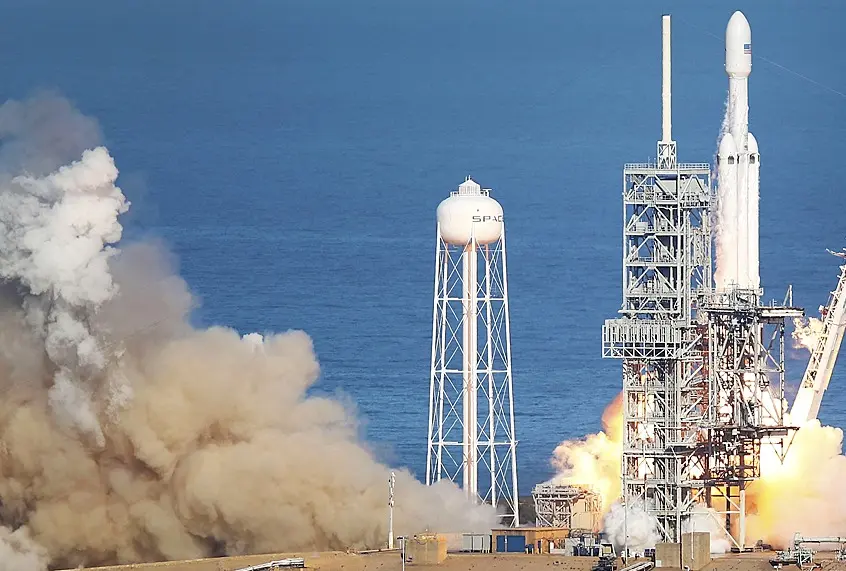
On February 6, 2018, Elon Musk’s aerospace venture, SpaceX, achieved a monumental milestone that reshaped the landscape of commercial spaceflight. Launching from historic Pad 39A at the Kennedy Space Center in Florida, the Falcon Heavy—at the time the world’s most powerful operational rocket—roared into the stratosphere. Beyond its engineering triumphs, including the synchronized, controlled landing of two reusable side boosters, the mission carried a peculiar and unforgettable payload: a cherry-red Tesla Roadster driven by a mannequin affectionately dubbed "Starman."
Broadcast globally across numerous digital and social platforms, the live-streamed footage provided breathtaking, crystal-clear views of the Earth’s unmistakable curvature as the vehicle ascended out of the atmosphere and into deep space.
For the mainstream scientific community and millions of enthralled internet users, the striking visuals served as an emphatic, high-definition mic-drop. Immediately, social media platforms erupted with triumphant declarations that the centuries-old debate—and the modern resurgence of the "flat-Earth" conspiracy—had finally been dealt a definitive blow. Yet, as history and the psychology of pseudoscientific belief suggest, expecting uncompromising visual proof to dissolve deeply entrenched conspiratorial worldviews may be a bridge too far. This article explores the staggering success of the Falcon Heavy launch, the intersection of modern meme culture with space exploration, and the resilient psychology of flat-Earth adherents in the face of undeniable ocular evidence.
Detailed Chronology: A Historic Day at Kennedy Space Center
The timeline leading up to the February 6 launch was fraught with anticipation, technological hurdles, and characteristic candor from SpaceX CEO Elon Musk. For years, aerospace analysts questioned whether the concept of strapping three Falcon 9 boosters together to generate more than 5 million pounds of thrust could succeed on its maiden voyage. Musk himself famously assigned only a 50 percent probability of success to the Falcon Heavy’s inaugural flight, noting the immense structural risks involved in staging and re-entry.
- T-Minus Hours (Morning, February 6, 2018): Crowds gathered along Florida’s Space Coast, alongside millions more tuning into live webcasts. Tension filled the air as Pad 39A—the legendary staging ground for Apollo moon missions and Space Shuttle flights—housed a rocket design unlike any seen since the Saturn V era.
- 3:45 PM EST (Liftoff): The Falcon Heavy ignited its 27 Merlin engines, lifting off with a deafening roar. The sheer magnitude of the thrust was broadcast in stunning 4K clarity across multiple camera angles, offering viewers unprecedented visual fidelity of a heavy-lift rocket punching through the troposphere.
- Post-Separation and Booster Landing: Minutes into the flight, the two side boosters separated and executed a synchronized, propulsive turnaround maneuver. Both boosters safely glided back to Cape Canaveral, landing upright in tandem—a cinematic feat that left spectators worldwide cheering.
- Orbital Insertion and "Starman": As the upper stage coasted into Earth orbit, the payload fairing peeled back to reveal the cherry-red Tesla Roadster. Equipped with cameras capturing continuous, unobstructed live feeds of the vehicle set against the backdrop of the planet, the broadcast beamed jaw-dropping vistas of a blue-and-white globe spinning serenely in the void.
[Liftoff: Kennedy Space Center]
       │
       ▼
[Booster Separation & Synchronized Landing]
       │
       ▼
[Upper Stage Coast & Fairing Deployment]
       │
       ▼
[Global Live Stream: Tesla Roadster & Earth’s Curvature]
       │
       ▼
[Public Reaction & The Great Internet Debate]
Supporting Context & Metrics: The Engineering Feat and the Digital Reaction
To understand why the Falcon Heavy launch became a cultural flashpoint, one must examine both the technical magnitude of the hardware and the viral ecosystem that amplified it.
Falcon Heavy Metrics
- Total Thrust at Liftoff: ~5.13 million pounds (roughly equivalent to eighteen 747 aircraft at full power).
- Payload Capacity to Low Earth Orbit (LEO): 63,800 kilograms (140,660 lbs).
- Payload Capacity to Mars: 16,800 kilograms (37,000 lbs).
- Core Configuration: Three modified Falcon 9 first-stage boosters functioning as a unified cluster.
While aerospace engineers celebrated the democratization and cost-reduction potential of heavy-lift reusable rocketry, the internet latched onto the artistic and existential nature of the payload. Placing a consumer automobile into heliocentric orbit while playing David Bowie’s "Space Oddity" on loop was an unmatched public relations triumph.
As the live feeds beamed back panoramic shots of the curving horizon, social media channels transformed into arenas of celebratory snark. Twitter users utilized the hashtag #Starman and #FlatEarth to mock those who deny orbital mechanics. Prominent digital creators and everyday users alike posted remarks such as:
- "Suck it, Flat Earthers."
- "Flat earth conspiracy officially debunked… with style."
- "Look at that flat earth," posted with heavy sarcasm alongside expansive wide-angle shots of our planet’s spherical limb.
Official Statements and Reactions
The scientific community, aerospace insiders, and cultural commentators quickly weighed in on the significance of the event.
Elon Musk, taking to Twitter from SpaceX Launch Control, captured the surreal nature of the moment with characteristic understatement: "View from SpaceX Launch Control. Apparently, there is a car in orbit around Earth."
NASA officials, while focused on their own Space Launch System (SLS) development, acknowledged the paradigm shift represented by commercial heavy-lift capability. The ability to return boosters to landing pads consistently lowers the barrier of entry for deep-space exploration, signaling a new era where private enterprise acts as the vanguard for interplanetary logistics.
However, the silence—or predictable pushback—from the organized flat-Earth community was equally telling. Rather than conceding defeat in the face of live, multi-angle telemetry and cinematic footage, proponents of the flat-Earth model leaned deeper into their core epistemological defensive strategies.
Future Outlook: The Resilience of Pseudoscience in the Information Age
Will the conclusive, high-definition live footage of the Falcon Heavy finally convince flat-Earth truthers to embrace reality? Historical precedent suggests an emphatic no.
To understand why, one must analyze the cognitive architecture of conspiracy theories. Flat-Earth adherents do not merely suffer from a lack of visual data; their belief system is rooted in a profound, foundational distrust of institutional authority—including NASA, global governments, academic institutions, and mainstream media.
Within the flat-Earth paradigm:
- All Visual Evidence is Fabricated: Any photograph, video stream, or live broadcast showing a spherical Earth is automatically categorized as CGI (Computer-Generated Imagery) or optical illusion.
- The "Cabal" Narrative: The vast scale of international cooperation required to maintain a "round-Earth lie" is viewed not as an impossibility, but as evidence of a powerful, shadowy conspiracy designed to hide spiritual or cosmic truths from humanity.
- Falsifiability Rejection: By definition, a true conspiracy theory is unfalsifiable. Any evidence presented to disprove the theory is simply reinterpreted as part of the conspiracy itself. Therefore, a successful SpaceX launch is not proof of orbital mechanics; to a truther, it is simply another elaborate production staged by corporate and state actors.
Looking Ahead
As humanity pushes further into the twenty-first century, the democratization of space travel will only accelerate. Upcoming missions to the Moon, commercial space stations in low Earth orbit, and crewed expeditions to Mars will continue to flood the public sphere with unprecedented imagery of our home planet.
While these visual triumphs will continue to inspire generations of scientists, engineers, and dreamers, they will likely fail to convert the most hardened skeptics. The Falcon Heavy launch of February 6, 2018, will be remembered in history books as a monumental leap for commercial rocketry—and simultaneously as a fascinating case study in the limits of physical evidence against the impenetrable armor of ideological belief.