Executive Overview
In a decisive move targeting the financial architecture supporting the Russian wartime economy and transnational cybercrime, the United Kingdom has levied sweeping economic sanctions against Cryptomus, a notoriously chameleonic cryptocurrency payment processor. Long identified by blockchain analytics firms and investigative journalists as a critical funnel for illicit funds, Cryptomus has systematically facilitated payments for ransomware gangs, international narcotics rings, darknet markets, and state-backed cyber-espionage entities.
The sanctions, formally issued by the U.K. government, freeze any assets tied to Cryptomus held within British financial institutions and legally bar UK-based enterprises from maintaining any commercial relationship with the platform. Alongside Cryptomus, the U.K. targeted a network of auxiliary virtual payment platforms, including VexPay, TokenSpot, and the Tsunami Payments service.
These measures represent a watershed moment in international financial enforcement. Unlike previous monetary penalties—such as a record-shattering CAD $176 million fine issued by Canada that ultimately proved uncollectible—sanctions possess the legal authority to dismantle the operational scaffolding of rogue payment hubs. Furthermore, legal and intelligence experts note that this marks the first known instance of a "Five Eyes" intelligence-sharing nation (Australia, Canada, New Zealand, the United Kingdom, and the United States) officially sanctioning a cryptocurrency entity incorporated within another Five Eyes jurisdiction.
Beneath its polished corporate facades and frequent rebranding efforts—most notably shifting its operations to a parallel service known as Heleket—Cryptomus has processed billions of dollars in illicit transactions. Its operations expose a sprawling ecosystem of regulatory arbitrage, phantom corporate addresses, and bizarre shell companies anchored by fake financial regulators in disputed territories.
Detailed Chronology: From Certa Payments to Heleket
The operational lifecycle of Cryptomus is a masterclass in corporate evasion. To fully understand how the platform managed to evade international law enforcement for years, it is necessary to trace its evolution through multiple corporate identities, regulatory dodging strategies, and geographical shell games.
2022–2023: Emergence and the Certa Payments Era
Emerging onto the digital landscape in 2022, the platform originally operated under the corporate banners of Certa Payments and Xeltox Enterprises. Positioned as a seemingly innocuous payment gateway for digital merchants, the platform quickly gained traction among Russian cryptocurrency exchanges and dark web vendors.
During its early phase, investigators tied Cryptomus to a Vancouver, Canada address. However, a deeper physical and digital inspection revealed that this address was shared with dozens of other foreign currency dealers and money transfer businesses—none of which maintained an actual physical presence at the location. The office served as little more than a paper drop, a common tactic used to project Western regulatory legitimacy while maintaining absolute anonymity for the individuals pulling the strings.
2024: The Mask Slips
By late 2024, investigative reporting by security researcher Brian Krebs and blockchain intelligence units exposed the deeply illicit nature of Cryptomus. Investigations revealed that the platform had established itself as the premier payment processing pipeline for dozens of Russian websites peddling cybercrime-as-a-service, ransomware execution frameworks, and illicit cash-out services that converted digital assets directly into Russian fiat currency.
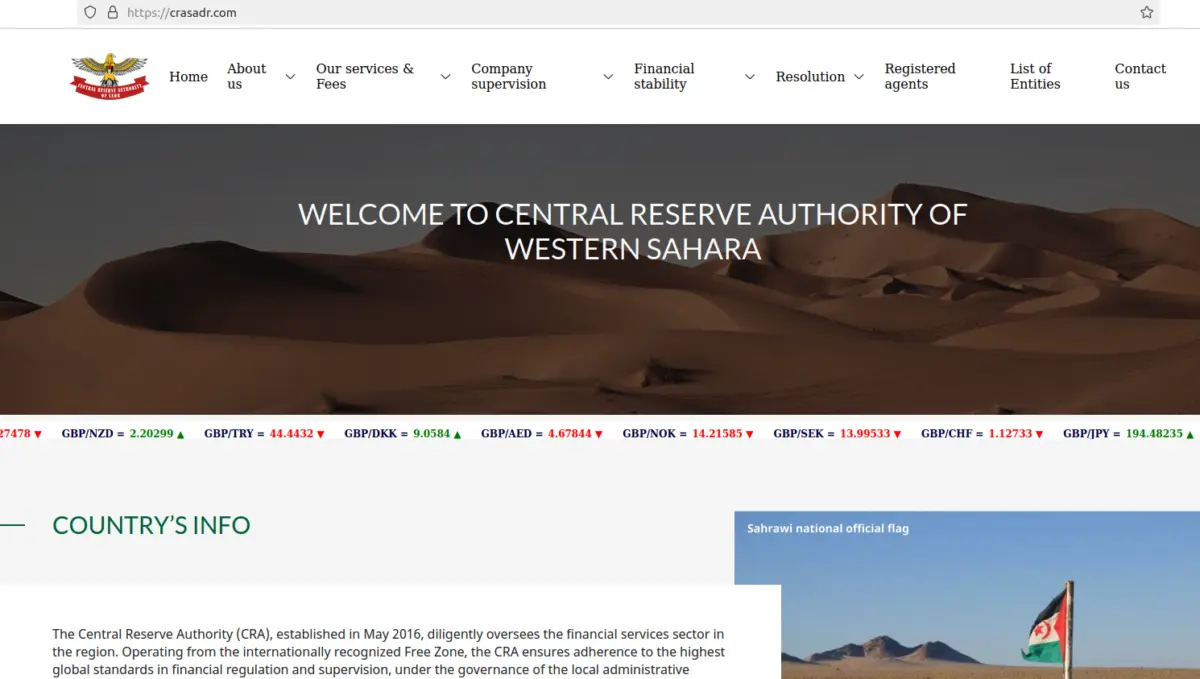
Investigations into the corporate ownership of Certa Payments uncovered a bizarre paper trail. The sole shareholder of the parent company was identified as a 25-year-old Ukrainian woman who simultaneously managed a web of interconnected shell corporations. Among these was the WS Management and Advisory Corporation, an entity that audaciously billed itself as the sovereign regulatory body exclusively overseeing licenses for cryptocurrency, foreign exchange, and online gaming businesses incorporated in the disputed region of Western Sahara.
Through websites like crasadr.com—the portal for the so-called Central Reserve Authority of Western Sahara—the network issued its own self-authenticated financial licenses. This fabricated regulatory framework granted Cryptomus the superficial authority to operate globally, exploiting legal grey areas across international jurisdictions.

2025: The Canadian Crackdown and the Birth of Heleket
The pressure on Cryptomus intensified dramatically in October 2025, when Canadian regulatory authorities levied a historic CAD $176 million fine against the platform for flagrant anti-money laundering (AML) violations.
Faced with a crippling financial penalty, Cryptomus executed a classic chameleonic maneuver. Rather than paying the fine or complying with international compliance standards, the platform appealed the penalty, drastically scaled back operations under its primary brand, and launched a parallel service dubbed Heleket. While Cryptomus temporarily instituted stricter "Know Your Customer" (KYC) protocols to throw regulators off its scent, Heleket stepped in seamlessly to process unverified, high-risk cryptocurrency transactions.
Support agents on encrypted messaging apps like Telegram routinely denied any formal affiliation between Cryptomus and Heleket, despite blockchain telemetry proving that Heleket was explicitly designed to absorb Cryptomus’s illicit client base without interruption.
October 2026: The U.K. Drops the Hammer
The cat-and-mouse game came to a crashing halt on October 8, 2026, when the United Kingdom formally issued its asset-freezing economic sanctions. Within hours of the announcement, user support bots for Cryptomus and Heleket on Telegram flooded with automated error messages, informing panicked users that the platform was suddenly unable to process transactions. The swift operational paralysis underscored the profound difference between monetary fines and targeted geopolitical sanctions.
Supporting Context & Metrics: The Scale of Illicit Processing
The financial footprint of Cryptomus and its successor, Heleket, is staggering. Independent forensic blockchain analyses conducted by industry leaders Chainalysis and TRM Labs have mapped the staggering volume of criminal capital that coursed through the platform’s veins.
TRM Labs Volume Analysis
In an April 2026 intelligence report, TRM Labs revealed that Cryptomus had processed more than $7 billion in cumulative transactions since its founding in 2022. While a portion of this volume represented legitimate e-commerce, a disproportionate percentage was tied directly to catastrophic criminal enterprises. TRM’s ledger analysis identified transactional links between Cryptomus and:
- Global vendors of Child Sexual Abuse Material (CSAM).
- State-sponsored and decentralized terrorist financing networks.
- International human trafficking rings.
- Prolific ransomware syndicates cashing out extortion demands.
Chainalysis Infrastructure Assessment
Following the U.K. sanctions announcement on October 8, 2026, Chainalysis published an extensive data breakdown illustrating how Cryptomus served as the beating heart of Russia’s illicit financial evasion network.
According to Chainalysis telemetry, Cryptomus and Heleket evolved into primary payment hubs that eclipsed many traditional cryptocurrency mixers in total illicit funds received across tracked criminal categories. The data highlighted a dramatic surge in activity, revealing that the number of illicit counterparties utilizing the platform skyrocketed to more than 900 unique malicious entities in a single month during late 2025.
By functioning as an unregulated bridge between Western digital assets and Russian financial institutions, Cryptomus played an instrumental role in insulating the Russian economy from international sanctions imposed in the wake of its geopolitical conflicts.
Official Statements and Expert Analysis
The international enforcement community and prominent blockchain investigators have lauded the U.K.’s actions, emphasizing the crucial distinction between punitive fines and asset-crippling sanctions.

Richard Sanders on the Limits of Fines vs. Sanctions
Richard Sanders, a veteran blockchain analyst and investigator who spent months mapping Cryptomus’s Byzantine infrastructure and interacting directly with its merchant base, highlighted why the U.K. sanctions represent a fatal blow where Canada’s fine fell short.
"A fine doesn’t stop a cryptocurrency payment processor from processing payments," Sanders wrote in a public analysis shared on professional networks. "Sanctions kill the operation. The distinction matters."
Sanders noted that because Canada’s CAD $176 million fine was levied against an entity adept at hiding behind shell companies and jurisdictional loopholes, it was effectively uncollectible. Cryptomus simply absorbed the financial hit on paper while quietly migrating its processing power to Heleket. By contrast, U.K. asset freezes and prohibitions on British corporate engagement cut off access to global liquidity pools and primary banking rails, rendering the platform toxic to any institution wishing to maintain compliance with Western law.
Furthermore, Sanders pointed out the unprecedented diplomatic nature of the enforcement action. Never before had a Five Eyes member state formally sanctioned a cryptocurrency enterprise incorporated within the sovereign borders of a fellow Five Eyes partner nation, exposing severe regulatory blind spots in international corporate registration procedures.
Chainalysis on Wartime Economic Infrastructure
In its official advisory, Chainalysis emphasized that the sanctions against Cryptomus, VexPay, TokenSpot, and Tsunami Payments are indicative of a broader strategic shift by Western governments. Rather than merely chasing individual ransomware wallets or darknet vendors, regulators are systematically dismantling the overarching infrastructure that allows illicit cash to be laundered into sovereign financial systems.
"Cryptomus and Heleket have emerged as major payment hubs for illicit activity," Chainalysis stated. "Targeting these payment processors is essential to dismantling the broader infrastructure supporting the wartime economy and global cybercrime syndicates."
Future Outlook: Whack-a-Mole in the Decentralized Underworld
The swift incapacitation of Cryptomus and Heleket following the U.K. sanctions demonstrates the immense power of coordinated governmental intervention, yet it also highlights the persistent challenges of policing decentralized finance (DeFi).
Cybercrime analysts anticipate that the operators behind Cryptomus will likely attempt yet another rebranding cycle, migrating their infrastructure to more permissive jurisdictions or further obfuscating their transaction layers through advanced decentralized exchange (DEX) protocols and cross-chain bridges. However, the U.K.’s willingness to target auxiliary platforms like VexPay, TokenSpot, and Tsunami Payments signals a more aggressive, comprehensive enforcement posture.
The downfall of Cryptomus serves as a cautionary tale for the crypto-processing sector. It proves that while shell companies, fake regulatory bodies in disputed territories, and rapid corporate name changes can buy time, they cannot indefinitely withstand the full weight of international intelligence sharing and asset-freezing sanctions. As regulatory nets tighten across the globe, the era of frictionless, state-backed cybercrime payment processing is facing its most formidable existential threat to date.