Executive Overview
In a decisive maneuver aimed at choking off the financial lifelines supporting the Russian wartime economy and transnational cybercrime, the United Kingdom has issued sweeping economic sanctions against Cryptomus. Known for its ability to rapidly morph its identity, Cryptomus is a high-volume cryptocurrency payment platform that blockchain intelligence firms and security experts have linked directly to ransomware laundering, narcotics trafficking, darknet market operations, fraud schemes, and specialized cybercrime-as-a-service providers.
Announced on October 8, the U.K. Foreign, Commonwealth & Development Office targeting freezes any assets held by Cryptomus within British financial institutions and legally bars all U.K. companies and citizens from engaging in business, virtual or otherwise, with the platform. Alongside Cryptomus, the U.K. government also clamped down on a cluster of associated virtual payment conduits, including VexPay, TokenSpot, and the Tsunami Payments service.
The sanctions represent a critical escalation in Western enforcement efforts against platforms designed to help Russian entities bypass international financial restrictions. While previous penalties—such as a record CAD $176 million administrative fine levied by Canada in late 2025—focused on anti-money laundering (AML) violations, security analysts emphasize that financial penalties alone rarely stop rogue payment processors. By upgrading the enforcement mechanism to formal economic sanctions, the U.K. has effectively criminalized the platform’s operations, creating an existential barrier that experts argue is the only reliable method to permanently dismantle transnational cybercrime infrastructure.
Detailed Chronology: From Certa Payments to Heleket
The trajectory of Cryptomus is a masterclass in corporate camouflage and regulatory evasion. To understand how the platform operated with impunity for years, one must trace its evolution through multiple corporate identities, geographic shell games, and strategic pivots designed to evade law enforcement.
Emergence and Early Growth (2022–2024)
Cryptomus emerged onto the digital underground in 2022, initially operating under names such as Certa Payments and Xeltox Enterprises. Promoted heavily across Russian-language cybercrime forums and Telegram channels, the platform quickly established itself as a preferred checkout gateway for illicit websites.
During its formative years, Cryptomus relied on a veneer of legitimacy, registering corporate entities in jurisdictions known for lax oversight. Notably, investigative reporting by Krebs on Security revealed that Cryptomus shared a modest Vancouver, Canada address with dozens of other foreign currency dealers and money transfer businesses—none of which maintained any physical presence at the location. Despite these glaring red flags, the platform processed billions of dollars in digital assets largely unchecked.
The Canadian Crackdown and the Birth of "Heleket" (2025)
By late 2024 and mid-2025, the true scale of Cryptomus’s operations had drawn intense scrutiny from global blockchain analytics firms and financial watchdogs. In October 2025, Canada’s financial intelligence and regulatory bodies dropped a hammer on the platform, slapping it with a record-breaking CAD $176 million fine for severe, systematic anti-money laundering violations.
Rather than folding, Cryptomus adopted a chameleonic survival strategy. The platform appealed the penalty while simultaneously launching a parallel, no-KYC (Know Your Customer) service christened "Heleket."
Blockchain forensics demonstrated that while Cryptomus experienced a temporary dip in volume after attempting to implement superficial compliance measures, Heleket immediately stepped into the breach. Heleket absorbed the unregulated, high-risk traffic, continuing to process massive volumes of funds for Russian exchanges and cybercrime syndicates with zero friction. Even as late as October 2026, automated support agents on Heleket’s Telegram channels brazenly denied any corporate affiliation with Cryptomus, despite overwhelming technical evidence proving they were run by the exact same operators.
The U.K. Sanctions Hammer (October 2026)
The cat-and-mouse game came to a head on October 8, 2026, when the U.K. government formally designated Cryptomus, its aliases, and its spin-off infrastructure under Russian sanctions regulations. The immediate impact was palpable: within hours of the announcement, user support bots for Cryptomus on Telegram were flooded with user inquiries, abruptly responding that the platform was suddenly and indefinitely unable to process transactions.
Supporting Context & Metrics: The Scale of Illicit Finance
To grasp why Western governments felt compelled to target Cryptomus and its sister services, one must examine the staggering volume of illicit capital that coursed through its digital arteries.

Multibillion-Dollar Volume
In April 2026, leading blockchain intelligence firm TRM Labs published a comprehensive risk assessment revealing that Cryptomus had processed more than $7 billion in cumulative transactions since its inception in 2022. While legitimate merchants occasionally utilized the platform due to its low fees and integration ease, a disproportionate percentage of this volume was tied directly to high-harm criminal enterprises, including:
- Ransomware-as-a-service (RaaS) extortion payouts.
- Vendors distributing child sexual abuse material (CSAM).
- Terrorist financing networks.
- Global human trafficking operations.
Outstripping Traditional Crypto Mixers
Data compiled by Chainalysis underscores the unprecedented scale at which Cryptomus and Heleket operated compared to traditional money-laundering tools. According to Chainalysis’s October 8 briefing, these platforms evolved into primary payment hubs for the Russian wartime economy, effectively replacing traditional crypto mixing services.
"Together, these services received more illicit funds across tracked categories than the mixers in our dataset, and the number of illicit counterparties surged to more than 900 in a single month in late 2025," Chainalysis reported.
The shift highlighted a dangerous evolution in cybercrime infrastructure: rather than using decentralized or protocol-based privacy mixers (which have faced increasing sanctions and software blocklists), criminal syndicates increasingly routed their funds through centralized, pseudo-legitimate payment processors that offered automated fiat off-ramps directly into Russian banking networks.
Official Statements and Expert Analysis
The international response to the U.K. sanctions underscores a profound shift in how allied intelligence and regulatory agencies view cryptocurrency payment processors. Experts agree that while fines are a useful warning shot, only targeted economic sanctions possess the legal teeth required to neutralize borderless criminal entities.
The Significance of Sanctions vs. Fines
Richard Sanders, a veteran blockchain analyst and investigator who spent months dissecting Cryptomus’s transaction networks and interacting undercover with its customer base, pointed out the stark structural difference between Canada’s earlier financial penalty and the U.K.’s new sanctions.
Writing on LinkedIn following the announcement, Sanders noted:
"A fine doesn’t stop a cryptocurrency payment processor from processing payments. Sanctions kill the operation. The distinction matters."
Sanders explained that because Canada’s CAD $176 million fine was levied against shell companies operating without recoverable domestic assets, the penalty was ultimately uncollectible. Cryptomus simply ignored the regulatory judgment, appealed through phantom legal teams, and launched Heleket. By contrast, U.K. sanctions disrupt banking relationships, compel global cloud and infrastructure providers to drop services, and legally compel international exchanges to freeze any associated liquidity pools.
A Historic "Five Eyes" Milestone
Furthermore, Sanders highlighted a groundbreaking geopolitical precedent set by the U.K. action: it marks the first known instance of a "Five Eyes" nation (comprising Australia, Canada, New Zealand, the United Kingdom, and the United States) officially sanctioning a cryptocurrency operation whose foundational corporate wrappers were anchored inside another Five Eyes jurisdiction (Canada). This unprecedented cross-border enforcement signals that allied nations are no longer willing to tolerate jurisdictional arbitrage within their own alliance blocks.
The Phantom Regulator: Unmasking the Western Sahara Connection
Perhaps the most bizarre and revealing aspect of Cryptomus’s operations is the mechanism by which it originally legitimized its financial services. How does a rogue payment processor acquire the veneer of regulatory compliance while operating shadow networks for Russian banks and darknet drug vendors?

The answer lies in a sprawling web of fake financial institutions overseen by a phony regulatory body positioned in a territory largely unrecognized as a sovereign nation.
The Certa Payments Ownership Structure
An exhaustive 2024 investigation into Cryptomus’s corporate parent, Certa Payments, uncovered that its sole shareholder was a 25-year-old Ukrainian woman. Alongside Cryptomus, this individual controlled several other shell entities, including the WS Management and Advisory Corporation.
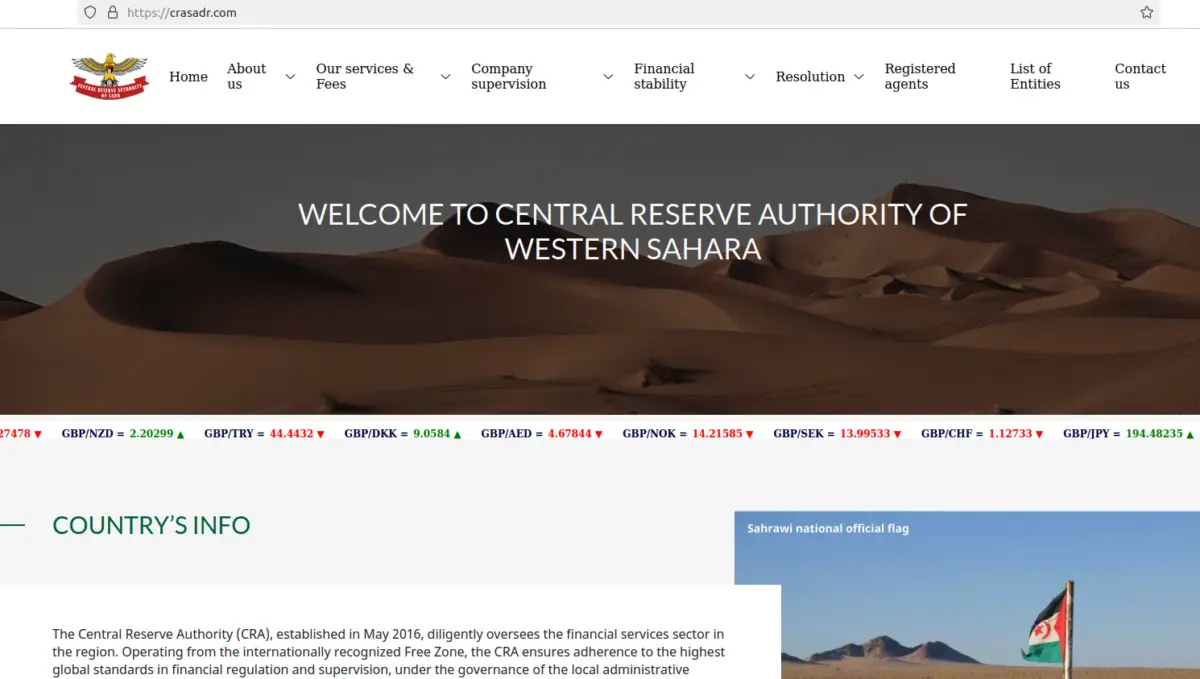
WS Management billed itself on paper as an official, exclusive regulatory body responsible for issuing licenses to cryptocurrency platforms, foreign exchange (Forex) brokers, and online gaming operators. However, its jurisdiction of authority was claimed to be the Western Sahara—a disputed territory in northwest Africa characterized by minimal international governmental oversight and virtually non-existent financial regulation.
The Digital Footprint of a Scam Regulator
Investigators traced the infrastructure of this phantom regulatory apparatus to digital breadcrumbs left across shared web servers:
- The primary regulatory portal—
crasadr.com, representing the purported Central Reserve Authority of Western Sahara—publicly listed the entities that had been granted official licenses to operate global crypto and Forex businesses, prominently featuring Cryptomus affiliates. - Technical analysis revealed that one of Certa Payments’ former operational domains (
certa.website) shared an identical server housing 12 other distinct domains, includingrasd-state.ws, which served as the propaganda and administrative hub for the fake Western Sahara central banking authority.
By inventing a regulatory framework anchored in a disputed geopolitical zone, the architects of Cryptomus engineered a synthetic shield of legitimacy. They could present "official" registration documents to partner banks, payment aggregators, and wary merchants, all while operating entirely outside the reach of legitimate international banking watchdogs.
Future Outlook: The Road Ahead for Crypto Enforcement
The joint pressure applied by Canadian regulatory fines, TRM Labs and Chainalysis forensic tracking, and finally the definitive U.K. economic sanctions marks a turning point in the global effort to police the intersection of cryptocurrency and state-sponsored geopolitical evasion.
While the immediate operational capability of Cryptomus and Heleket has been severely degraded—as evidenced by unresponsive Telegram support bots and frozen transaction queues—law enforcement agencies remain realistic about the resilience of underground cybercrime networks. Historically, when a major payment hub like Cryptomus is targeted, its operators frequently rebrand, fragment their liquidity, or migrate underlying server infrastructure to non-cooperative jurisdictions.
Nevertheless, the U.K.’s actions establish a vital blueprint for future multi-agency interventions. By stripping away the corporate illusions, exposing the fake regulatory bodies of disputed territories like Western Sahara, and weaponizing economic sanctions rather than relying solely on uncollectible monetary fines, Western allies are systematically dismantling the financial architecture that sustains modern cybercrime and fuels the Russian war machine.
As blockchain analysts continue to map out the secondary spin-offs attempting to inherit Cryptomus’s illicit market share, the message to the crypto underground is unmistakable: the era of unchecked, chameleonic payment processors operating with impunity across allied borders is rapidly drawing to a close.