Executive Overview
In a decisive escalation against international financial crime, the United Kingdom has levied sweeping economic sanctions against Cryptomus, a notoriously adaptable cryptocurrency payment platform. Regulators and blockchain intelligence agencies have identified Cryptomus as a critical nexus for illicit finance, channeling funds for global ransomware syndicates, narcotics trafficking networks, darknet marketplaces, and specialized cybercrime services. Crucially, investigators point out that the platform’s continuous flow of illicit capital has actively assisted the Russian Federation in circumventing Western financial restrictions tied to its wartime economy.
The sanctions, formally issued by the U.K. government on October 8, freeze any assets linked to Cryptomus held within British financial institutions and legally bar UK-based entities and individuals from conducting any commercial transactions with the platform, whether virtual or traditional. Alongside Cryptomus, the U.K. targeted a broader ecosystem of virtual payment conduits, including VexPay, TokenSpot, and the Tsunami Payments service.
Cryptomus has proven to be a master of corporate camouflage. Emerging in 2022 and operating previously under aliases such as Certa Payments and Xeltox Enterprises, the platform routinely pivots its infrastructure to evade law enforcement. Most recently, following a record-shattering regulatory penalty in Canada, the network birthed a parallel service known as Heleket.
Blockchain analytics firms, including Chainalysis and TRM Labs, estimate that Cryptomus and its spin-offs have processed billions of dollars in illicit transactions, serving as the financial backbone for thousands of bad actors worldwide. Industry experts view the U.K.’s intervention as a watershed moment: unlike monetary fines, which illicit actors often shrug off or ignore, comprehensive state sanctions possess the extraterritorial teeth required to systematically dismantle core digital crime infrastructure.
Detailed Chronology: The Evolution and Evasion of Cryptomus
The lifecycle of Cryptomus is a masterclass in modern corporate shell games, illustrating how illicit cryptocurrency platforms exploit regulatory blind spots, shell companies, and jurisdictional friction.
2022: Emergence and Early Operations
Cryptomus burst onto the digital asset landscape in 2022, aggressively marketing itself as an e-commerce payment gateway. However, behind its slick user interface lay an infrastructure explicitly tailored to cater to high-risk and criminal enterprises. Functioning initially under corporate entities such as Certa Payments and Xeltox Enterprises, the platform quickly became the payment processor of choice for dozens of Russian cryptocurrency exchanges and underground websites hawking cybercrime services, hacking tools, and stolen data.
2024–2025: Regulatory Scrutiny and the Canadian Crackdown
As transaction volumes scaled into the billions, independent investigations—most notably a December 2024 expose by Krebs on Security—exposed the deep plumbing connecting Cryptomus to traditional Russian banking channels and underground syndicates.
The platform’s corporate facade was similarly murky. Investigators discovered that Cryptomus shared a nominal Vancouver, Canada address with dozens of other foreign currency dealers and money transfer businesses—none of which maintained an actual physical presence at the location. The sole shareholder of Cryptomus’s parent company, Certa Payments, was identified as a 25-year-old Ukrainian national who simultaneously headed several other corporate entities, including an organization purporting to regulate financial entities in the disputed territory of Western Sahara.
In late 2025, Canadian authorities brought the hammer down, levying a historic CAD $176 million fine against Cryptomus for sweeping anti-money laundering (AML) and know-your-customer (KYC) violations.

The Birth of Heleket
Facing a nine-figure penalty, Cryptomus engaged in classic chameleonic maneuvers. While formally appealing the Canadian fine, the platform launched a parallel service dubbed Heleket. According to blockchain intelligence reports, when Cryptomus briefly instituted stricter KYC requirements that cratered its mainstream transaction volumes, Heleket stepped in seamlessly to maintain uninterrupted, no-KYC payment processing for the platform’s criminal clientele.
Support agents operating on encrypted messaging apps like Telegram brazenly denied any connection between Cryptomus and Heleket—even as internal routing, infrastructure, and user bases overlapped entirely.
October 2026: The U.K. Drops the Hammer
Recognizing that administrative fines imposed by nations like Canada were effectively uncollectible and failed to halt operations, the United Kingdom intervened on October 8, 2026. By placing Cryptomus, Heleket, VexPay, TokenSpot, and Tsunami Payments under strict economic sanctions, London cut the platforms off from the formal British financial system and criminalized any material support from UK entities. The immediate impact was palpable: within hours of the sanctions announcement, automated support bots for Cryptomus and Heleket on Telegram notified inquiring users that the platforms were suddenly and inexplicably unable to process transactions.
Supporting Context & Metrics: The Scale of Illicit Enterprise
The sheer volume of capital moving through Cryptomus and its derivatives highlights the scale to which modern cybercrime relies on specialized, crypto-enabled payment processors. Independent blockchain forensics organizations have mapped out staggering figures regarding the platform’s operations.
- Cumulative Volume: In April 2026, blockchain intelligence firm TRM Labs published data showing that Cryptomus had processed more than $7 billion in transactions since its inception in 2022. This staggering sum encompassed not only sanctions evasion funds for Russian entities but also revenue tied to child sexual abuse material (CSAM) vendors, international terrorist financing networks, and human trafficking operations.
- Surge in Illicit Counterparties: According to a telemetry report published by Chainalysis on October 8, 2026, Cryptomus and Heleket rapidly evolved into premier payment hubs for high-risk assets. Chainalysis noted that the services received more illicit funds across tracked categories than traditional cryptocurrency "mixers" in their dataset. Most alarming was the velocity of the abuse: the number of active illicit counterparties interacting with the platform surged to more than 900 in a single month during late 2025.
- The "Five Eyes" Precedent: Blockchain analyst and investigator Richard Sanders, who spent months mapping Cryptomus’s intricate network infrastructure and transacting with its user base, highlighted the unique geopolitical milestone represented by the U.K. action. For the first time, a "Five Eyes" intelligence-sharing nation (comprising Australia, Canada, New Zealand, the United Kingdom, and the United States) has formally sanctioned a cryptocurrency operation tied to a fellow Five Eyes jurisdiction (Canada).
Official Statements and Industry Analysis
The international cybersecurity and blockchain analytics community has rallied behind the U.K.’s sanctions, viewing them as a necessary evolution in combating digital crime.
Richard Sanders emphasized the fundamental difference between regulatory fines and state-level economic sanctions when dealing with transnational, pseudonymous crypto operations:
"A fine doesn’t stop a cryptocurrency payment processor from processing payments. Sanctions kill the operation. The distinction matters."
Sanders’ analysis addresses the core weakness of traditional enforcement mechanisms. While a $176 million fine issued by Canada serves as a strong deterrent on paper, rogue payment processors operating primarily in the digital realm can easily ignore domestic debts, shift branding, or abandon shell companies. Sanctions, conversely, create global legal liabilities, forcing international exchanges, liquidity providers, and financial partners to instantly sever ties or risk secondary sanctions and criminal prosecution.
The analytical team at Chainalysis echoed these sentiments in their official blog post addressing the October 8 sanctions:

"Cryptomus and Heleket have emerged as major payment hubs for illicit activity. The U.K. sanctions target the broader infrastructure supporting Russia’s wartime economy, cutting off vital digital pipelines that have allowed bad actors to launder billions outside the reach of traditional banking controls."
The Phantom Regulators: Tracing the Authority of Cryptomus
One of the most bizarre and illustrative aspects of the Cryptomus investigation is the origin of its supposed regulatory legitimacy. How does an obscure crypto platform processing billions of dollars in illicit funds secure the legal paperwork necessary to operate?
According to structural mapping conducted during the December 2024 Krebs on Security investigation, the sole shareholder of Cryptomus’s parent firm, Certa Payments, was a 25-year-old Ukrainian woman. Alongside Cryptomus, she directed several other corporate entities, including the WS Management and Advisory Corporation.
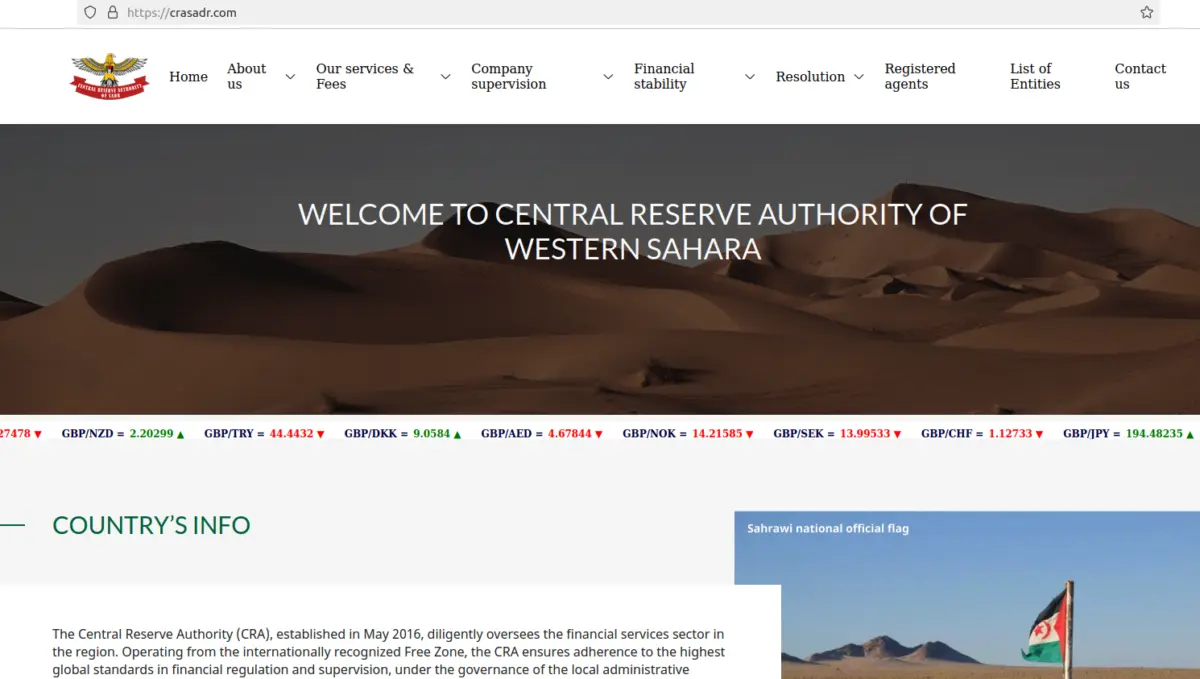
WS Management and Advisory Corporation marketed itself as an exclusive, official regulatory body responsible for issuing licenses to cryptocurrency exchanges, foreign exchange brokers, and online gaming businesses incorporated within the Western Sahara—a disputed region in northwest Africa not widely recognized as a sovereign nation.
The regulatory body operated through a web of dubious digital infrastructure:
- Its primary portal,
crasadr.com, functioned as the website of the "Central Reserve Authority of the Western Sahara," publishing lists of corporate entities supposedly vetted and authorized to provide global financial services. - Technical domain analysis revealed that one of Certa Payments’ former web properties (
certa.website) shared a server housing 12 other domains, includingrasd-state.ws, a mirror site tied directly to the self-declared reserve authority of the disputed territory.
This administrative fiction allowed Cryptomus to project an aura of formal compliance to prospective business partners and lower-tier merchants, masking an unregulated, criminal-friendly payment engine behind a smokescreen of phony bureaucratic authority.
Future Outlook: The Crackdown on Crypto-Facilitated Sanctions Evasion
The U.K.’s decisive targeting of Cryptomus, Heleket, VexPay, TokenSpot, and Tsunami Payments marks a major turning point in how Western governments police the intersection of cryptocurrency and geopolitical conflict. As traditional financial institutions tighten compliance and deploy advanced transaction-monitoring tools, state-backed threat actors and transnational criminal syndicates have increasingly turned to specialized, borderless crypto payment processors to maintain liquidity.
However, the rapid collapse of Cryptomus’s Telegram support bots and the freezing of its operational pipelines following the October 8 sanctions demonstrate that these platforms possess a fatal vulnerability: reliance on global digital infrastructure and liquidity networks that ultimately intersect with regulated jurisdictions.
Moving forward, intelligence and compliance experts expect regulatory bodies across the Five Eyes alliance and the European Union to adopt a synchronized approach. By moving beyond monetary penalties and deploying hard economic sanctions against chameleonic crypto hubs, international law enforcement is sending an unmistakable message: rebranding, shell companies, and phantom regulatory authorities will no longer shield facilitators of illicit finance from the full weight of global state power.