Executive Overview
In a decisive escalation against the financial infrastructure supporting the Russian wartime economy and transnational cybercrime, the United Kingdom has levied sweeping economic sanctions against Cryptomus. Known colloquially as a "chameleonic" cryptocurrency platform, Cryptomus has long operated as a digital haven for ransomware operators, drug traffickers, darknet market vendors, and fraud syndicates.
The U.K. Treasury’s sanctions—enacted on October 8—freeze any assets held by Cryptomus within British financial institutions and legally prohibit U.K.-based entities from providing commercial, virtual, or operational services to the platform. Alongside Cryptomus, the British government targeted a network of auxiliary virtual payment processors, including VexPay, TokenSpot, and the Tsunami Payments service.
According to leading blockchain intelligence firms and independent investigators, Cryptomus has evolved from a boutique payment processor into a multi-billion-dollar juggernaut. Since its inception in 2022, the platform has processed upwards of $7 billion in transactions, seamlessly bridging the gap between illicit digital assets and traditional fiat currency. By continuously mutating its brand identity—rebranding sequentially as Certa Payments, Xeltox Enterprises, and, most recently, Heleket—the platform has attempted to outpace global regulatory enforcement.
The U.K. action marks a pivotal turning point in international crypto compliance. Unlike previous monetary fines issued by jurisdictions like Canada—which critics argue lacked the teeth to halt operations—these sanctions represent a hard legal blockade. Furthermore, national security experts note that this is the first known instance of a "Five Eyes" nation (Australia, Canada, New Zealand, the United Kingdom, and the United States) directly sanctioning a cryptocurrency entity incorporated within another Five Eyes jurisdiction, signaling unprecedented cross-border intelligence sharing and regulatory alignment.
Detailed Chronology: From Certa Payments to Heleket
The operational history of Cryptomus is a masterclass in corporate evasion, deliberate obfuscation, and regulatory arbitrage.
2022: Emergence and Early Operations
Cryptomus burst onto the digital landscape in 2022, initially incorporating under the corporate moniker Certa Payments (and later utilizing Xeltox Enterprises). Positioning itself as a standard merchant of digital asset payment gateways, the platform quickly established deep ties within the Russian underground economy. It became an indispensable bridge for dozens of Russian cryptocurrency exchanges and websites hawking cybercrime-as-a-service packages.
During its formative years, the platform shared a registered corporate address in Vancouver, British Columbia, with dozens of other foreign currency dealers and money-transfer businesses. Subsequent physical investigations revealed that none of these entities maintained an actual operational footprint at the location, pointing to a classic shell-company framework designed to project false legitimacy.
October 2025: Canada’s Record Fine and the Birth of Heleket
By late 2025, international scrutiny reached a boiling point. Canadian regulatory bodies cracked down on the platform, slapping Cryptomus with a historic CAD $176 million fine for egregious anti-money laundering (AML) and know-your-customer (KYC) violations.
Faced with mounting pressure and a cratering transaction volume caused by newly instituted KYC compliance checks, the platform’s leadership pivoted rather than complied. Cryptomus appealed the Canadian financial penalty while simultaneously launching a parallel, no-KYC service dubbed "Heleket." Operating largely out of the spotlight initially, Heleket absorbed the illicit volume shed by its parent platform, ensuring that the flow of funds to Russian and darknet actors remained uninterrupted. Telegram support bots for Heleket brazenly denied any structural affiliation with Cryptomus, even as blockchain tracing proved otherwise.
October 2026: The U.K. Hammer Falls
The facade finally fractured on October 8, 2026, when the United Kingdom formally issued its sanctions package. Within hours of the announcement, automated systems and customer support portals for the ecosystem began to falter. Inquiries directed to the Cryptomus and Heleket support bots on Telegram were met with automated error messages stating that the platforms were suddenly and inexplicably unable to process transactions.

Supporting Context & Metrics: The Scale of Illicit Finance
To understand the urgency behind the U.K. sanctions, one must examine the staggering volume of illicit capital that passed through Cryptomus and its spin-off iterations.
Multi-Billion-Dollar Throughput
In an April 2026 intelligence report published by blockchain analysis firm TRM Labs, investigators revealed that Cryptomus had processed more than $7 billion in transactions since its 2022 launch. While the platform processed legitimate merchant traffic, a vast and disproportionate percentage of its volume was tied to high-harm criminal enterprises, including:
- Ransomware-as-a-Service (RaaS): Extortion payouts funneled from corporate and municipal cyberattacks.
- Child Sexual Abuse Material (CSAM): Financial rails utilized by purveyors of illicit media.
- Terrorist Financing: Cross-border transactions supporting designated extremist networks.
- Human Trafficking: Payment mechanisms used by international smuggling rings.
The Chainalysis Assessment: Outpacing Traditional Mixers
According to a comprehensive October 8, 2026 blog post by blockchain data-crunching firm Chainalysis, Cryptomus and its successor, Heleket, functioned as critical pillars supporting Russia’s wartime economy by evading Western financial sanctions.
"Cryptomus and Heleket have emerged as major payment hubs for illicit activity," Chainalysis noted. "Together, these services received more illicit funds across tracked categories than the mixers in our dataset, and the number of illicit counterparties surged to more than 900 in a single month in late 2025."
This metric highlights a fundamental shift in cybercrime financing. Rather than relying solely on complex cryptocurrency mixing services (such as Tornado Cash) to launder stolen funds, modern cybercriminals and state-backed actors increasingly utilized pseudo-legitimate, high-volume payment processors willing to look the other way in exchange for processing fees.
Official Statements and Investigator Insights
The mechanics of uncovering Cryptomus required months of meticulous digital forensics. Leading the charge was independent blockchain analyst and investigator Richard Sanders, who spent extensive time mapping the platform’s infrastructure and interacting directly with its illicit customer base.
The Distinction Between Fines and Sanctions
Weighing in on the significance of the U.K.’s actions, Sanders drew a sharp distinction between monetary penalties and asset-freezing sanctions. In a widely circulated analysis posted to LinkedIn, Sanders emphasized why Canada’s record fine ultimately failed to curb the platform’s behavior.
"A fine doesn’t stop a cryptocurrency payment processor from processing payments," Sanders wrote. "Sanctions kill the operation. The distinction matters."
Sanders noted that because Canada’s CAD $176 million fine was levied against an entity adept at hiding behind shell companies and foreign jurisdictions, it was essentially uncollectible and unenforceable. By contrast, U.K. sanctions criminalize any interaction with the platform, effectively cutting off its access to Western banking channels, liquidity providers, and legal operational space.
Unprecedented Five Eyes Collaboration
Furthermore, Sanders highlighted the geopolitical milestone achieved by this enforcement action. It marks the first known instance of one "Five Eyes" nation utilizing its sovereign sanctioning powers against a cryptocurrency operation incorporated within the borders of another Five Eyes partner. This underscores a deepening level of cross-border intelligence sharing, where domestic regulatory loopholes are systematically closed through allied international pressure.

The Phantom Regulator: Tracing the Roots to Western Sahara
Perhaps the most surreal aspect of the Cryptomus investigation—uncovered during a deep-dive probe by Krebs on Security in December 2024—is the bizarre bureaucratic mechanism the platform used to manufacture its perceived legitimacy.
Where do pseudo-exchanges and high-risk payment processors derive their legal authority to offer international financial services? In the case of Cryptomus, the trail leads not to a recognized global financial capital, but to a web of fake institutions overseen by a phony regulatory body positioned in a disputed territory.
The 25-Year-Old Director and the Western Sahara Shell
Corporate registry documents analyzed during the investigation revealed that the sole shareholder of Cryptomus’s parent company, Certa Payments, was a 25-year-old Ukrainian woman. Notably, she also served as the head of several other corporate entities, including the WS Management and Advisory Corporation.
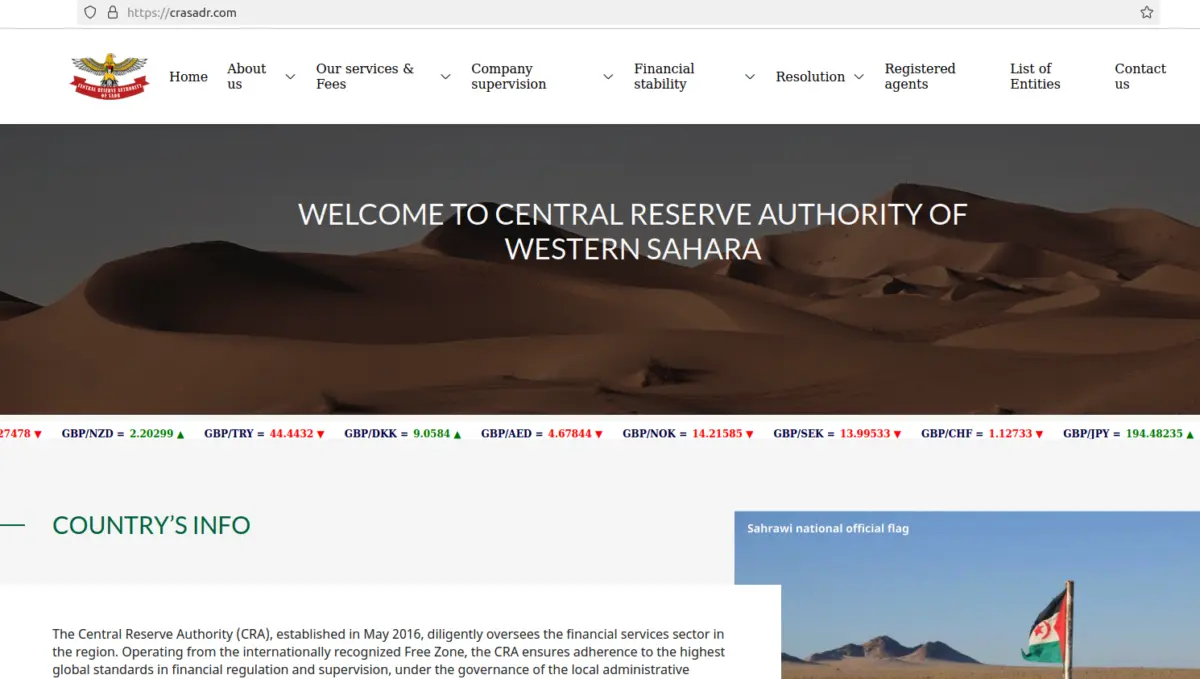
This corporation marketed itself as an exclusive, authoritative regulatory body responsible for overseeing and licensing cryptocurrency brokerages, foreign exchange firms, and online gaming businesses incorporated within the Western Sahara—a disputed region in northwest Africa that lacks widespread international recognition as a sovereign state.
Phony Bureaucracy in Action
The regulatory body’s official website (crasadr.com) brazenly advertised its services, claiming to assist corporate applicants with rapid bank setups, online gaming licenses, and foreign exchange licensing.
The depth of the deception was laid bare when technical analysts traced the infrastructure of Certa Payments. One of Certa Payments’ former operational domains (certa.website) shared a physical server with 12 distinct domains, including rasd-state.ws—the official website for the phantom "Central Reserve Authority of the Western Sahara."
By inventing a regulatory framework within a politically contested zone largely ignored by mainstream international watchdogs, Cryptomus was able to hand out self-certified compliance badges to itself and its darknet clients, masquerading as a regulated fintech enterprise while quietly servicing the global criminal underworld.
Future Outlook: The Death Knell for No-KYC Gateways?
The coordinated U.K. sanctions against Cryptomus, Heleket, TokenSpot, and VexPay signal a dark horizon for unregulated crypto payment processors operating in the shadows of the global financial system.
As blockchain analytics firms grow increasingly sophisticated in tracking cross-chain movements, and as intelligence agencies bridge the gap between virtual wallets and physical jurisdictions, the era of the "chameleonic" crypto platform is rapidly drawing to a close. Simply changing a company name, spinning up a parallel domain (like Heleket), or purchasing a fraudulent license from a phantom regulator in Western Sahara is no longer sufficient to evade the long arm of international law.
While cybercriminals will undoubtedly attempt to innovate new methods of obfuscation, the U.K.’s decisive action against Cryptomus proves that modern economic sanctions—when backed by robust blockchain intelligence and Five Eyes cooperation—remain the most lethal weapon in dismantling the financial plumbing of transnational cybercrime and state-sponsored sanctions evasion.