Executive Overview
In a major technical leap for cloud-native data architecture, Amazon Web Services (AWS) has announced the general availability of native vector search in Amazon DynamoDB. This flagship capability bridges the long-standing gap between traditional operational databases and modern artificial intelligence workflows. For organizations building applications powered by generative AI—ranging from Retrieval-Augmented Generation (RAG) and semantic agentic memory systems to complex recommendation engines and real-time anomaly detection—the announcement marks the removal of one of the most persistent engineering hurdles in modern software development: the multi-database synchronization tax.
Historically, combining transactional data with vector embeddings meant adopting a fragmented architecture. Developers were forced to provision, patch, and maintain a dedicated vector store alongside their operational database, maintaining complex, failure-prone data synchronization pipelines just to keep vectors aligned with their source of truth. This added substantial operational overhead, inflated data-movement and licensing costs, and introduced latency bottlenecks at scale.
With native vector search embedded directly into DynamoDB’s serverless architecture, vectors now live alongside standard operational data under a unified infrastructure and a predictable pay-per-request pricing model. Operating at single-digit millisecond latency, boasting over 99% recall precision, and capable of scaling infinitely across trillions of vectors without pre-provisioned servers or maintenance windows, this release fundamentally redefines what a NoSQL database can achieve in the age of machine learning.
Detailed Chronology & Technical Architecture
The rollout of vector search in DynamoDB represents the culmination of deep engineering efforts within AWS to address the architectural demands of large language models (LLMs) and intelligent autonomous agents.

The Operational Challenge of the Past
Prior to this release, developers deploying semantic search applications on AWS faced a choice between operational friction and architectural complexity. If a user profile, product catalog, or inventory ledger resided in a DynamoDB table, adding natural language search capabilities required generating vector embeddings via models like Amazon Bedrock Titan or OpenAI, writing them to an external vector database, and building synchronization scripts using event-driven tools like Amazon DynamoDB Streams coupled with AWS Lambda.
This approach introduced multiple points of failure:
- Eventual Consistency Lags: Synchronization pipelines inevitably suffered from replication lag, resulting in search results returning stale or missing data.
- Cost Multipliers: Maintaining separate storage tiers, compute resources, and management planes for operational data versus vector data inflated total cost of ownership (TCO).
- Latency Degradation: Network hops between distributed operational stores and external vector caches challenged strict Service Level Agreements (SLAs), particularly when scaling to millions or billions of items.
The New Native Paradigm
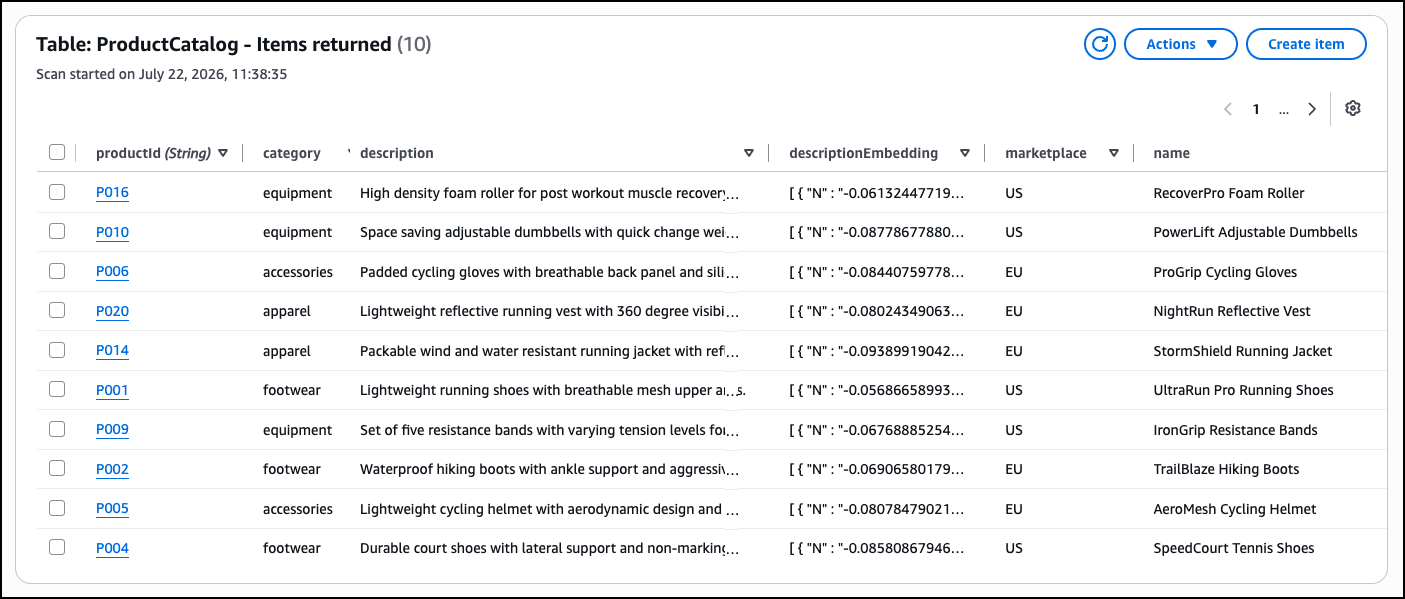
DynamoDB’s native vector search solves these challenges by treating vectors as first-class citizens. Vectors are stored natively inside existing tables using standard List data types composed of floating-point numbers.
+-----------------------------------------------------------------------+
|                        Amazon DynamoDB Table                          |
|                                                                       |
|  [PK] productId     : "SPOR-8821"                                     |
|       category      : "footwear"                                      |
|       name          : "All-Terrain Running Shoe"                      |
|       price         : 129.99                                          |
|       marketplace   : "US"                                            |
|       description   : "Lightweight running shoes designed for..."     |
|       descriptionEmbedding : [-0.0142, 0.0381, -0.0054, ...] [List]   |
+-----------------------------------------------------------------------+
           |                                           |
           v (Vector Index Creation)                   v (Query Execution)
+----------------------------------+        +---------------------------+
|      ProductDescriptionIndex     |        |       SearchVectors API   |
|  - Dimension: 1536               |        |  - Query Vector           |
|  - Distance: Cosine              |        |  - Top K (up to 100)      |
|  - Partition Key: marketplace    |        |  - Inline Filters         |
+----------------------------------+        +---------------------------+
To implement semantic search on an existing table, engineers follow a precise three-step technical workflow:

-
Table Preparation & Embedding Generation:
Machine learning models—such as Amazon Bedrock Titan Text Embeddings, Cohere Embed, or OpenAI models—are used to transform unstructured text (such as product descriptions, user reviews, or support tickets) into dense numerical vectors. These arrays of floats are written directly to the DynamoDB item using a standardPutItemorUpdateItemoperation. Because DynamoDB utilizes its nativeListtype, no schema migrations or disruptive alterations are required. -
Vector Index Configuration:
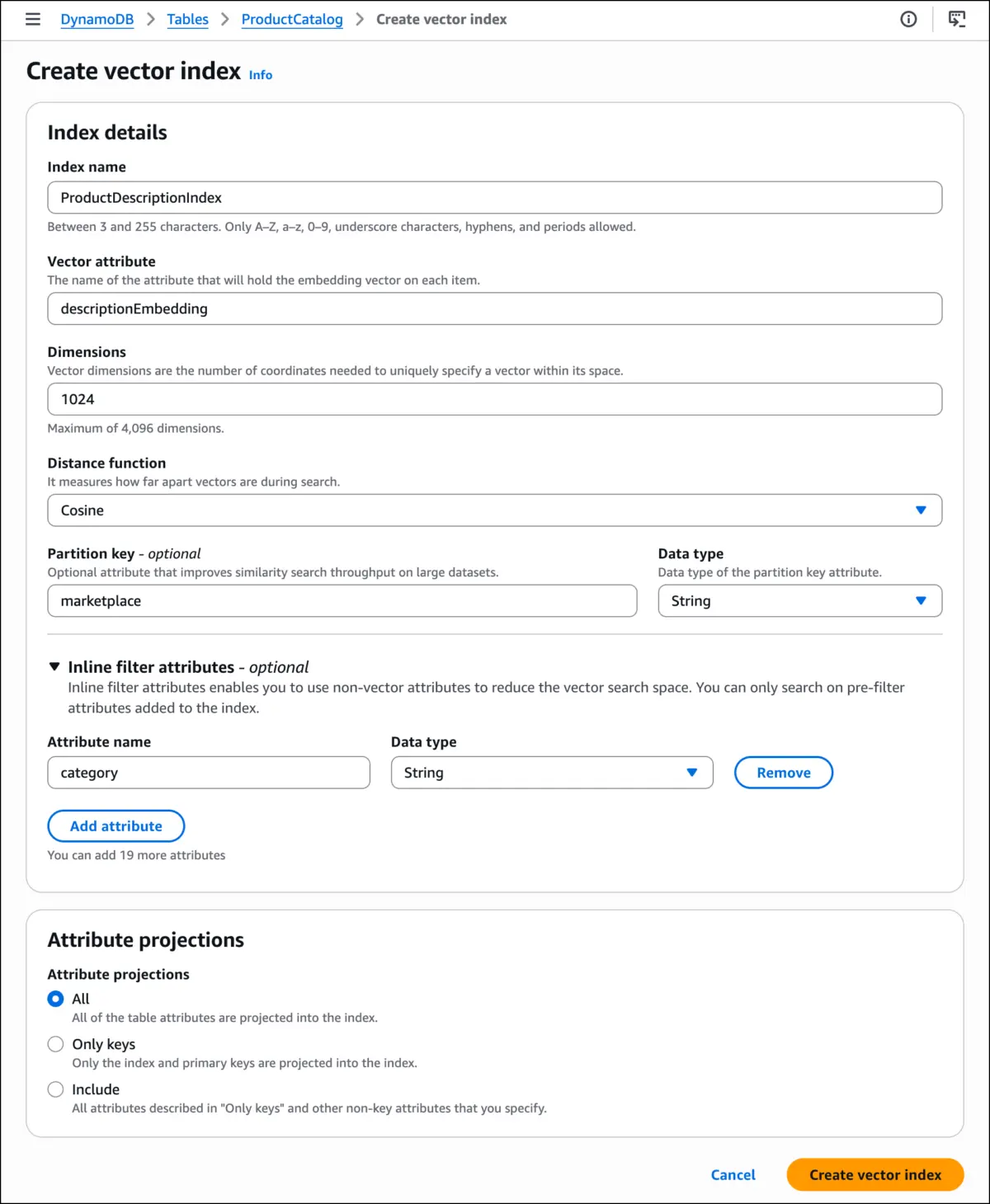
Within the DynamoDB console, AWS CLI, or Infrastructure-as-Code (IaC) tools like AWS CloudFormation, engineers create a dedicated vector index on the attribute housing the embeddings. Configuration parameters include:- Dimensions: Matching the output size of the chosen embedding model (supporting up to 4,096 dimensions).
- Distance Function: Selection among Cosine (measuring vector angle, ideal for text semantics), Euclidean (measuring straight-line distance), or Dot Product (measuring magnitude and alignment).
- Partition Key: An optional configuration (such as
marketplaceortenantId) that shards vector distribution across partitions, optimizing scale and isolating search scopes without performing full-index scans. - Inline Filter Attributes: Non-vector attributes (e.g.,
category = 'footwear') designated for exact-match filtering during query execution.
-
Query Execution via
SearchVectors:
At runtime, natural language queries are transformed into query vectors via the same embedding model. The newSearchVectorsAPI accepts the query vector, aTop Kparameter (returning up to 100 results), partition scoping, and inline filters. The database returns semantically ranked items alongside all operational attributes in a single, atomic serverless response.
Supporting Context & Metrics
The quantitative benchmarks underpinning DynamoDB’s vector search capabilities establish a new benchmark for serverless AI data layers:
- Latency & Recall Performance: The engine delivers single-digit millisecond query latency while maintaining 99%+ recall accuracy, ensuring that users receive the most mathematically relevant results without sacrificing system responsiveness.
- Scale and Dimensionality: Designed to handle datasets scaling to trillions of vectors, the service natively supports high-dimensional spaces up to 4,096 dimensions, accommodating state-of-the-art multi-modal embedding models.
- Operational Simplicity: As a fully serverless offering, there are no instances to provision, scale groups to configure, or maintenance windows to schedule. The underlying storage layer scales horizontally and dynamically as data volumes grow.
- Unified Economics: By eliminating external vector databases, enterprises avoid duplicate licensing fees, inter-AZ data transfer charges, and the engineering hours previously sunk into maintaining fragile synchronization scripts.
Official Statements & Industry Impact
The release has drawn significant attention from enterprise architects and cloud strategists who view it as a milestone in the convergence of transactional and analytical (HTAP/AI) workloads.
Industry analysts point out that the administrative overhead of microservices architectures often creates severe friction for teams trying to deploy generative AI features rapidly. By baking vector capabilities into a foundational database engine that already powers thousands of mission-critical enterprise workloads worldwide, AWS has substantially lowered the barrier to entry for AI innovation.
"For years, our engineering teams spent countless hours building out complex dual-database architectures—syncing operational records from DynamoDB into specialized vector stores just to enable basic semantic recommendations," noted a leading cloud infrastructure architect during technical briefings. "Bringing vector search natively into DynamoDB removes an entire class of synchronization bugs, reduces infrastructure overhead, and allows developers to focus purely on business logic and model quality."
Furthermore, the integration of inline filtering directly within the vector index answers a long-standing critique of early vector databases, which often struggled to execute hybrid queries (combining strict metadata filtering with approximate nearest neighbor searches) efficiently at scale. By enabling developers to scope searches by partition keys and exact-match attributes simultaneously, DynamoDB ensures that queries remain performant even in multi-tenant or multi-geography environments.
Future Outlook & Getting Started
With general availability now live across all commercial AWS Regions—including AWS GovCloud (US)—the launch signals a broader evolution in how cloud platforms intend to support autonomous, agentic applications.
As enterprises transition from simple proof-of-concept chatbots to autonomous AI agents capable of executing multi-step business workflows, the requirement for ultra-low-latency, highly reliable memory stores becomes critical. DynamoDB’s native vector search is uniquely positioned to serve as the long-term memory layer for agentic architectures, where agents must rapidly recall past interactions, contextual documents, and operational states within milliseconds.
Immediate Next Steps for Builders
Engineers and database administrators looking to adopt the capability can immediately access updated documentation via the Amazon DynamoDB Developer Guide. To accelerate development, AWS has also introduced support for the AWS MCP Server and associated plugins, allowing developers to query vector search documentation, generate API calls, and configure indexes directly within their preferred AI-assisted coding environments.
Feedback channels are actively monitored via AWS re:Post for Amazon DynamoDB, ensuring that user telemetry and community insights will directly inform the ongoing feature roadmap for the service. As cloud computing continues its inevitable shift toward intelligence-native infrastructure, Amazon DynamoDB has firmly positioned itself at the center of the enterprise AI stack.