Executive Overview
In the fast-evolving landscape of artificial intelligence, a persistent bottleneck has plagued localized enterprise deployments: the hardware divide. High-performing Large Language Models (LLMs) with massive parameter counts historically demand equally massive compute resources—typically clusters of enterprise-grade GPUs that are financially prohibitive for small-to-medium enterprises (SMEs) or local office environments.
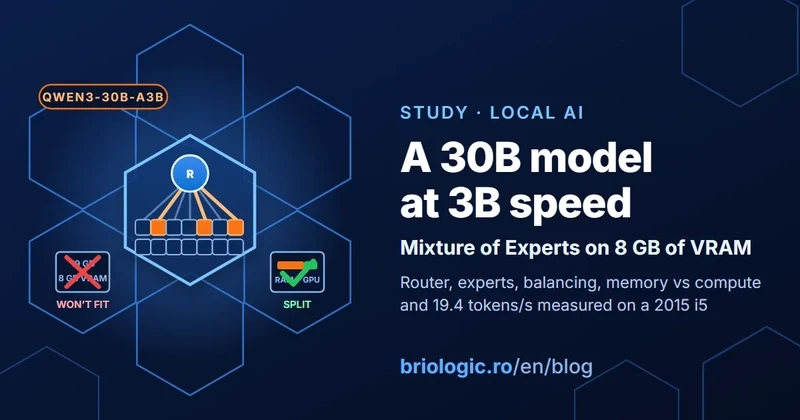
Enter the Qwen3-30B-A3B model, a technical tour de force that bridges this gap. By utilizing a Mixture of Experts (MoE) architecture, this model boasts a total weight profile of 30.5 billion parameters while activating only 3.3 billion parameters per token. In practical terms, it requires the storage memory of a heavy, 30B-class model, but it executes computations at the speed and efficiency of a compact 3.5B-class model.
Rigorous benchmarking on a standard, mid-tier office desktop from 2015—featuring an Intel Core i5-6600K processor, 32 GB of DDR4 RAM, and an NVIDIA RTX 3060 Ti graphics card with 8 GB of VRAM—yielded a staggering 19.4 tokens per second during generation. This breakthrough shifts the paradigm for on-premises AI deployment, proving that robust, privacy-compliant language intelligence can run locally without requiring expensive hardware upgrades.
Detailed Chronology & Architectural Evolution
To fully appreciate the breakthrough represented by Qwen3-30B-A3B, one must look at how language models process information. In a traditional "dense" model (such as the Qwen3-8B), every single parameter participates in calculating the output for every token. This uniform processing creates a linear relationship between model size, memory bandwidth consumption, and generation latency.
The Anatomy of the MoE Layer
The Qwen3-30B-A3B model transforms this architecture by replacing the traditional Multi-Layer Perceptron (MLP) block found in dense layers with a Mixture of Experts block.

- The Router Mechanism: Positioned immediately after the attention layer, the router is a lightweight computational gate. For every incoming token vector, the router computes scores across 128 distinct "expert" MLPs.
- Selective Activation: Utilizing a softmax function and a top-8 selection algorithm, the router dynamically picks only the 8 most relevant experts per token. The remaining 120 experts are completely bypassed and are not even read from system memory for that specific token.
- Sparse vs. Dense Efficiency: Across its 48 layers, a single token activates just 384 of the model’s 6,144 total expert networks. This conditional execution creates a roughly 10-to-1 ratio between the parameters stored on disk (19 GB) and the active parameters working per token (~3.3 billion).
Training Strategies and Load Balancing
Developing an MoE model presents unique training hurdles. Without intervention, a phenomenon known as "expert collapse" occurs: the router consistently favors a small subset of experts, leaving the rest untrained and rendering the model inefficient.
To counteract this, Qwen developers integrated a specialized auxiliary loss term (router_aux_loss_coef: 0.001) into the training objective. This penalizes uneven token distributions across batches, forcing the router to utilize the entire expert network effectively. Following pre-training across roughly 36 trillion tokens, the model underwent "strong-to-weak" distillation using larger teacher models like Qwen3-32B and Qwen3-235B-A22B.
Supporting Context & Metrics
Evaluating Qwen3-30B-A3B requires mapping its structural specifications directly against dense counterparts like Qwen3-8B and Qwen3-32B.
Comparative Architectural Specifications
| Characteristic | Qwen3-30B-A3B (MoE) | Qwen3-8B (Dense) | Qwen3-32B (Dense) |
|---|---|---|---|
| Stored Parameters | 30.5 billion | 8.19 billion | ~32 billion |
| Active Parameters / Token | 3.3 billion | 8.19 billion | ~32 billion |
| Layers | 48 | 36 | 64 |
| Internal Vector Size | 2,048 | 4,096 | 5,120 |
| Experts per Layer / Active | 128 / 8 | N/A (Dense) | N/A (Dense) |
| Native Context Length | Up to 262,144 tokens | 32,768 tokens | 128,000 tokens |
| Ollama File Size (Q4_K_M) | 19 GB | 5.2 GB | ~20 GB |
Empirical Benchmarks on Legacy Hardware
When deployed via Ollama on an Intel i5-6600K system with 32 GB of DDR4-2400 RAM and an 8 GB RTX 3060 Ti, performance metrics illuminated the distinct advantages of the MoE architecture over fully dense models of equivalent memory footprints:
- Model Loading Times: 52.3 seconds for the 19 GB MoE model, compared to 18.1 seconds for the smaller 5.2 GB dense 8B model.
- Prompt Reading (Prefill): 32.4 tokens per second for the 30B MoE, versus 130.2 tokens per second for the 8B model. The drop-off here is directly attributable to the CPU-GPU memory split required by the larger file size.
- Generation Speeds: The Qwen3-30B-A3B model achieved 19.4 tokens per second, easily outpacing human reading speeds. By contrast, a fully dense 32B model of identical memory footprint would theoretically crawl at under 2 tokens per second on the same hardware due to memory bandwidth saturation.
Official Statements & Variant Analysis
A critical discovery during deployment involves understanding the distinct variants bundled under the generic qwen3:30b tag in Ollama. Official model documentation and repository digests reveal that the ecosystem encompasses three fundamentally different behaviors under a single name:

qwen3:30b(Thinking-2507): Always engages an internal reasoning loop before outputting text. While highly analytical, it is prone to infinite repetition loops if constrained by rigid length prompts without strict presence penalties.qwen3:30b-instruct(Instruct-2507): Bypasses the internal reasoning chain, responding directly to prompts. This variant is ideally suited for standard office productivity tasks, email summarization, and local document retrieval.qwen3:30b-a3b-q4_K_M(Original Hybrid): Features a switchable thinking mode with a 40K native context window.
Consultants and enterprise architects must explicitly target the Instruct variant for localized business applications to avoid runaway token generation loops and ensure predictable response times.
Future Outlook & Enterprise Implementation
The emergence of models like Qwen3-30B-A3B signals a major shift in how local AI infrastructure will be budgeted and deployed. Enterprises no longer need to invest heavily in enterprise-grade GPU accelerators (such as NVIDIA A100s or H100s) simply to run high-intelligence models on-premises.
The Viability of Memory-Bound Scaling
Because MoE generation speed is governed by the volume of active parameters read per token rather than the total size of the model weights, system RAM bandwidth becomes the primary performance frontier. Upgrading system memory configurations (e.g., ensuring dual-channel DDR4/DDR5 setups) yields massive performance dividends for a fraction of the cost of discrete GPU upgrades.
On-Premises Privacy and Document Intelligence
For companies bound by strict data governance frameworks (such as GDPR, HIPAA, or proprietary corporate secrecy policies), routing internal documentation through cloud-hosted APIs is a non-starter. Localized platforms utilizing sparse MoE models enable businesses to deploy intelligent document analysis agents directly on existing office workstations.
As hardware-software co-design matures, sparse mixture-of-experts architectures will likely become the default standard for edge AI, democratizing advanced reasoning capabilities for every desktop in the modern enterprise.