Executive Overview
For centuries, humanity has looked up at the night sky, seeking answers to the fundamental questions of our existence: Where did we come from? How big is the universe? And how will it all end? Today, an international coalition of scientists has brought us closer to answering those profound questions than ever before.
Perched on a remote mountain peak in Arizona’s rugged Sonoran Desert, a specialized apparatus known as the Dark Energy Spectroscopic Instrument (DESI) has spent the last five years quietly revolutionizing modern astronomy. The culmination of this monumental effort is now public: the largest, most detailed three-dimensional map of the universe ever created.
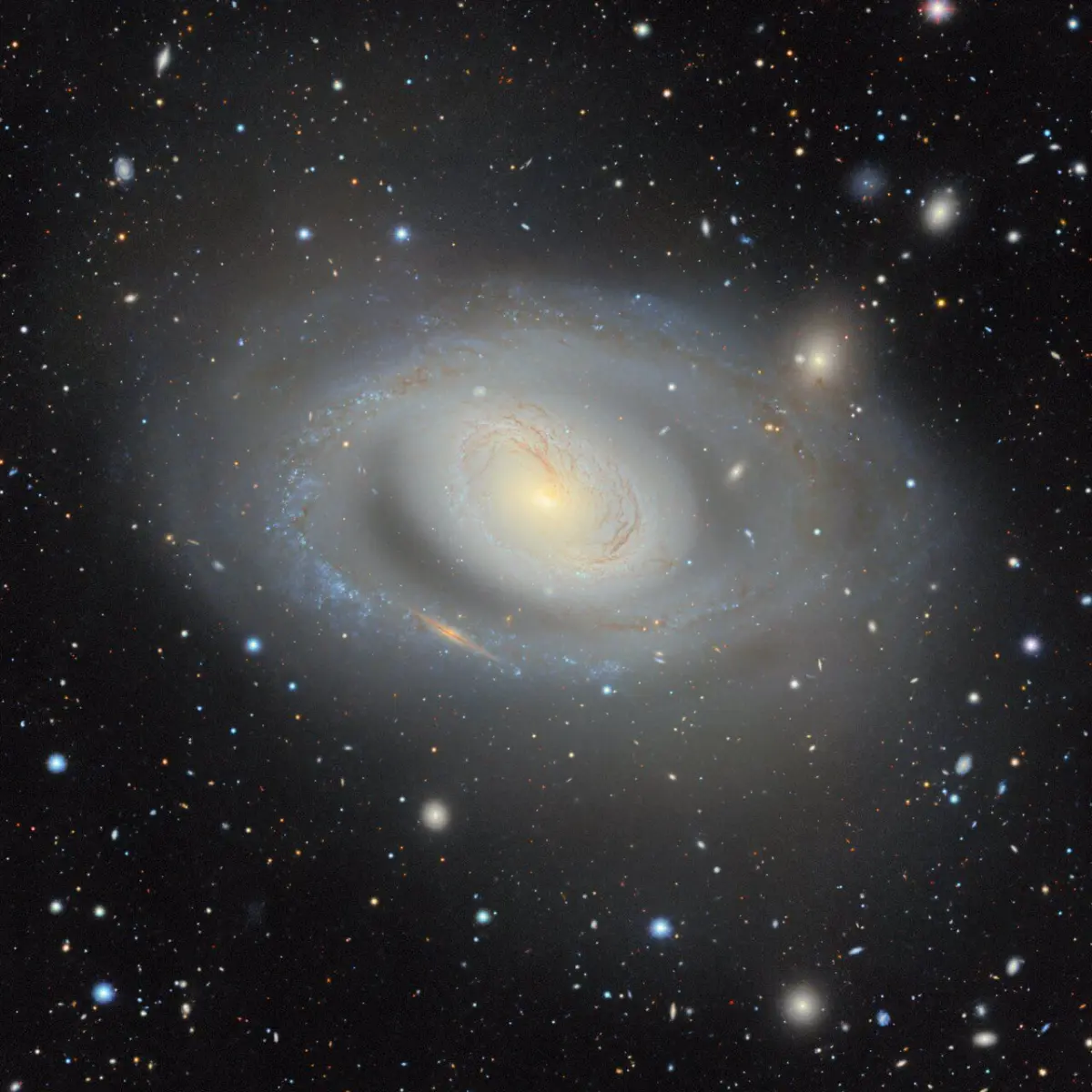
Covering an astonishing 75 percent of the entire night sky, this newly minted digital atlas is a treasure trove of cosmic data. It boasts 5.6 trillion pixels, cataloging approximately 4 billion individual celestial objects—ranging from nearby asteroids and stellar nurseries within our own Milky Way to hyper-luminous quasars, massive black holes, and sprawling galaxy clusters billions of light-years away.
More than just a breathtaking picture of the heavens, this survey is a vital scientific weapon. Its primary mission is to help humanity hunt down dark energy: the mysterious, pervasive force driving the accelerated expansion of the cosmos. While dark energy makes up roughly 68 percent of the universe, it remains one of the greatest blind spots in modern physics. We cannot see it, touch it, or directly measure it. Yet, by meticulously mapping the positions and trajectories of billions of cosmic beacons, DESI is allowing scientists to indirectly observe how this enigmatic force shapes reality.
Crucially, this unprecedented data set is not locked behind academic paywalls. Through the DESI Legacy Imaging Surveys, a free, publicly accessible online tool, anyone with an internet connection can now explore the cosmos with professional-grade imaging data. Whether you are an amateur astronomer, a curious student, or a seasoned astrophysicist, the universe is now literally at your fingertips.
Detailed Chronology: The Making of a Cosmic Masterpiece
The creation of the world’s most comprehensive sky map did not happen overnight. It is the product of decades of foundational groundwork, international collaboration, and sheer engineering grit.
1. Laying the Groundwork (2000s – Early 2010s)
Long before DESI ever pointed its robotic eyes toward the heavens, astronomers recognized the need for a comprehensive digital survey of the night sky to serve as a baseline for deeper cosmological studies. Over nearly two decades, precursor imaging programs gathered preliminary data across multiple observatories, stitching together fragmented pieces of the puzzle. These projects laid the technical and logistical framework required to handle astronomical data on a petabyte scale.
2. The Five-Year Observing Campaign (Recent Years)
The centerpiece of the current data release is DESI’s five-year observational campaign, which utilized the Mayall 4-meter Telescope at the Kitt Peak National Observatory near Tucson, Arizona.
However, mapping the universe from the ground introduces unique challenges. Earth-bound telescopes must peer through our own atmosphere, which distorts light, as well as the thick disk of the Milky Way, which is choked with stars, gas, and cosmic dust.
To overcome this, engineers outfitted the telescope with a marvel of modern optical engineering: a focal plane equipped with 5,000 robotic, fiber-optic "eyes." Each of these mechanical actuators can reposition itself automatically in seconds to capture the light of individual galaxies. Rather than trying to pierce through the dense, dust-clogged center of our galaxy, researchers cleverly aimed DESI’s gaze outward—out of the top and bottom of the Milky Way, where the view of deep space is unobstructed.
3. The Data Flood and Earlier Releases
As the survey progressed, data poured in at an overwhelming rate. Earlier this year, DESI researchers made headlines by releasing a preliminary 3D map that tracked the exact distances of 47 million galaxies and quasars. That subset alone reconstructed an astonishing 11 billion years of cosmic history.
Now, with the release of the complete DESI Legacy Imaging Surveys dataset, the scientific community has access to a comprehensive optical and near-infrared mosaic that underpins virtually all modern extragalactic astronomy. Over 160 scientists directly contributed to the data collection phase, and the resulting archive has already been cited in upwards of 1,800 peer-reviewed scientific papers.
Supporting Context & Metrics: Decoding the Numbers
To truly appreciate the scope of the DESI Legacy Imaging Surveys, it helps to examine the sheer scale of the project through hard data and cosmological context.
The Scale of the Survey
- Sky Coverage: Approximately 75% of the entire celestial sphere.
- Pixel Count: 5.6 trillion pixels of high-resolution imaging data.
- Celestial Objects Cataloged: Approximately 4 billion unique objects, including stars, distant galaxies, quasars, and black holes.
- Collaborative Workforce: More than 160 core scientists, backed by institutional partnerships spanning multiple continents.
- Research Impact: Over 1,800 academic papers published using preliminary and ongoing data releases.
The Mystery of Dark Energy
To understand why DESI matters, one must understand the standard model of cosmology. For much of the 20th century, scientists believed that the expansion of the universe—kicked off by the Big Bang 13.8 billion years ago—should be slowing down due to the mutual gravitational pull of all matter.

However, in 1998, observations of distant supernovae revealed a shocking truth: the expansion of the universe is actually accelerating. Space itself is stretching apart at an ever-increasing rate. Physicists assigned a placeholder name to the mysterious engine driving this acceleration: dark energy.
While dark energy accounts for roughly 68 percent of the universe’s total energy budget (with dark matter making up another 27 percent, and normal matter—stars, planets, you and I—comprising a mere 5 percent), scientists know next to nothing about its fundamental nature. Is it Einstein’s cosmological constant—a fixed property of space itself? Or is it a dynamic, evolving field that changes over time?
Recent hints from the first three years of DESI data—when combined with observations of supernovae and the Cosmic Microwave Background (the leftover radiation from the Big Bang)—have suggested a tantalizing possibility: dark energy may not be constant; it might be slowly weakening over time.
If confirmed by the full five-year analysis scheduled for release in 2027, this discovery would fundamentally rewrite our understanding of physics, potentially pointing the way toward a "Theory of Everything" that bridges quantum mechanics with general relativity.
Official Statements and Expert Perspectives
The release of the DESI Legacy Imaging Surveys has sent ripples of excitement throughout the global scientific community. Leaders of the project emphasize both its practical utility for researchers and its profound cultural significance for the general public.
"It’s part of the fabric of astronomy research now," notes David Schlegel, a researcher at the Lawrence Berkeley National Laboratory and co-lead of the Legacy Surveys. "When you’re working with astronomical objects today, you often start by pulling up the Legacy Imaging Viewer to see what you’re looking at."
Schlegel’s sentiment highlights how quickly the tool has transitioned from a specialized research initiative into the default baseline for observational astronomy. Rather than having to piece together disparate archives from various telescopes, researchers worldwide now turn to the DESI interface as their primary digital viewport into the universe.
Arjun Dey, co-director of the Legacy Surveys and an astronomer with the National Science Foundation (NSF), underscored the dual nature of the project: advancing hard science while democratizing access to the cosmos.
"Explorations of our universe always start with images of the night sky," Dey said in a joint press statement. "These data are fundamental to the investigation of the expansion history of the universe and the formation of our galaxy. But the skies belong to everyone, and this survey gives everyone the chance to marvel at their wonders."
Future Outlook: What Lies Ahead for Cosmic Cartography
While the completion of the five-year DESI survey marks a monumental milestone, it is far from the end of the road. In many ways, it is just the beginning of a new chapter in spatial exploration.
1. The 2027 Comprehensive Analysis
Astronomers and physicists are eagerly awaiting 2027, when the research team plans to release the final, comprehensive analysis of the full five-year data set. By integrating the complete temporal and spatial data archive, scientists hope to paint a cinematic picture of the universe’s past, present, and future that is sharper and more definitive than anything previously attempted. This analysis will provide a stringent test for theories regarding the evolution—and potential decay—of dark energy.
2. Synergy with Next-Generation Observatories
Ground-based surveys like DESI do not exist in a vacuum. As space agencies launch increasingly sophisticated orbital observatories, ground-based maps serve as vital reference guides. For instance, DESI’s comprehensive sky coverage will act as an essential comparison and calibration point for NASA’s newly launched Nancy Grace Roman Space Telescope, which is designed to probe wide-field infrared astronomy and hunt for answers regarding dark energy from above Earth’s obscuring atmosphere.
3. Harnessing Artificial Intelligence
Handling petabytes of astronomical data is beyond the capacity of human researchers alone. To extract every ounce of insight hidden within the 5.6 trillion pixels of the Legacy Imaging Surveys, scientists are increasingly turning to advanced artificial intelligence and machine learning algorithms. These AI tools are trained to comb through the noise, automatically identifying rare cosmic phenomena, classifying galaxy morphologies, and mapping subtle gravitational anomalies at speeds that dwarf traditional analytical methods.
A Universe for Everyone
As we stand on the precipice of these new discoveries, the DESI Legacy Imaging Surveys stand as a testament to human curiosity and international cooperation. By transforming a billion-pixel puzzle into an open-access digital window, the project ensures that unlocking the universe’s greatest secrets is no longer the exclusive domain of elite institutions. The stars are open for business—and anyone with an internet connection is invited to look inside.