Executive Overview
The modern wellness landscape is undergoing a profound paradigm shift. Consumers are no longer waiting for symptoms to manifest before engaging with the healthcare system; instead, they are aggressively leaning into preventive care, utilizing wearable technology, continuous glucose monitors, blood panels, and full-body scans to map their internal biology. Yet, one of the most foundational, complex, and historically misunderstood frontiers of human health remains largely untapped: the gut microbiome.
Enter Austin-based Tiny Health, a pioneering at-home microbiome testing startup that bridges the gap between emerging scientific literature and everyday wellness. Founded in 2020 by serial entrepreneur Cheryl Sew Hoy, Tiny Health has officially announced a massive $33 million Series B funding round led by prominent venture capital firm B Capital. This latest capital injection brings the company’s total funding to an impressive $46 million, following a $4.5 million seed round in 2021 and an $8.5 million Series A in late 2023.
Participation in the Series B round included a mix of returning and new backers. Existing investors—including Spero Ventures, The Venture City, and Overwater Ventures—doubled down on their initial bets, while new heavyweights such as Black Opal Ventures and Alumni Ventures joined the cap table. As part of the investment, Nick Whitehead, senior principal at B Capital, will secure a seat on Tiny Health’s board of directors.
Operating in an increasingly crowded preventive health market, Tiny Health has distinguished itself through advanced shotgun metagenomic sequencing, a booming B2B practitioner network, and a rapidly expanding repository of nearly 200,000 microbiome samples. With the fresh $33 million funding, the company plans to scale its enterprise partnerships, grow its headcount from 40 to 70 employees, accelerate clinical research initiatives, and deploy a proprietary AI tool designed to translate complex microbial data into life-changing, actionable insights.
Detailed Chronology: From Personal Frustration to Enterprise Scale
The genesis of Tiny Health is rooted in a familiar entrepreneurial narrative: a founder searching for answers that traditional medicine could not immediately provide.
The Spark: A Mother’s Quest for Answers (2020)
When Cheryl Sew Hoy’s daughter developed chronic eczema, allergies, and severe food sensitivities shortly after birth, Sew Hoy immersed herself in scientific literature regarding the infant gut microbiome. The family medical history presented a glaring puzzle: her daughter had been delivered via C-section, whereas her younger son, born vaginally, exhibited no such health conditions.
This stark contrast sparked a burning question: could differences in early microbial exposure dictate long-term immune and metabolic health?
While the academic literature did not provide an immediate clinical diagnosis for her daughter, it planted the seed for a revolutionary enterprise. "I learned that you can course-correct if you focus on the early life of the baby. If they’re missing certain beneficial bacteria, it can really cause a lot of issues for the infant," Sew Hoy reflects. Crucially, when she brought these academic findings to her pediatricians, she was met with blank stares. None of her doctors understood the clinical implications of early microbial dysbiosis.
Recognizing an immense education and service gap in pediatric medicine, Sew Hoy incorporated Tiny Health in Austin, Texas, just a week after her son’s birth in 2020.
Bootstrapping and Scientific Foundation (2020–2022)
Before seeking institutional venture capital, Sew Hoy self-funded the enterprise, investing $50,000 of her own money to launch an initial pilot study. She spent nearly a year meticulously collecting stool samples and architecting the technological backbone of the platform.
Unlike her previous entrepreneurial venture—digital coupon company Reclip.It, which was successfully acquired by Walmart Labs in 2013—Tiny Health demanded deep domain expertise in molecular biology and bioinformatics. To build a credible clinical foundation, Sew Hoy assembled a powerhouse leadership team. Kimberley Sukhum joined as Chief Science Officer in 2021, spearheading the company’s rigorous assay development. She was followed by co-founder Donald Koo, who oversees technology operations, and Dr. Elisa Song, an integrative pediatrician who transitioned from a clinical advisor to Chief Medical Officer.
Commercial Launch and the Pivot to Adult Testing (2022–2023)
Tiny Health spent two rigorous years developing and validating its platform before officially launching its direct-to-consumer (DTC) at-home baby gut test in 2022.
The infant test served as a strategic, high-impact wedge into the market. Parents desperate for answers regarding chronic childhood ailments like eczema and colic finally had an accessible tool to analyze their infants’ gut flora. Over time, however, the company’s demographic footprint organically evolved. While Tiny Health initially expanded its offerings to include pregnancy, vaginal microbiome, and general adult wellness tests, adult testing rapidly outpaced infant testing to become the company’s largest revenue segment.
The Series B Milestones (2024 and Beyond)
Today, Tiny Health is experiencing hyper-growth. Overall revenue has more than doubled year-over-year, while its B2B division—"Powered by Tiny"—experienced a staggering fourfold expansion over the past year. Though Sew Hoy has elected to keep precise revenue metrics and the company’s current valuation private, she notes that the post-money valuation for the Series B round is "much higher" than that of its late-2023 Series A.
Supporting Context & Metrics: How the Technology Works
To understand Tiny Health’s market traction, one must examine its technological methodology and how it stacks up against competing wellness modalities.
The Science: Shotgun Metagenomic Sequencing
Many commercial microbiome kits utilize 16S rRNA gene sequencing, a cheaper technique that identifies broad categories of bacteria down to the genus level. Tiny Health, by contrast, relies on shotgun metagenomic sequencing, a comprehensive technique that sequences all microbial DNA present in a sample.
According to Sew Hoy, this method yields a vastly superior, high-resolution view of the microbial ecosystem. It allows Tiny Health to detect not only bacteria, but also fungi, archaea, viruses, and parasites down to the species and strain levels. Furthermore, the sequencing reports analyze what those specific microbes are actively doing—such as producing short-chain fatty acids or promoting inflammation—and pair these insights with evidence-backed dietary, lifestyle, and supplement recommendations.
"We are a wellness test," Sew Hoy emphasizes. "We’re not a diagnostic… It’s very actionable, very evidence-backed." Insurance does not currently cover these wellness panels, as they map microbiome composition rather than formally diagnosing underlying pathologies.
The Consumer Experience & Competitive Landscape
The testing process is frictionless for the user:
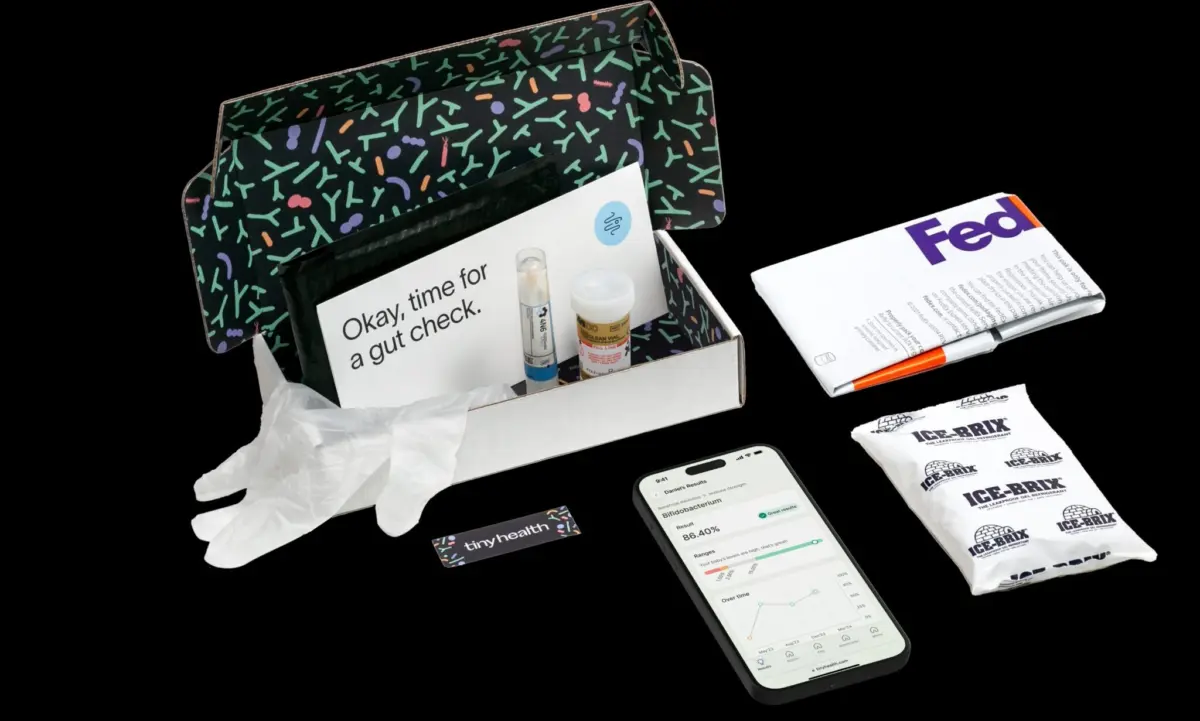
- Sample Collection: Customers collect a minute stool sample using a specialized sanitary swab.
- Laboratory Processing: The sample is mailed to Tiny Health’s partner laboratories, where microbial DNA is extracted and sequenced via shotgun metagenomics.
- Report Generation: Users receive a comprehensive digital dashboard outlining their microbial diversity, pathogen presence, and functional metabolic pathways.
- Ongoing Tracking: Through subscription options like Tiny Plus, customers can purchase baseline assessments paired with routine retests to monitor gut health improvements over time.
The broader digital health landscape features alternative approaches to digestive wellness. For instance, Austin-based competitor Throne Science has captured headlines by developing a smart device that attaches directly to residential toilets to track stool consistency, frequency, and hydration via optical sensors. Throne recently secured a $10 million Series A round led by Will Ventures. While Throne monitors macroscopic waste outputs in real-time, Tiny Health targets the microscopic internal actors driving those outputs.
Official Statements and Industry Validation
The decision by B Capital to lead Tiny Health’s Series B round underscores a broader macro-trend: venture capitalists are pouring capital into consumer-empowered preventive health platforms.
Nick Whitehead, Senior Principal at B Capital, offered a detailed perspective on why his firm chose to back Tiny Health in an email to industry press:
"We’re in the middle of a real shift in how people engage with their own health. Consumers are paying out of pocket for wearables, blood panels, and full-body scans because they want to understand what’s happening inside their bodies before something goes wrong. The gut microbiome is one of the most important and least understood pieces of that picture… Tiny Health turns that science into something people can actually act on, and we believe the company that does this well will define the category."
During B Capital’s rigorous due diligence process, the firm consulted extensively with practicing clinicians to evaluate the clinical utility of various commercial gut tests. According to Whitehead, "Tiny Health was consistently the test they rated highest." He also highlighted the unique defensive moat created by Tiny Health’s longitudinal dataset—specifically, its ability to track families and infants over multi-year periods.
Beyond Direct-to-Consumer: The Explosion of "Powered by Tiny"
While the direct-to-consumer channel established the brand, Tiny Health’s institutional and enterprise division—Powered by Tiny—is rapidly emerging as its primary growth engine.
Powering Healthcare Providers and Elite Institutions
The B2B pivot happened organically. Early DTC customers routinely took their Tiny Health reports to their primary care physicians, functional medicine doctors, and integrative pediatricians. Many clinicians, unequipped to interpret complex metagenomic data, reached out to Tiny Health for guidance.

Recognizing an opportunity, the startup built a dedicated provider network. Today, Tiny Health serves more than 6,000 healthcare practitioners, offering specialized training modules to help clinicians integrate microbiome metrics into patient care plans.
Furthermore, the "Powered by Tiny" infrastructure white-labels or integrates testing protocols into elite health organizations and wellness platforms. Current strategic partners include:
- Mayo Clinic’s Executive Health and Longevity Programs
- Fullscript (a leading care management and supplement dispensing platform)
- Superpower (a comprehensive longevity and preventive health platform)
The division also collaborates with supplement manufacturers and academic researchers who require robust metagenomic data to validate the efficacy of their clinical trials and formulations.
Future Outlook: Artificial Intelligence and Disease Prevention
With $33 million in fresh dry powder, Tiny Health’s roadmap for the coming years is aggressive, ambitious, and heavily data-driven.
Harnessing 200,000 Samples with TinyAI
Having accumulated nearly 200,000 microbial samples over its operational history, Tiny Health sits atop one of the largest proprietary repositories of human microbiome data in the world. To unlock the full commercial and clinical value of this dataset, the company is actively developing TinyAI.
Powered by internal data lakes and rigorously vetted scientific research, TinyAI is designed to act as an intelligent co-pilot for users and clinicians, helping them interpret intricate metagenomic readouts with hyper-personalized clarity. By stripping away identifying personal health information to protect privacy, Tiny Health feeds this data into its machine-learning pipelines to uncover novel correlations.
The Long-Term Vision: Predictive Medicine
The ultimate horizon for Tiny Health extends far beyond lifestyle wellness. Published peer-reviewed research has formally associated gut microbiome dysbiosis and imbalances with more than 100 distinct chronic conditions, spanning autoimmune diseases, metabolic disorders, mental health anomalies, and gastrointestinal syndromes.
"We want to be able to predict disease before it happens and intervene before it happens," Sew Hoy stated during an interview.
To validate this thesis, Tiny Health has already published four peer-reviewed scientific papers focusing primarily on infant populations. With its new capital, the company plans to fund expansive new clinical studies focused on adults. Notably, $5 million of the Series B proceeds will be explicitly channeled into a dedicated research program that grants external clinical researchers and academic partners access to Tiny Health’s vast testing infrastructure and anonymized data pools.
Scaling the Organization
To support these multifaceted expansion goals, Tiny Health plans to aggressively scale its workforce. The company currently employs roughly 40 individuals and is actively looking to fill 30 new roles across engineering, clinical science, enterprise sales, and customer success.
As consumer spending on proactive healthcare continues to accelerate, Tiny Health is positioning itself at the absolute center of the longevity revolution. By combining accessible at-home testing, rigorous shotgun metagenomic sequencing, an entrenched B2B medical network, and cutting-edge artificial intelligence, the Austin startup is turning the once-mysterious gut microbiome into a clear, navigable roadmap for lifelong human health.