Executive Overview
For centuries, astronomers and planetary scientists have grappled with a glaring celestial paradox: Venus—our closest planetary neighbor, nearly identical to Earth in mass, physical dimensions, and bulk internal structure—possesses no natural satellite. Within the framework of standard planetary formation theories, bodies of such substantial scale routinely capture or co-create moons through debris accretion discs following giant impacts. While it remains theoretically plausible that Venus simply never formed a satellite, the statistical improbability of Earth’s twin developing in complete isolation has driven decades of speculative research.
Traditionally, planetary scientists hypothesized that if a moon ever orbited Venus, its disappearance must have been orchestrated by cataclysm. The prevailing narrative pointed toward a colossal impact with a rogue celestial body—an event violent enough to completely obliterate the satellite or blast its remnants into deep space.
However, a paradigm-shifting study published in The Astrophysical Journal by a team of researchers at the University of California, Riverside (UCR), paints a radically different, far more insidious picture. Spearheaded by astrophysicist Steven Kane, the research proposes that Venus did not require a catastrophic external collision to lose its moon. Instead, the planet’s own gravitational field, coupled with an exceptionally sluggish rotation rate, executed a slow-motion execution. Over epochs of gravitational tug-of-war, Venus dragged its satellite inward until tidal forces tore the body apart, completely swallowing the fragments.
"Venus didn’t require a catastrophe to arrive at what we can see today," explained Steven Kane, lead author of the paper, in a university press release. "It turns out the gravity of the planet itself combined with the rate at which it spins naturally caused the moon to collapse on top of it."
This discovery does more than just solve a localized solar system mystery; it introduces a vital new variable into the global search for habitable exoplanets. By establishing that slow-spinning terrestrial worlds are prone to consuming their own moons, this research reshapes how astrobiologists model planetary evolution, climate stability, and the environmental prerequisites necessary for life to take root across the cosmos.
Detailed Chronology: The Mechanics of a Tidal Devouring
To understand how a planet can inadvertently consume its own moon, one must look closely at the complex interplay between rotational momentum and gravitational tides.
In orbital mechanics, a planet’s rotation does not merely dictate the length of its day; it actively exerts a dynamic force on any orbiting satellite. Depending on the planet’s rotational velocity relative to the orbital speed of the moon, this interaction can manifest as either an outward push or an inward pull.
When a planet spins rapidly relative to its moon’s orbit, tidal friction transfers rotational energy outward to the satellite. This is precisely the dynamic currently at play in the Earth-Moon system. Earth completes a full rotation every 24 hours—a relatively brisk pace in planetary terms. As a result, Earth’s tidal bulges outpace the Moon, continuously transferring momentum and boosting our natural satellite into a higher orbit. Rather than spiraling inward toward doom, our Moon is currently drifting away from Earth at a steady rate of approximately 1.5 inches (3.8 centimeters) per year.
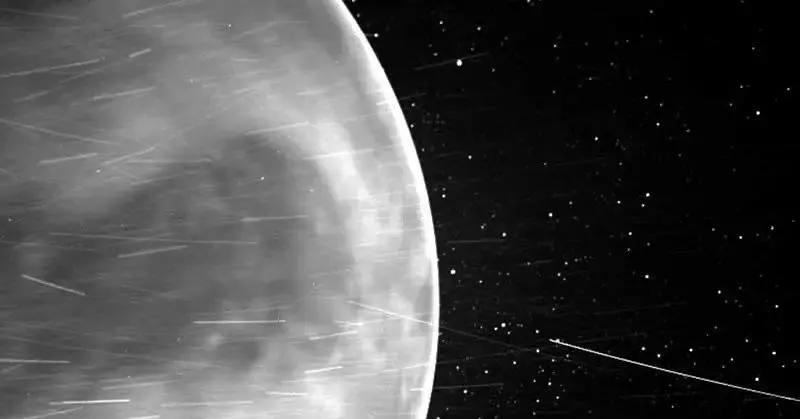
Venus, however, operates under entirely different physical parameters. When astronomers characterize Venus as a slow spinner, they are understating a truly extreme cosmic anomaly. Venus requires an astonishing 243 Earth days to complete just one full rotation on its axis. Remarkably, this rotation period is longer than Venus’s entire orbit around the Sun (which takes roughly 225 Earth days), making the brilliant morning star the slowest rotating planet in our solar system. Furthermore, Venus rotates in a retrograde direction—spinning backward compared to most other planets, including Earth.
This protracted, sluggish rotation fundamentally alters the tidal equation. Without the rapid rotational momentum required to push a satellite outward, the gravitational influence of Venus exerts an unrelenting inward pull. Any moon caught in this retrograde, low-speed gravitational well would experience extreme orbital decay. Over millions of years, the satellite would be drawn closer and closer to the planet’s upper atmosphere, crossing the critical Roche limit—the minimum distance to which a celestial body, held together only by its own gravity, can approach a second body without being torn apart by tidal forces. Once past this threshold, the moon would fragment into a ring of debris before eventually raining down into the Venusian mantle, completely consumed by the planet.
Supporting Context & Metrics: Simulating the Doom of a Venusian Satellite
To test and verify this theoretical framework, Steven Kane and his UCR research team constructed a sophisticated computer model designed to simulate the complex gravitational interactions between terrestrial planets and their hypothetical satellites.
Before running simulations on Venus, the research team rigorously tested their software by recreating the known evolutionary history and orbital migration of Earth’s Moon, successfully validating the model’s predictive accuracy. Once confirmed, they expanded the simulation parameters to explore a wide array of historical scenarios for Venus.
Key Simulation Parameters:
- Planetary Rotation Speeds: Varied from Venus’s current sluggish rate (243 Earth days) up to artificially accelerated speeds (10 to 12 hours per rotation).
- Hypothetical Lunar Masses: Ranging from 0.01 to 10 times the mass of Earth’s natural satellite.
- Orbital Configurations: Factoring in diverse initial eccentricities, inclinations, and orbital radii.
The outcomes of these extensive simulations revealed a striking consistency. Under the vast majority of baseline conditions—particularly those matching the actual physical characteristics of Venus—the lunar satellite did not maintain a stable orbit. Instead, it inevitably spiraled inward, succumbed to extreme tidal stresses, fractured, and was absorbed by the planet.
"When I made this discovery, I was shocked," Kane recalled, reflecting on the uniformity of the data. "I thought surely the broad range of scenarios I was exploring would lead to a variety of results. But it all went pretty much in the same direction."
In a handful of isolated test cases, the simulations indicated that a moon could survive for up to 4.5 billion years—essentially the entire lifespan of the solar system. However, these survival scenarios required highly artificial adjustments, such as speeding up Venus’s rotation rate to a brisk 10 to 12 hours per day while pairing it with a moon roughly equal in mass to Earth’s. Given the intrinsic nature of Venus’s current lethargic spin, these survival conditions remain mathematically possible yet physically improbable.
The Challenge of Physical Verification
Proving that Venus once possessed a moon is an immensely difficult empirical challenge. Unlike Earth, whose surface is dotted with ancient geological formations and impact craters dating back billions of years, Venus boasts a profoundly young outer shell.
Through radar mapping and surface analysis, planetary scientists have determined that the uppermost layer of Venusian rock is only a few hundred million years old. Although the planet itself formed concurrently with the rest of the solar system approximately 4.6 billion years ago, extreme, planet-wide resurfacing events—driven by catastrophic volcanic outpourings and intense tectonic upheavals—have essentially melted, paved over, and entirely remodeled the Venusian crust.
Consequently, any direct surface evidence of an ancient moon’s impact craters or debris fields has been thoroughly erased. If physical traces of an absorbed satellite still exist, they must lie deep within the planet’s interior.
On Earth, deep seismological surveys—monitoring seismic waves traveling through the planet’s mantle and core—have provided invaluable clues regarding the Moon’s giant-impact formation by revealing anomalous density structures deep underground. If future space agencies manage to successfully deploy long-duration seismic landers to the surface of Venus, analogous deep-mantle measurements might finally uncover geochemical signatures or gravitational anomalies left behind by a moon that was swallowed eons ago.
Official Statements and Expert Perspectives
The implications of the UC Riverside study extend far beyond the historical mechanics of our second planet. The consumption of a satellite is not a passive event; it represents a monumental transfer of energy and angular momentum that fundamentally alters the destiny of the host world.
Swallowing a massive satellite would have injected staggering amounts of kinetic energy and angular momentum directly into Venus. This influx would have profoundly shifted the planet’s rotation rate, internal geology, and atmospheric climate, potentially acting as the defining catalyst that steered Venus away from a temperate, Earth-like infancy and toward its current runaway greenhouse hellscape.
This revelation also injects a new perspective into the modern search for habitable exoplanets. For decades, astrobiologists attempting to identify life-supporting worlds among distant star systems have debated the exact role played by large moons. It is widely understood that Earth’s Moon plays a critical role in stabilizing our planet’s axial tilt, thereby moderating seasonal extremes and providing a stable climate conducive to complex biological evolution. However, the scientific community remains deeply divided over whether a large moon is an absolute prerequisite for planetary habitability.
"My feeling is there are benefits to having a moon, but it isn’t required for habitability," stated Steven Kane, addressing the broader astrobiological context. "The moon has definitely changed the way Earth has evolved through time, but we don’t fully know how important that role is."
By demonstrating that planets with exceptionally slow rotation speeds are structurally ill-equipped to retain moons, Kane’s research provides exoplanet hunters with a powerful new diagnostic filter. When scanning distant star systems for potentially habitable Earth-sized worlds, identifying the presence of liquid water and atmospheric oxygen is no longer enough. Astronomers must now factor in rotational dynamics: even if a terrestrial exoplanet resides comfortably within its star’s Goldilocks zone, a sluggish rotational velocity may spell a doomed trajectory for any natural satellite it once claimed.
Future Outlook: Implications for Planetary Science and Exoplanet Exploration
As planetary science enters a golden age of robotic exploration and advanced space telescopes, the shadow of Venus looms larger than ever. Long dismissed as Earth’s toxic, pressure-cooker twin, Venus is increasingly recognized as a vital laboratory for understanding how terrestrial planets evolve—and how easily planetary systems can veer off course.
Upcoming missions to Venus, such as NASA’s DAVINCI (Deep Atmosphere Venus Investigation of Noble gases, Chemistry, and Imaging) and VERITAS (Venus Emissivity, Radio Science, InSAR, Topography, and Spectroscopy) missions, alongside the European Space Agency’s EnVision orbiter, promise to unveil unprecedented details regarding the planet’s atmospheric composition, surface mineralogy, and internal geodynamics. While these missions are primarily designed to decode Venus’s climate history and volcanic past, the conceptual framework established by Kane and his team highlights the importance of looking deeper—both literally and figuratively—into the planet’s history.
Furthermore, as the James Webb Space Telescope (JWST) and upcoming ground-based extremely large telescopes characterize the atmospheres and rotation rates of nearby rocky exoplanets, theorists will rely heavily on numerical models like the UCR tidal simulation. Understanding the precise relationship between planetary spin, tidal decay, and satellite loss will allow scientists to better reconstruct the dynamical histories of alien solar systems.
Ultimately, the hypothesis that Venus ate its moon transforms our understanding of our planetary neighbor from a static geological failure into the protagonist of a violent, slow-motion cosmic tragedy. It serves as a sobering reminder that the architecture of our solar system is not merely a collection of static orbits, but a dynamic, evolving battlefield of gravity, momentum, and time—where even a planet and its moon can become locked in an embrace so tight, it leads to total consumption.