Executive Overview
In the fast-evolving landscape of digital communication, personalization has become the ultimate currency. From customizable chat backgrounds and ringtones to tailored notification sounds, users increasingly expect messaging platforms to adapt to their individual styles and communicative preferences. WhatsApp, Meta’s flagship messaging platform boasting over two billion active users globally, has traditionally maintained a rigid, uniform user interface to ensure cross-platform consistency and simplicity. However, recent developments suggest that the platform is finally relaxing its strict design boundaries.
According to a fresh wave of code discovered by the eagle-eyed app researchers at WABetaInfo, WhatsApp is actively developing a feature that will fundamentally change how users interact with messages: customizable default emoji reactions.
For years, whenever an iOS or Android user has long-pressed a message to express a quick sentiment, they have been greeted by the same immutable lineup of six default reaction icons: the thumbs-up, red heart, laughing face, surprised face, crying face, and folded hands (or thumbs-down variants depending on regional builds). While users have long been able to tap a plus sign to open the full emoji keyboard for alternative expressions, those six primary slots have remained entirely static.
The upcoming feature aims to shatter this limitation. By introducing a new “Default reactions” settings menu, WhatsApp will empower users to swap out any or all of the six default reaction slots with icons drawn directly from the comprehensive emoji library. Whether users want to swap the traditional thumbs-up for a fire symbol, a skull, a clapping pair of hands, or a niche internet meme emoji, the choice will soon be entirely theirs.
While early code references point toward potential integration with the rumored WhatsApp Plus subscriber tier, early indications suggest this could eventually roll out as a broadly accessible customization tool. Although the feature is still hidden deep within internal test builds and remains inaccessible even to active TestFlight beta testers, its dual discovery across both iOS and Android ecosystems points to an inevitable public rollout in a future app update.

Detailed Chronology: Uncovering the Custom Reaction Feature
The journey toward fully customizable emoji reactions has been a gradual process of discovery, pieced together line-by-line by software sleuths tracking Meta’s continuous updates across mobile platforms.
The Status Quo of Message Expressions
To understand the significance of this upcoming feature, one must examine the current state of WhatsApp’s reaction tray. Rolled out globally to massive acclaim in 2022, emoji reactions transformed group chats and direct messages by reducing conversational clutter. Instead of sending an entire message consisting of "LOL" or "Agreed," users could simply attach a tiny emoji anchor to a specific chat bubble.
However, user experience (UX) friction quickly emerged. While the initial six quick-reactions attempt to cover universal human emotions, they rarely align with the specific subcultures, humor styles, or contextual needs of every user base. Friends interacting in a gaming chat might frequently rely on emojis like the joystick, skull, or crying-laughing face, yet they are forced to repeatedly tap the "+" button to bypass the platform’s rigid default options.
The Android Breakthrough
The first hints that Meta was rethinking its static reaction tray surfaced in early beta builds designated for Android devices. Code analysts dissecting WhatsApp’s APK files discovered preliminary string references pointing to a settings toggle allowing users to modify their primary reaction tray. While the UI elements were incomplete and non-functional, the intent was crystal clear: WhatsApp was laying the architectural foundation to decouple the quick-reaction tray from its hardcoded constraints.
The iOS TestFlight Discovery
The narrative shifted to Apple’s ecosystem when WABetaInfo uncovered equivalent references within the latest WhatsApp beta for iOS via TestFlight. Examining package structures revealed a nascent "Default reactions" configuration panel.
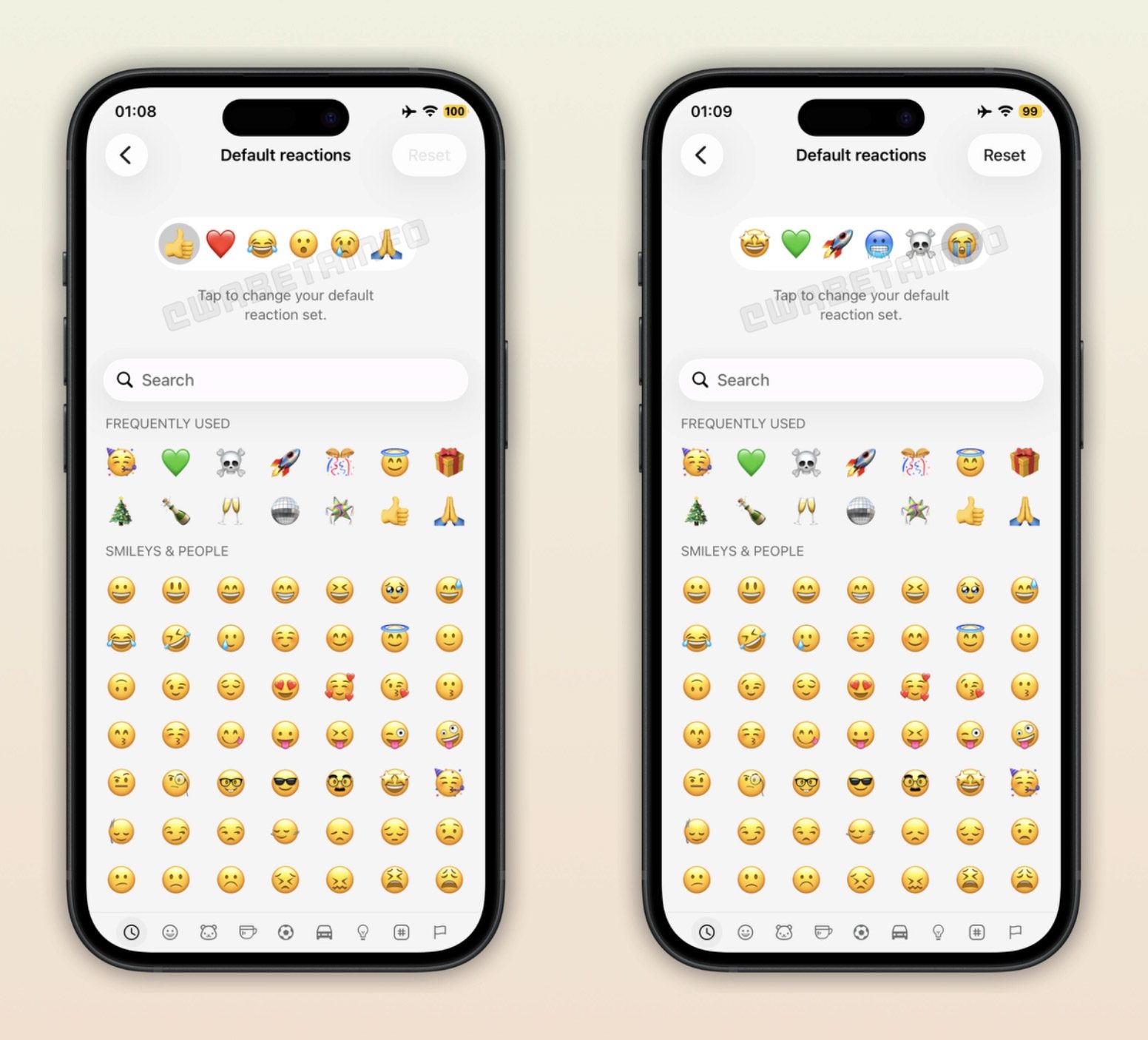
Visual assets and design breakdowns obtained from these internal builds illustrated how the feature is intended to function in practice:
- The Side-by-Side Comparison: The interface features a dual-state view. On the left side rests the classic, unyielding six-emoji default tray. On the right side sits the personalized configuration, displaying an entirely bespoke collection of custom emojis handpicked by the user from the full system keyboard.
- Granular Control: Users are not restricted to replacing just one or two slots; the system permits the total overhaul of all six default positions.
- The Safety Net: Recognizing that users might experiment and subsequently wish to revert their choices, Meta has built-in a straightforward "Restore Default" button, ensuring that anyone can effortlessly reset their reaction tray back to square one at a moment’s notice.
Despite these advanced code clues, the feature remains dormant. It is currently locked behind server-side flags, meaning even dedicated beta testers enrolled in Apple’s TestFlight program cannot yet toggle the feature on in their live environments. Nevertheless, historical precedent dictates that once UI mockups and settings strings reach this stage of development, public beta deployment usually follows within a matter of weeks.
Supporting Context & Metrics: The Psychology of Emoji Communication
To appreciate why a seemingly minor tweak like changing reaction icons matters to millions, one must examine the staggering scale and psychological impact of emojis in modern digital discourse.
The Universal Language of the Internet
According to data compiled by Unicode and various digital communication watchdogs, over 90% of the world’s online population uses emojis regularly. On messaging giants like WhatsApp, where billions of messages are exchanged daily, emojis serve a critical communicative function: paralanguage.
In face-to-face conversations, tone of voice, facial expressions, and body language provide essential context to spoken words. In text-based environments, emojis fill that vacuum, softening blunt statements, injecting humor, and clarifying intent.
| Metric Category | Estimated Global Data / Industry Benchmark |
|---|---|
| Daily WhatsApp Messages Sent Worldwide | Over 100 Billion |
| Global Smartphone Users Utilizing Emojis | > 90% |
| Average Daily Emoji Sent Worldwide (All Platforms) | Billions per day |
| Primary Driver of Chat Engagement | Quick-tap expressive tools (Reactions) |
Why Customization Drives User Retention
In the hyper-competitive arena of instant messaging—where WhatsApp fights for dominance against Apple’s iMessage, Telegram, Signal, and Facebook Messenger—personalization is a primary retention lever.
- Self-Expression and Identity: Users view their chat applications as digital extensions of their personal identities. The ability to curate the tools of expression fosters a deeper sense of ownership over the software.
- Community Subcultures: Different demographics utilize distinct visual shorthand. Gen Z and millennial chat groups often rely on ironic or hyper-specific emojis (such as the skull 💀 to signify amusement, or the clown face 🤡) that far outweigh traditional corporate-approved icons like the standard crying-laughing face.
- Competitive Parity: Competitors like Telegram have long permitted deep interface customizability, including custom reactions and interactive animated stickers. For WhatsApp to maintain its edge among power users, closing these UX gaps is essential.
Official Statements and Platform Strategy
Meta has traditionally maintained a measured approach to rolling out user-facing customizability features on WhatsApp, prioritizing network stability, encryption integrity, and minimalist UI design over chaotic feature bloat.
While official press releases regarding the custom default reactions feature have not yet been published by Meta’s communications team—owing to the early beta phase of development—company insiders and product roadmap leaks indicate a broader corporate shift. Meta is increasingly exploring monetization and premium value-adds without compromising the core end-to-end encrypted messaging experience that defines WhatsApp’s brand.
The WhatsApp Plus Factor
An intriguing detail highlighted in early technical analyses is the potential tie-in between custom reaction sets and the rumored WhatsApp Plus subscription tier.
For years, unofficial and third-party modified versions of the app—often colloquially termed "WhatsApp Plus"—attracted millions of users by offering illegal or insecure modifications, including custom themes, different reaction trays, and expanded file-sharing limits. By formally introducing deeply requested customization features into official builds—potentially gated behind an optional, value-added subscriber tier or rolled out universally as a platform enhancement—Meta can effectively neutralize the security risks associated with third-party modded apps while simultaneously capturing new revenue streams.

Whether custom reactions ultimately land as a free, universally available baseline feature or debut as part of a premium package remains one of the most closely watched details of this upcoming release cycle.
Future Outlook: What’s Next for WhatsApp’s Interface?
As WhatsApp continues to transition from a purely functional utility tool into a feature-rich social communications hub, the introduction of customizable default reactions represents a significant philosophical milestone. It signals that Meta’s design teams are increasingly willing to loosen their grip on the standardized UI in favor of user-driven adaptability.
Anticipated Rollout Timeline
Based on historical tracking of similar features by WABetaInfo:
- Phase 1 (Current): Code integration and internal testing within private developer builds.
- Phase 2 (Expected Q4 / Early Next Year): Deployment to public beta testers via TestFlight (iOS) and Google Play Beta (Android), allowing real-world telemetry collection and bug identification.
- Phase 3 (General Availability): Global rollout to all stable-channel users across iOS and Android platforms.
Broader Implications for Messaging UI
Looking ahead, the success of customizable reactions could pave the way for even deeper personalization options within WhatsApp. Analysts predict potential future enhancements such as:
- Custom Reaction Animations: Allowing users to assign bespoke visual effects or haptic feedback patterns to specific reactions.
- Dynamic Reaction Folders: Grouping reaction sets based on context (e.g., professional chats vs. close friends).
- Expanded Sticker Integration: Allowing lightweight stickers to be utilized directly within the primary reaction workflow.
For now, users on both iOS and Android must exercise patience. While the code is written and the interface mockups are verified, the final green light rests with Meta’s quality assurance teams. When the feature finally breaks out of beta, it promises to make everyday digital conversations a little more personal, a lot more expressive, and entirely tailored to the individual user.