Executive Overview
In the contemporary digital landscape, the proliferation of personal electronics has created a silent, localized infrastructure crisis on desks around the world. Between high-performance laptops, power-hungry gaming handhelds, tablets, smartphones, wireless audio peripherals, and smart accessories, the average remote worker, creator, or enthusiast routinely manages half a dozen or more rechargeable devices. Standard wall outlets and fragmented, low-wattage charging bricks are no longer sufficient to manage this ecosystem. They create clutter, introduce cable management nightmares, and often lack the requisite power delivery protocols to fast-charge modern hardware.
Addressing this modern infrastructural bottleneck, Amazon has introduced a significant price cut on the robust Sabrent 8-Port 252W USB Desktop Charging Station. Normally retailing at a higher baseline, this powerhouse multi-port hub has seen its price slashed down to $59.60 by applying a 34% off discount via the exclusive coupon code "HLKLIRDO".
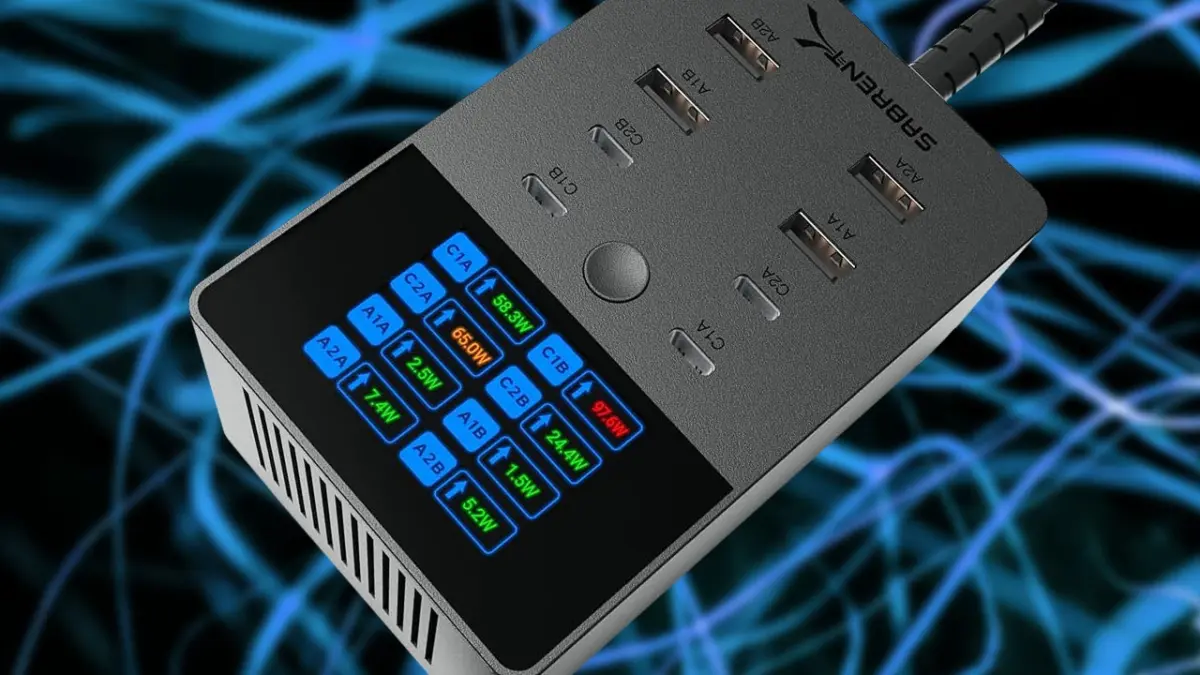
This pricing milestone marks a notable moment for tech consumers: it is the first time this high-capacity desktop charging station has dipped below the $60 threshold. For power users, multi-device households, and tech enthusiasts seeking to clean up their workspace while future-proofing their charging capabilities, this discount presents an opportune moment to upgrade. Featuring a versatile mix of four USB Type-C ports—each capable of delivering up to 100W of isolated power—alongside four USB Type-A ports, a comprehensive 252W total power budget, and a real-time LCD status display, this hardware represents a serious shift away from single-purpose wall chargers toward centralized, intelligent power distribution.
Detailed Chronology: The Evolution of Desktop Power Delivery
To understand the significance of a 252W, eight-port desktop charging station, one must look at the rapid evolution of power delivery standards over the past decade.
The Era of Fragmentation (Pre-2018)
Before the widespread adoption of USB Power Delivery (USB-PD) and USB Type-C standardization, consumers faced a chaotic landscape of proprietary charging blocks. Laptops required distinct proprietary barrel plugs or early, bulky square connectors; smartphones used a mix of micro-USB, early Type-C, and Lightning cables; and accessories charged at sluggish 5W (5V/1A) speeds. Desktop charging stations of that era were little more than glorified power strips with integrated USB boards that trickled meager currents, completely incapable of powering a modern productivity laptop, let alone a gaming handheld.
The Rise of GaN and High-Wattage Multi-Port Hubs (2019–2023)
The introduction of Gallium Nitride (GaN) semiconductor technology revolutionized the power electronics industry. GaN components could handle significantly higher voltages and switching frequencies than traditional silicon, allowing manufacturers to shrink the physical footprint of high-wattage chargers while dramatically improving thermal efficiency.
During this window, brands began rolling out multi-port desktop chargers capable of delivering 60W, 100W, and eventually 140W total outputs. However, these early multi-port hubs often suffered from power-allocation quirks. Plugging in a second or third device would frequently trigger a disruptive power-negotiation handshake, momentarily cutting power to existing connections to redistribute wattage across ports.
The Modern Power Hub Paradigm (2024–Present)
Entering the mid-2020s, stations like the Sabrent 8-Port 252W Desktop Charger reflect the maturity of modern power distribution systems. Equipped with advanced Power Delivery 3.0 (PD 3.0) and Programmable Power Supply (PPS) protocols, these devices offer dynamic, intelligent power management.
Sabrent’s trajectory with this specific hardware model has been closely tracked by retail analysts and tech consumers alike. Since its commercial rollout, the unit has maintained a relatively stable market price, reflecting its heavy-duty internal engineering and comprehensive component list. Throughout late 2024 and early 2025, minor promotional discounts occasionally lowered its price, but it stubbornly resisted breaking the psychological $60 floor. That barrier has now officially fallen. By dropping to $59.60 via coupon code "HLKLIRDO", this historic pricing event signifies not just a routine sale, but an aggressive push by retailers to make high-end GaN-adjacent multi-port desktop infrastructure accessible to mainstream consumers.
Supporting Context & Metrics: Breaking Down the Sabrent 252W Station
To fully evaluate whether the Sabrent 8-Port 252W USB Desktop Charging Station belongs on your desk, it is necessary to examine its hardware architecture, port allocation, power delivery metrics, and safety profiles under a microscope.
Comprehensive Port Architecture and Power Limits
The unit houses an impressive total of eight independent charging ports, neatly bifurcated into two distinct categories:
-
Four USB Type-C Ports:
- Individual Output: Up to 100W per port (when utilized independently or within specific distribution thresholds).
- Capabilities: Fully capable of driving demanding hardware, including high-end productivity laptops (MacBook Pro, Dell XPS, Lenovo ThinkPad), tablets (iPad Pro), smartphones, and power-hungry portable gaming systems such as the Asus ROG Ally X, Valve Steam Deck, and Lenovo Legion Go.
- Protocol Support: Power Delivery 3.0 (PD 3.0) and Programmable Power Supply (PPS), allowing for optimized voltage steps that reduce heat generation during smartphone fast-charging routines.
-
Four USB Type-A Ports:
- Individual Output: Up to 18W per port.
- Capabilities: Engineered for legacy electronics, lower-draw accessories, and peripherals. This includes wireless mice, mechanical keyboards, gaming headsets, wireless controllers, smartwatches, and true wireless earbuds.
Total Power Budget and Simultaneous Load Management
The station operates on a 252W total maximum power budget, divided evenly across its two banks:
- USB-C Bank Max Output: 126W total maximum allocation.
- USB-A Bank Max Output: 126W total maximum allocation.
When all eight ports are populated simultaneously, the intelligent internal circuitry automatically manages the power allocation to ensure that connected hardware receives stable, regulated current without overloading the station’s internal transformers.

The Real-Time LCD Status Display
One of the standout hardware features distinguishing professional-grade charging stations from basic consumer power strips is telemetry. The Sabrent unit integrates a built-in LCD status display.
In professional and enthusiast environments, knowing how much power a device is actually drawing is crucial for troubleshooting slow-charging issues or monitoring battery health. The LCD screen provides real-time readouts of power draw per port, eliminating guesswork. If a connected laptop fails to fast-charge, a quick glance at the display immediately reveals whether the cable is dropping the connection to a lower USB 2.0 data/power profile or if the device has completed its fast-charging curve and tapered down its intake.
Build Quality, Form Factor, and Longevity
Desktop clutter is the enemy of productivity. Rather than forcing users to reach behind heavy desks or crawl under furniture to plug in wall adapters, a desktop charging station anchors power directly to the workspace surface via an extended AC power cord.
Furthermore, long-term durability is a critical metric often overlooked in budget tech accessories. Industry tracking—including firsthand long-term usage reports from commerce management professionals who have maintained operational Sabrent multi-port charging hardware for nearly six years—indicates that these units exhibit exceptional longevity. Solid thermal dissipation design, robust internal soldering, and comprehensive over-current, over-voltage, and short-circuit protections ensure that the device can handle continuous, multi-year deployment without degrading performance.
Official Statements & Industry Perspective
While consumer electronics manufacturers frequently market multi-port chargers using hyperbolic marketing terminology, industry analysts and hardware reviewers evaluate these devices strictly through the lens of safety compliance, protocol adherence, and real-world thermal performance.
Industry insiders note that the integration of Programmable Power Supply (PPS) in high-wattage desktop chargers is no longer optional—it is a baseline requirement for modern device health. PPS allows the charger to dynamically adjust voltage and current in real-time (in fine increments of 20mV) by communicating directly with the connected device. This drastically reduces conversion heat loss, protecting both the charger’s internal capacitors and the lithium-ion cells inside modern smartphones and handheld gaming consoles.
Furthermore, safety advocates emphasize the importance of UL certification, over-temperature protection (OTP), and over-current protection (OCP) in units pushing upwards of 250 watts. A multi-port charger operating near maximum load handles substantial electrical current; substandard internal wiring or poorly engineered thermal management can lead to thermal runaway or hardware failure. Sabrent’s engineering reputation—built on decades of producing reliable internal storage controllers, docks, and power accessories—positions this 252W station as an enterprise-grade solution scaled for consumer desktop deployment.
Future Outlook: The Direction of Desktop Power Infrastructure
As we look toward the remainder of the decade, the trajectory of personal computing hardware suggests that power demands will only continue to rise, making robust desktop charging infrastructure an essential investment rather than a luxury.
1. The Proliferation of High-TDP Mobile Gaming and Productivity
The explosion of portable gaming handhelds (Steam Deck, Asus ROG Ally, MSI Claw, and their generational successors) has normalized the expectation of console-quality gaming on mobile, high-refresh-rate displays. These devices regularly draw between 30W and 65W under sustained gaming loads. When paired with a modern laptop requiring 96W to 140W under heavy rendering or coding workflows, single-port wall bricks quickly exhaust available wall outlets. Future-proof desktop stations equipped with multiple true-100W outputs will become standard centerpieces for digital workstations.
2. Evolving USB-PD Standards (USB-PD 3.1 and EPR)
The wider rollout of USB Power Delivery 3.1 and Extended Power Range (EPR) standards allows for power delivery up to 240W over a single Type-C cable (48V at 5A). While current stations like Sabrent’s 252W model cap individual Type-C ports at 100W, the underlying industry momentum is shifting toward higher single-port thresholds. However, for the vast majority of current-generation laptops, tablets, phones, and peripherals, a dedicated 100W port remains more than sufficient to saturate maximum fast-charging speeds.
3. The Shift Toward Centralized Workspace Management
The transition toward hybrid work models—where professionals fluidly move between home offices, co-working spaces, and corporate environments—has cemented the value of clean, modular desk setups. Centralized charging stations reduce physical wear and tear on device charging ports by providing stable, anchored connection points. They also eliminate the friction of packing and unpacking travel bricks every time a user commutes.
Conclusion and Buying Recommendation
The availability of the Sabrent 8-Port 252W USB Desktop Charging Station for $59.60 (via coupon code "HLKLIRDO") represents a rare convergence of heavy-duty engineering and aggressive retail discounting. Breaking the $60 barrier for the first time since October 2025 transforms this device from a specialty enthusiast luxury into a highly accessible upgrade for anyone struggling with desktop cable clutter and power starvation.
With eight total ports, four dedicated 100W USB-C ports utilizing Power Delivery 3.0 and PPS, four 18W USB-A ports for peripheral management, a total 252W output ceiling, and a real-time LCD power-draw monitor, this charging station effectively future-proofs any modern workstation. Whether you are charging a fleet of mobile devices, powering a demanding productivity laptop, or keeping a high-performance gaming handheld juiced during marathon sessions, this hardware delivers industrial-grade reliability directly to your desktop surface.
For consumers looking to clean up their workspace and streamline their electronic ecosystem, utilizing the Amazon coupon code HLKLIRDO before inventory or promotional windows close is an investment that will pay dividends in workspace organization and charging efficiency for years to come.