Executive Overview
In a major architectural leap for enterprise database management, Amazon Web Services (AWS) has announced a powerful new capability for Amazon Aurora PostgreSQL: the ability to directly query operational data alongside analytical data lakes formatted in Apache Iceberg and Apache Parquet. Powered by the embedded, high-performance DuckDB analytical engine—brought in-house following the acquisition of DuckLabs—this new feature allows developers, data engineers, and AI systems to execute complex queries across live transactional tables and multi-year data archives using standard SQL.
Historically, organizations looking to merge real-time transactional data with historical records had to build complex, brittle, and expensive Extract, Transform, Load (ETL) or reverse-ETL pipelines. These architectures frequently introduced data duplication, inflated cloud infrastructure expenditures, and created administrative overhead as teams struggled to keep siloed systems synchronized. Furthermore, with the exponential rise of autonomous AI agents requiring instantaneous context from disparate data sources, pre-replicating and predicting every conceivable dataset has become an impossibility.
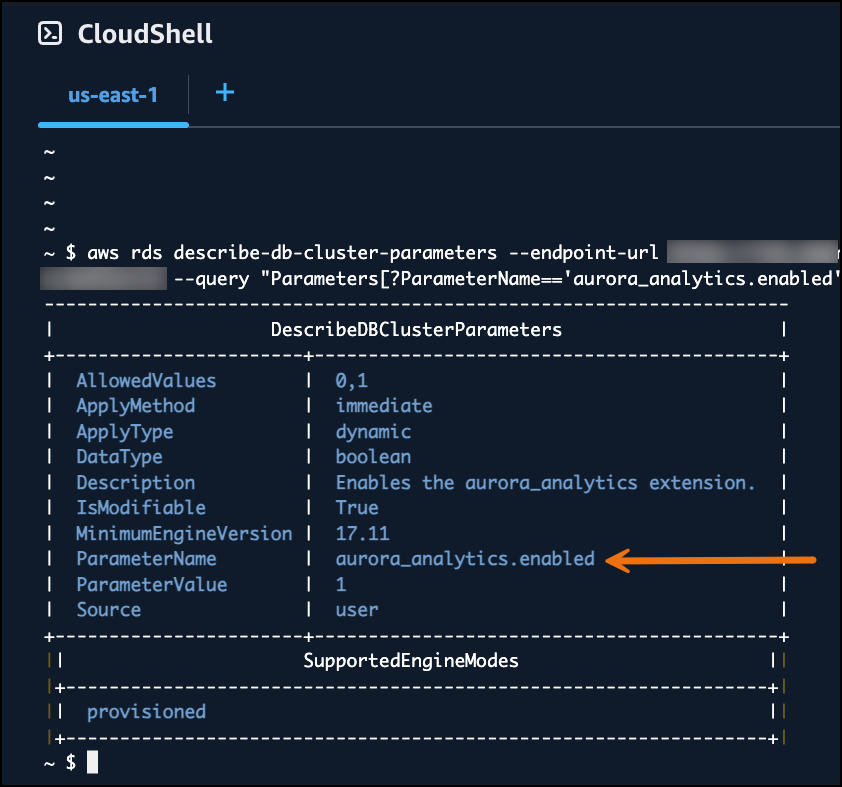
By embedding DuckDB directly within the Aurora PostgreSQL architecture, AWS has effectively eliminated the artificial barrier separating operational databases (OLTP) and analytical data lakes (OLAP). Processing happens entirely within the database boundaries without requiring additional network hops or data-duplication pipelines. Available immediately across all commercial and AWS GovCloud regions for Aurora PostgreSQL versions 17 (starting from 17.11) and 18 (starting from 18.6) at no additional software cost, this feature fundamentally redefines how applications interface with multi-tier enterprise data.
Detailed Chronology and Technical Architecture
The Integration of DuckDB into the AWS Ecosystem
The seeds of this release were planted when DuckLabs, the core engineering team behind the wildly popular open-source analytical database DuckDB, joined Amazon. DuckDB has long been celebrated in the data science and engineering communities for its vector-optimized query execution engine, which is specifically designed for analytical workloads (OLAP) running on single nodes.
Rather than forcing users to export data out of Aurora into a separate data warehouse or data lake engine, AWS architects embedded the DuckDB engine directly inside the Aurora PostgreSQL memory space and process lifecycle. This localized integration means that analytical scans against Amazon S3-stored Parquet and Iceberg files run with near-native efficiency, leveraging advanced execution optimizations such as predicate pushdown and column pruning.
Setting Up and Configuring Aurora Analytics
Implementing this functionality within an existing cloud environment requires minimal administrative friction. Administrators initiate the capability by attaching a specialized AWS Identity and Access Management (IAM) role—configured with the AuroraAnalytics feature permission—to their Amazon Aurora PostgreSQL cluster. This role grants Aurora secure, governed read access to designated buckets in Amazon S3, S3 Tables, and the AWS Glue Data Catalog.
Once the cluster is provisioned, database administrators run a simple command via the psql client or the Amazon RDS console to activate the capability:
CREATE EXTENSION aurora_analytics;Following the extension enablement, users define foreign tables pointing directly to their data lake assets. Notably, Aurora simplifies schema management by automatically inferring column definitions directly from the underlying file metadata. For large-scale data lakes housing hundreds or thousands of datasets, administrators can bypass manual table creation entirely by invoking the IMPORT FOREIGN SCHEMA command, which automatically bulk-registers all Iceberg or Parquet tables contained within an AWS Glue Data Catalog database.
Federation via Iceberg REST Catalogs (IRC)
Beyond native AWS Glue integrations, the system supports open ecosystems through Iceberg REST Catalog (IRC) compatibility. Organizations managing their data assets in external catalogs can register those catalogs once with the AWS Glue Data Catalog. From that point forward, foreign tables can be established against these external repositories seamlessly. A single SQL query can thus execute a distributed join across live Aurora tables, internal Iceberg tables, and externally cataloged data stores—all without copying or moving a single byte of data.
Supporting Context & Metrics: A Practical Walkthrough
To understand the tangible impact of this release, consider a common financial services use case: maintaining high-performance compliance and auditing systems.
The Traditional Approach vs. The New Paradigm
In a legacy setup, an application requiring a customer’s complete transaction history—comprising the last 7 days of live operations alongside 5 years of archived history—would require a multi-step engineering effort. Live records reside in an Aurora PostgreSQL transactional table (recent_transactions), while the multi-year archive is stored as compressed Parquent files in Amazon S3.
Historically, query engineers had to build nightly batch ingestion jobs to pull historical data into the operational database, vastly inflating storage costs and bloating backup sizes. Alternatively, they had to route application queries through an external query engine like Amazon Athena, introducing network latency and fracturing application logic.

Implementing the Direct Query Pattern
With the new aurora_analytics extension, the process is compressed into a single, elegant step. First, the administrator defines a foreign table mapping directly to the historical archive in S3:
CREATE FOREIGN TABLE transaction_history ()
SERVER aurora_analytics_server
OPTIONS (
    location 's3://<my-enterprise-bucket>/finance/transaction_history.parquet',
    format 'parquet'
);
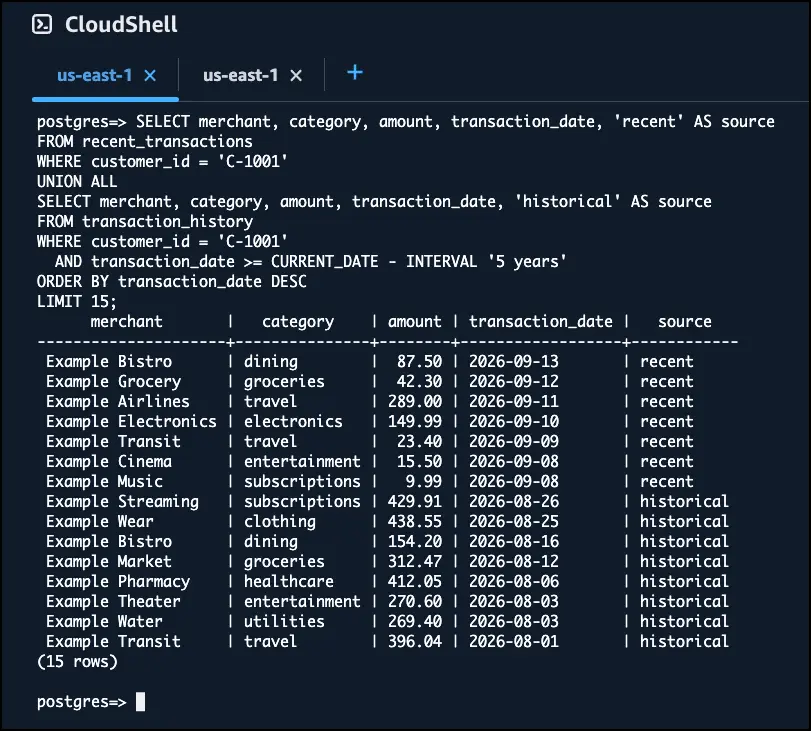
Notice the empty parentheses: Aurora reads the structural metadata directly from the Parquet file headers. Next, a developer writes a unified query using standard PostgreSQL syntax, blending real-time transactional data with deep historical records via a UNION ALL operation:
SELECT merchant, category, amount, transaction_date, 'recent' AS source
FROM recent_transactions
WHERE customer_id = 'C-1001'
UNION ALL
SELECT merchant, category, amount, transaction_date, 'historical' AS source
FROM transaction_history
WHERE customer_id = 'C-1001'
  AND transaction_date >= CURRENT_DATE - INTERVAL '5 years'
ORDER BY transaction_date DESC
LIMIT 15;
Under-the-Hood Performance Metrics
When this query executes, the workload is intelligently split:
- Aurora PostgreSQL handles the high-velocity operational scan for the most recent 7 days of data.
- The embedded DuckDB engine executes an optimized, vectorized analytical scan against the immutable Parquet files sitting in Amazon S3.
- Smart Caching: Frequently accessed data lake segments are cached locally within the Aurora instance memory, accelerating subsequent read requests.
Engineers can inspect the exact telemetry of these operations using the aurora_analytics_stat_statements() diagnostic function, which reports fine-grained execution metrics including rows scanned, total bytes read from Amazon S3, and cache hit ratios.
For performance scenarios demanding single-digit-millisecond latency on hot analytical segments, developers can materialize data lake slices directly into native Aurora tables using standard commands like CREATE TABLE AS SELECT or MERGE INTO, completely decoupling historical reads from the primary write-intensive operational path. Furthermore, these analytical scans can be fully offloaded to read-only Aurora replicas, protecting primary database performance.
Official Statements and Industry Implications
The integration of DuckDB into Aurora PostgreSQL signals a broader industry shift toward hybrid transactional/analytical processing (HTAP) without the requirement of dedicated, proprietary data warehouses for routine cross-silo analysis.
AWS engineering leadership emphasizes that this capability has been designed with future extensibility in mind. Because the core analytics layer is built around the open-source DuckDB engine, subsequent upstream performance enhancements and functional improvements to DuckDB will automatically flow down into Amazon Aurora and potentially other AWS data services.
Industry analysts point out that this release is particularly timely given the explosive growth of generative AI and autonomous software agents. AI agents deployed within enterprise environments require dynamic, unpredictable access to vast arrays of contextual data. Expecting an engineering team to pre-build specialized ETL pipelines for every ad-hoc query an AI agent might generate during a reasoning loop is fundamentally unsustainable. By providing a single SQL endpoint capable of reasoning across operational databases and cold data lakes simultaneously, AWS has provided developers with a robust foundation for next-generation intelligent applications.
Future Outlook and Availability
The direct querying capability for Apache Iceberg and Parquet data inside Amazon Aurora PostgreSQL is available immediately across all commercial AWS Regions and AWS GovCloud (US) Regions. Crucially, AWS has chosen to make this capability available at no additional software license charge. Customers incur costs solely based on incremental Aurora compute consumed during query execution and standard Amazon S3 request and data retrieval pricing.
As enterprises continue to accumulate petabytes of unstructured and semi-structured data in data lakes while maintaining mission-critical transactional records in relational databases, the architectural divide between OLTP and OLAP systems will continue to shrink. By embedding analytical engines like DuckDB directly into core relational services like Aurora PostgreSQL, AWS has established a new benchmark for database interoperability, performance, and operational simplicity.
Developers and database administrators looking to get started can immediately provision or upgrade clusters to Aurora PostgreSQL version 17.11 or version 18.6, configure their IAM policies, and reference the official Amazon Aurora documentation to transform their data architecture today.