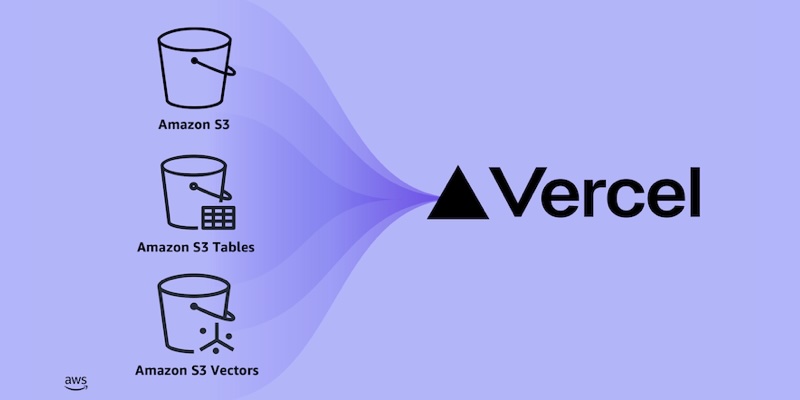
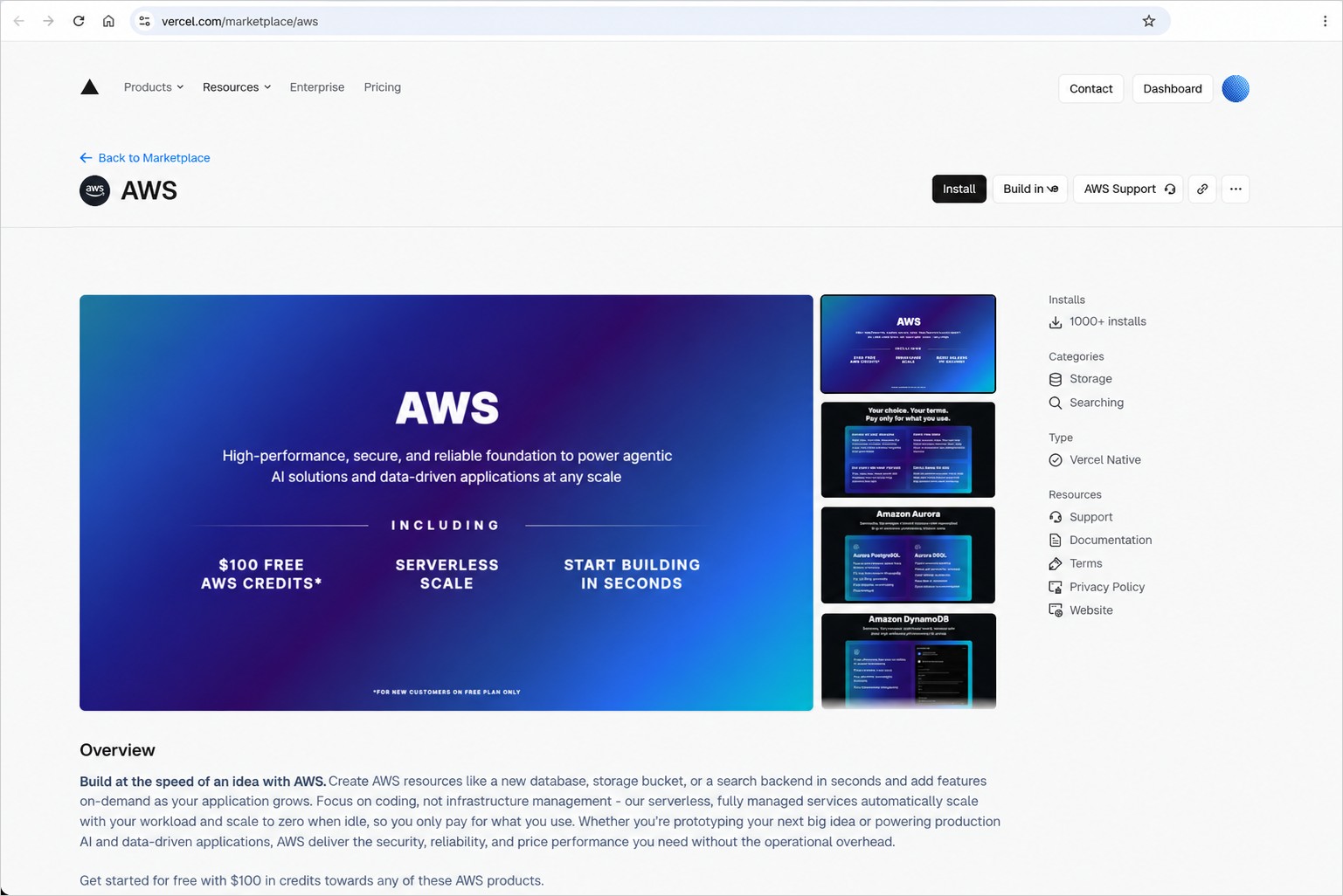
In a significant leap forward for modern cloud-native software engineering, Vercel and Amazon Web Services (AWS) have formally announced the native integration of Amazon Simple Storage Service (Amazon S3) directly into the Vercel Marketplace and v0 by Vercel. This powerful convergence bridges Vercel’s elite frontend and full-stack developer workflow with AWS’s unmatched durability, scalability, and performance in cloud storage.
For years, developers building high-performance web applications and cutting-edge artificial intelligence systems faced an administrative friction point: managing infrastructure required context-switching between Vercel’s fluid deployment pipeline and the AWS Management Console. Provisioning storage, configuring Identity and Access Management (IAM) policies, handling static credentials, and orchestrating security configurations often slowed down the velocity of product teams.
Today, that friction is eliminated. Developers can now provision Amazon S3 storage resources—including specialized workloads like Amazon S3 Tables and Amazon S3 Vectors—with mere clicks inside the Vercel dashboard or through natural language prompts via v0. By combining object storage, analytics, and vector storage seamlessly alongside existing AWS integrations such as Amazon Aurora, Amazon DynamoDB, and Amazon OpenSearch Serverless, this collaboration delivers a complete, unified application stack. Powered by secure OpenID Connect (OIDC) authentication with zero static keys required, this release establishes a new benchmark for how frontend agility and hyperscale cloud infrastructure can operate in tandem.
Detailed Chronology
The journey toward this unified developer experience represents a continuous evolution in cloud architecture, bridging the historically siloed worlds of static web hosting and deep backend data persistence.
The Era of Disconnected Workflows
Historically, web application development and cloud storage provisioning operated in parallel universes. Front-end frameworks like Next.js accelerated how developers built user interfaces, deploying globally across edge networks in seconds. However, whenever an application required persistent object storage, transactional databases, or analytical engines, the workflow ground to a halt. Developers had to leave their development environment or deployment platform, log into the AWS Management Console, manually create S3 buckets, configure CORS rules, set up bucket policies, and generate long-lived AWS access keys. These keys then had to be manually copy-pasted into environment variables, creating latent security risks and administrative overhead.
The Rise of Vercel Marketplace and AWS Synergy
Recognizing the need for integration, Vercel progressively introduced marketplace integrations for core AWS database services, including Amazon Aurora, Amazon DynamoDB, and Amazon OpenSearch Serverless. These foundational steps proved that developers wanted the convenience of serverless provisioning without sacrificing the enterprise-grade reliability of AWS. Yet, object storage—the lifeblood of user-uploaded assets, media, and unstructured document lakes—remained conspicuously absent from this direct provisioning loop, forcing developers to maintain legacy configuration pipelines for S3.
The Paradigm Shift: Native S3, S3 Tables, and S3 Vectors on Vercel
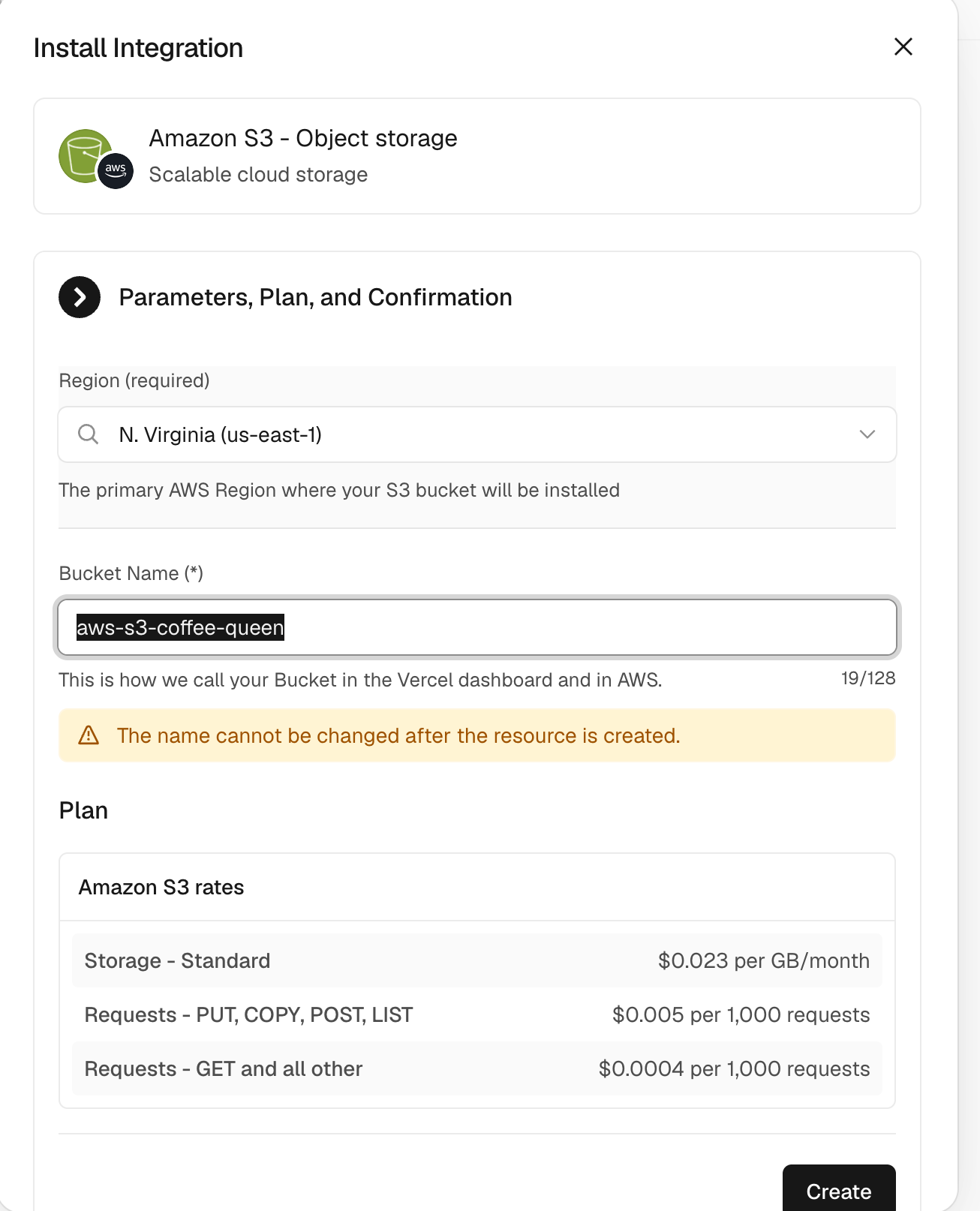
The modern milestone arrives with the native integration of Amazon S3 into the Vercel Marketplace and v0. By expanding support to encompass three distinct modern workloads—everyday object storage, high-performance analytics via S3 Tables, and semantic AI search via S3 Vectors—Vercel and AWS have fundamentally closed the loop. Provisioning is now entirely automated: developers select their desired resource type and region in the Vercel dashboard, and the platform handles the infrastructure orchestration behind the scenes, injecting temporary credentials securely at runtime via AWS Security Token Service (AWS STS) and OIDC token exchange.
Supporting Context & Metrics
To truly appreciate the engineering magnitude of this release, one must examine the specific technological pillars supporting this integration and the operational metrics driving its adoption.
The Triad of Workloads: Object Storage, S3 Tables, and S3 Vectors
Modern web applications are no longer simple CRUD (Create, Read, Update, Delete) interfaces; they are dynamic, data-intensive, AI-driven ecosystems. The Vercel-AWS S3 integration addresses this complexity by supporting three specialized architectural paradigms:
General-Purpose Object Storage: Designed for everyday web assets, user uploads, document repositories, and media streaming. Using standard AWS SDK clients (@aws-sdk/client-s3), developers can execute uploads, listings, and retrievals within Next.js API routes with minimal boilerplate.
S3 Tables: Purpose-built for analytics, S3 Tables deliver fully managed Apache Iceberg tables natively within S3. As data volumes scale, these tables automatically optimize query performance, executing automated compaction and maintenance. By leveraging libraries like DuckDB (@duckdb/node-api) directly inside Vercel Functions, developers can perform lightning-fast aggregate queries over massive datasets without standing up external data warehousing infrastructure.
S3 Vectors: Tailored explicitly for the artificial intelligence era, S3 Vectors provide purpose-built, cost-optimized vector storage. This allows AI agents, Retrieval-Augmented Generation (RAG) pipelines, and semantic search engines to query embeddings directly from S3 storage without requiring a standalone vector database.
Security is often the primary casualty of developer convenience. In traditional workflows, hardcoded or environment-stored static AWS access keys represent a persistent security vulnerability. The Vercel-AWS integration eliminates static credentials entirely.
At runtime, Vercel’s execution environment utilizes awsCredentialsProvider from @vercel/functions/oidc to exchange a short-lived OpenID Connect (OIDC) token directly with AWS STS. This generates strictly scoped, temporary security credentials tied precisely to the execution lifecycle of the function. Environment variables injected into the project—such as AWS_REGION, AWS_ROLE_ARN, and resource identifiers—serve merely as routing metadata, ensuring that compromised environment variables cannot translate into long-term cloud breaches.
Account Flexibility and Financial Incentives
Flexibility is paramount for engineering teams ranging from agile startups to massive enterprises. Developers can either create a brand-new AWS account directly through the Vercel integration—complete with an onboarding incentive of $100 in AWS credits valid for six months—or link an existing AWS enterprise account. When linking an existing account, Vercel provisions resources safely within the user’s infrastructure, preserving existing billing structures, enterprise discounts, and AWS-native governance tooling while streamlining the deployment workflow.
Official Statements
Industry leaders from both Vercel and Amazon Web Services have emphasized the transformative impact of this collaboration on the developer community.
Guillermo Rauch, CEO and Founder of Vercel, highlighted the core mission of developer velocity:
"Developers want to focus on building extraordinary user experiences, not wrestling with cloud infrastructure configurations and IAM policies. By bringing Amazon S3, S3 Tables, and S3 Vectors directly into the Vercel Marketplace and v0, we are giving millions of builders immediate access to the world’s most robust storage infrastructure without ever leaving their natural workflow. It’s enterprise-grade power wrapped in consumer-grade simplicity."
Echoing this sentiment, AWS cloud storage leadership underscored the alignment between hyperscale infrastructure and modern web development frameworks:
"Amazon S3 has long been the backbone of the internet’s data layer. By natively integrating S3 into Vercel and v0, we are bridging the gap between hyperscale cloud capabilities and cutting-edge frontend deployment. Whether developers are building simple photo galleries, complex analytical engines using Apache Iceberg, or sophisticated AI agents powered by S3 Vectors, they can now do so with absolute confidence in security, scale, and performance."
Future Outlook
The integration of Amazon S3 into the Vercel ecosystem marks a definitive turning point in how full-stack cloud applications will be conceptualized, architected, and deployed over the coming decade.
The Rise of Conversational Cloud Engineering via v0
Perhaps the most forward-looking aspect of this release is its deep integration with v0 by Vercel. Natural language prompting is rapidly evolving from a coding assistant into a complete infrastructure provisioning engine. Developers can now type natural language instructions into v0—such as "Build a support chatbot that answers queries from my company’s PDF manuals" or "Create a real-time analytics dashboard for my clickstream traffic"—and watch as v0 autonomously provisions the underlying S3 Vectors or S3 Tables resources, wires up the secure OIDC authentication pipelines, and generates fully functional, production-ready frontend and backend code.
Toward Fully Unified Serverless Ecosystems
As cloud architectures continue to converge, the traditional boundaries separating frontend edge networks, backend compute execution, and persistent data layers are dissolving. The ability to manage a complete, end-to-end application stack—ranging from React server components and Next.js APIs to Aurora databases, DynamoDB tables, OpenSearch search indices, and S3 object, vector, and table storage—all governed by a single AWS account, a unified billing model, and zero static credentials, points toward an exceptionally streamlined future for software engineering.
For developers eager to explore these capabilities, the integration is available immediately across all commercial AWS Regions supported by Vercel. Teams can visit the Vercel Marketplace or launch v0 to begin provisioning next-generation web and AI applications today.