Executive Overview
Amazon Web Services (AWS) has announced a transformative expansion of its serverless ecosystem with the introduction of native GPU support for EC2 G-series instances running on AWS Lambda Managed Instances (LMI). This capability enables developers and enterprises to execute high-performance, GPU-accelerated workloads—such as machine learning (ML) inference, media processing, rendering, and scientific computing—with the operational simplicity and automated scaling inherent to serverless architectures.
Historically, deploying GPU infrastructure has been plagued by heavy operational overhead. Engineering teams have had to manually provision instances, reconcile complex driver dependencies and CUDA versions, plan rigid capacity, and custom-build event integration pipelines. Furthermore, because single workloads rarely saturate an entire GPU, organizations frequently suffered from low utilization rates while footing the bill for idle capacity.
The integration of GPU support into AWS Lambda eliminates these hurdles. By packaging workloads as Open Container Initiative (OCI) images, teams can leverage fully managed infrastructure where Lambda handles provisioning, auto-scaling, event integration, and concurrency management. This breakthrough empowers developers to spin up enterprise-grade AI and specialized computing workloads in minutes, combining the robust hardware performance of Amazon EC2 with the agility of serverless computing.
Detailed Chronology: A Step-by-Step Implementation Journey
To demonstrate the real-world viability and seamless nature of this new paradigm, practitioners can deploy a complete Large Language Model (LLM) inference endpoint in roughly ten minutes. The workflow follows a precise four-step lifecycle: configuring capacity, building the container image, deploying the function, and executing payloads.
Step 1: Creating a Custom Capacity Provider
The journey begins by establishing a capacity provider that dictates which GPU instance types Lambda can access and how they should auto-scale. By specifying multiple instance types (such as g5.2xlarge, g6.2xlarge, and g6e.2xlarge), developers give Lambda the flexibility to choose the most cost-effective available option and gracefully fail over across hardware generations during capacity constraints.
    "CapacityProviderName": "lmi-gpu-cp",
    "VpcConfig":
        "SubnetIds": ["subnet-aaaa", "subnet-bbbb", "subnet-cccc"],
        "SecurityGroupIds": ["sg-aaaa"]
    ,
    "PermissionsConfig":
        "CapacityProviderOperatorRoleArn": "arn:aws:iam::111122223333:role/lmi-operator-role"
    ,
    "InstanceRequirements":
        "AllowedInstanceTypes": [
            "g5.2xlarge", "g6.2xlarge", "g6e.2xlarge"
        ]
    ,
    "CapacityProviderScalingConfig":
        "ScalingMode": "Auto",
        "MaxVCpuCount": 96
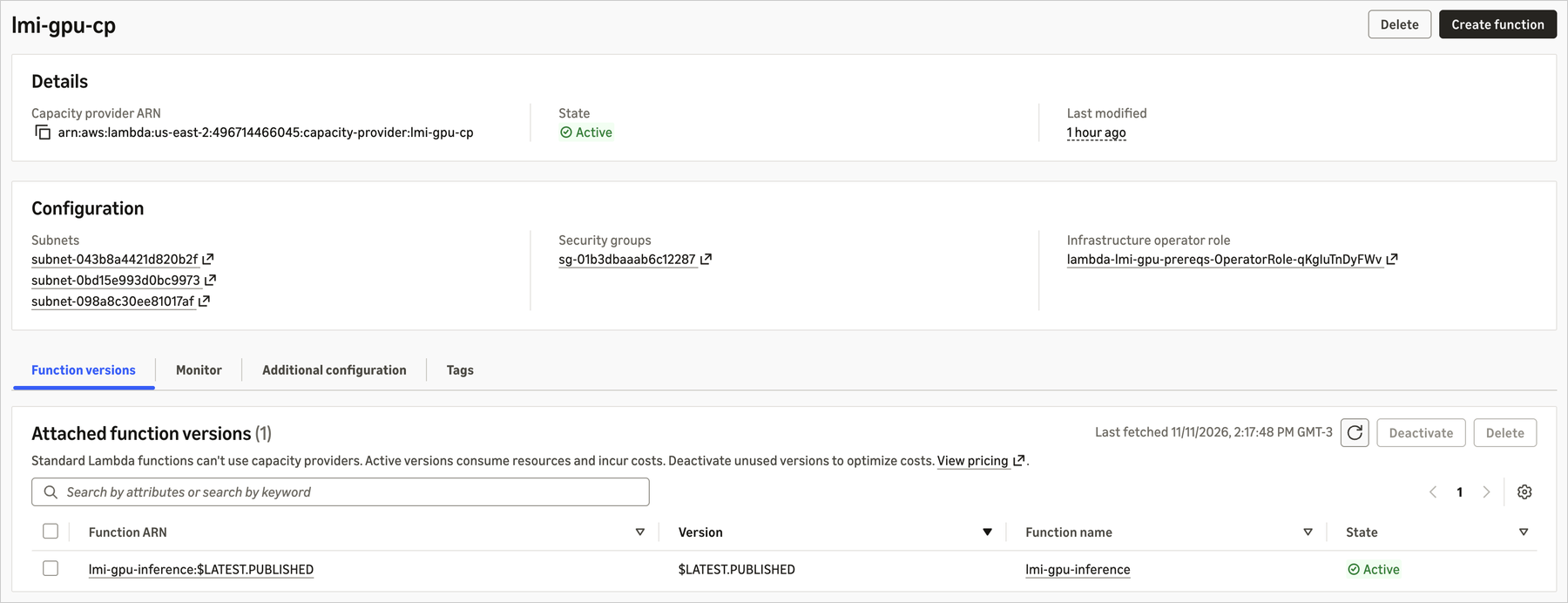
Executing this configuration via the AWS CLI registers the lmi-gpu-cp capacity provider in an active state, linking it directly to the designated virtual private cloud (VPC) subnets and security groups.
Step 2: Building and Pushing the Container Image
Rather than forcing developers to manually construct inference servers or handle intricate library integrations, AWS provides curated deep-learning base images containing PyTorch, the Transformers library, the CUDA toolkit, and optimized serving frameworks like vLLM.
For a basic LLM deployment utilizing a model such as Qwen/Qwen2.5-1.5B-Instruct, the entire Dockerfile can be reduced to a single line:

FROM public.ecr.aws/lambda/deep-learning-containers/vllm:cuda-v1Once built, the image is pushed to Amazon Elastic Container Registry (Amazon ECR), ready to be referenced by the Lambda function.
Step 3: Function Creation and Configuration
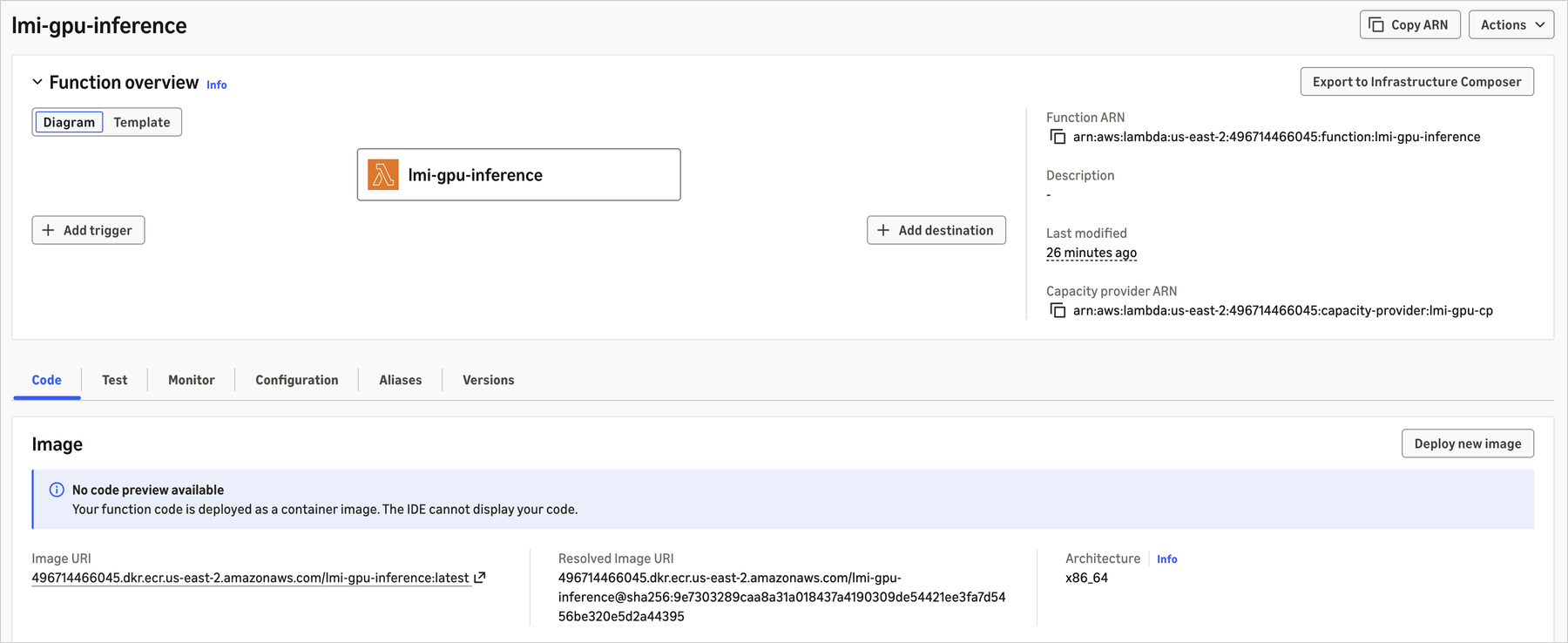
The third phase involves creating the Lambda function itself. By setting the MODEL_ID environment variable to a Hugging Face repository, local path, or Amazon S3 URI, developers instruct Lambda to download model weights, manage GPU memory, and serve incoming requests automatically.
    "FunctionName": "lmi-gpu-inference",
    "PackageType": "Image",
    "Code":  "ImageUri": "111122223333.dkr.ecr.us-east-2.amazonaws.com/lmi-gpu-inference:latest" ,
    "Role": "arn:aws:iam::111122223333:role/lmi-gpu-inference-execution-role",
    "Timeout": 900,
    "MemorySize": 16384,
    "EphemeralStorage":  "Size": 32768 ,
    "Environment":  "Variables":  "MODEL_ID": "Qwen/Qwen2.5-1.5B-Instruct"  ,
    "CapacityProviderConfig":
        "LambdaManagedInstancesCapacityProviderConfig":
            "CapacityProviderArn": "arn:aws:lambda:us-east-2:111122223333:capacity-provider:lmi-gpu-cp",
            "ExecutionEnvironmentMemoryGiBPerVCpu": 4,
            "PerExecutionEnvironmentMaxConcurrency": 4

    ,
    "AcceleratorConfig":  "AcceleratorMemorySize": 16
Key architectural parameters include the AcceleratorConfig, which ensures the execution environment lands on an appropriately sized GPU, and PerExecutionEnvironmentMaxConcurrency, which allows vLLM to batch concurrent requests. This maximizes hardware utilization by allowing multiple invocations to share a single copy of the model residing in GPU memory.
Step 4: Publishing and Invoking the Endpoint
To prevent cold-start latency for end-users, functions on Lambda Managed Instances execute from a published version. Publishing provisions the execution environment, downloads model weights, and warms up the inference engine ahead of time.
aws --region us-east-2
  lambda publish-version
  --function-name lmi-gpu-inference
  --publish-to LATEST_PUBLISHED
Invoking the endpoint with a standard OpenAI-compatible JSON payload yields immediate results:
aws --region us-east-2
  lambda invoke
  --function-name 'lmi-gpu-inference:$LATEST.PUBLISHED'
  --cli-binary-format raw-in-base64-out
  --payload '"messages": ["role": "user", "content": "Explain serverless GPU inference in one sentence."], "max_tokens": 128'
  /dev/stdout
The resulting output confirms that the model successfully processed the request inside a serverless execution environment, returning standard OpenAI-formatted completion metadata.
Supporting Context & Technical Metrics
The integration of GPU instances into Lambda Managed Instances is underpinned by robust technical boundaries designed to support demanding enterprise workloads:
- Extended Timeouts: Functions support timeouts of up to 90 minutes for asynchronous and event-source mapping invocations, accommodating heavy batch processing, multi-step inference, and complex media transcoding jobs.
- Storage and Memory Limits: Container images up to 32 GB are supported (with files up to 10 GB), paired with up to 32 GB of NVMe ephemeral storage in
/tmpfor caching model weights. - Optimized Boot Times: Seekable OCI (SOCI) lazy loading allows execution environments to begin running tasks before container images are fully downloaded, slashing startup times by up to 70%.
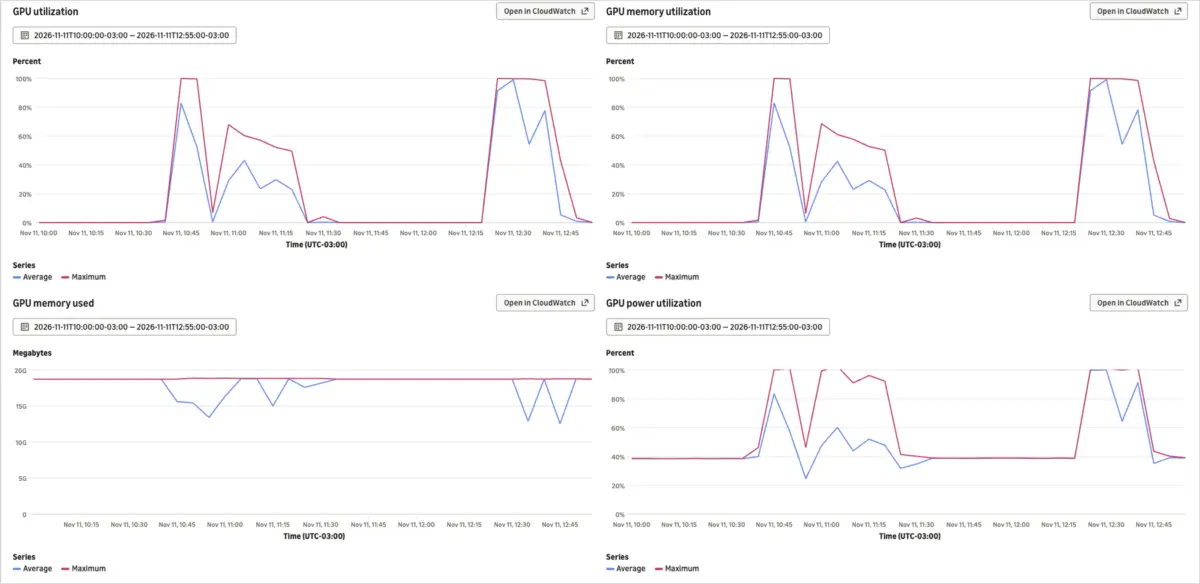
- Granular Observability: Amazon CloudWatch natively surfaces GPU metrics—including GPU utilization, GPU memory utilization, GPU memory used, and GPU power utilization—alongside standard serverless execution metrics.
+-----------------------------------------------------------------------------------+
|                         AWS Lambda Managed Instances (LMI)                        |
|                                                                                   |
|  +--------------------+    +--------------------+    +-------------------------+  |
|  | Event Triggers     | -> | Lambda MicroVMs    | -> | GPU-Accelerated LMI     |  |
|  | (S3, SQS, API GW)  |    | (CPU-based logic)  |    | (vLLM / Custom OCI)     |  |
|  +--------------------+    +--------------------+    +-------------------------+  |
+-----------------------------------------------------------------------------------+
Official Statements and Architectural Philosophy
AWS engineers emphasize that this release is designed to bridge the gap between self-managed infrastructure and true serverless abstraction.
"Customers have repeatedly asked to run GPU workloads with the absolute simplicity of serverless," notes lead product documentation from AWS. "Building on self-managed GPU infrastructure forces teams to waste cycles on driver compatibility, capacity planning, and scaling logic. By consolidating functions onto shared instances and keeping GPUs busy across concurrent requests, we eliminate these operational barriers while maximizing the return on hardware investment."
By deeply integrating GPU workloads into the broader Lambda programming model—such as combining them with Lambda Durable Functions for multi-step workflow orchestration and Lambda MicroVMs for secure, stateful CPU execution logic—AWS is establishing a unified runtime environment for modern, agentic AI applications.
Future Outlook & Industry Implications
The availability of native GPU support on AWS Lambda Managed Instances marks a significant milestone in the evolution of cloud-native computing. By lowering the barrier to entry for accelerated hardware, AWS is democratizing access to high-performance machine learning and data processing.
Looking forward, we can expect organizations to rapidly migrate custom inference microservices, specialized computer vision pipelines, and real-time audio/video transcoding tasks away from bloated, always-on Kubernetes clusters and onto serverless paradigms. As support expands beyond the initial G-series lineup (G4dn, G5, G6, G6f, Gr6, Gr6f, G6e) to future hardware generations, the financial and operational friction of scaling accelerated workloads will continue to shrink, paving the way for more responsive, cost-effective, and intelligent cloud architectures.