Executive Overview
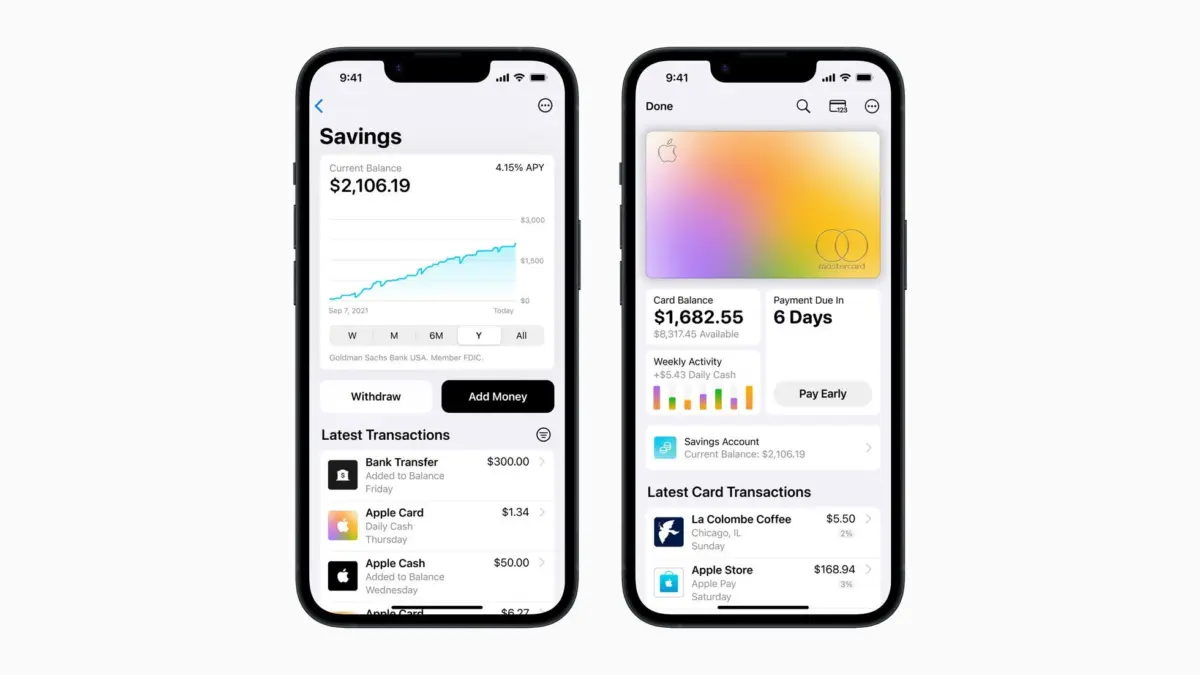
In a calculated and aggressive expansion of its consumer financial services ecosystem, Apple officially launched a high-yield savings account for Apple Card users, developed in strategic partnership with Wall Street titan Goldman Sachs. The rollout marks a significant escalation in Apple’s multi-year campaign to embed itself into the daily financial lives of its massive global user base, transforming the iPhone from a communications and entertainment hub into a comprehensive digital wallet and neo-banking platform.
The core offering of this newly introduced product is straightforward yet disruptive: Apple Card holders can now automatically deposit their "Daily Cash"—the cashback rewards accrued from purchases made using
the card—directly into an FDIC-insured savings account boasting an impressive Annual Percentage Yield (APY) of 4.15%. To put this figure into perspective, it towers over the national average and exponentially outperforms traditional brick-and-mortar financial institutions. For instance, legacy giants like Bank of America offer standard savings account yields as low as 0.01% APY, rendering traditional deposits virtually stagnant against the forces of inflation.
However, the ambitions of the Apple-Goldman Sachs partnership extend far beyond merely storing spare change or automated rewards. The platform allows users to bypass traditional banking conduits entirely by depositing personal funds directly from external bank accounts into their Apple savings account, up to a maximum balance cap of $250,000—the standard limit for Federal Deposit Insurance Corporation (FDIC) coverage.
This strategic maneuver positions Apple not just as a hardware manufacturer or software developer, but as a formidable competitor to traditional retail banks, fintech disruptors, and digital-first neo-banks. Coming on the heels of the recent rollout of Apple’s "Buy Now, Pay Later" (BNPL) service—which directly challenges established players like Klarna and Affirm—the high-yield savings account signals that Apple’s fintech ambitions are transitioning from exploratory ventures to core business drivers. This report provides a comprehensive examination of the mechanics behind Apple’s new financial product, analyzes its broader economic implications, details official corporate statements, and evaluates the future outlook of the tech giant’s war on traditional banking.
Detailed Chronology: From Apple Pay to the Digital Wallet Revolution
To fully comprehend the significance of the Apple Card high-yield savings account, it is essential to trace the deliberate, step-by-step evolution of Apple’s financial services strategy over the past decade. Apple has methodically built a fortress of services designed to increase user retention, generate high-margin recurring revenue, and deeply integrate hardware with proprietary software ecosystems.
Phase One: The Genesis of Mobile Payments (2014–2018)
Apple’s journey into financial services began in October 2014 with the introduction of Apple Pay. Initially met with skepticism from traditional banking institutions that feared losing control over customer relationships, Apple Pay slowly revolutionized point-of-sale transactions by replacing physical credit and debit cards with secure, tokenized digital cards stored within the iPhone’s Wallet app.
Over the next few years, Apple steadily expanded Apple Pay’s footprint globally, integrating transit systems, peer-to-peer payments via Apple Pay Cash, and in-app purchasing capabilities. While Apple Pay was fundamentally a friction-reducing utility designed to drive iPhone sales rather than a direct monetization engine for financial transactions, it laid the essential groundwork for consumer trust in Apple as a secure custodian of financial data.
Phase Two: The Physical-Digital Hybrid—The Apple Card (2019)
In March 2019, Apple took a quantum leap forward by announcing the Apple Card, created in partnership with Goldman Sachs and backed by the Mastercard payment network. Released later that summer, the Apple Card was heralded for its sleek, laser-etched titanium physical card (which lacked numbers, CVV codes, or signature lines for enhanced security) and its deeply integrated digital counterpart housed within the iOS Wallet app.
The Apple Card introduced several consumer-friendly innovations:
- No Fees: Apple famously eliminated annual fees, foreign transaction fees, over-the-limit fees, and late fees.
- Daily Cash: Unlike traditional credit cards that require users to accumulate points over months before redeeming them for gift cards or statement credits, the Apple Card paid out cash rewards instantly ("Daily Cash") ranging from 1% to 3% depending on the merchant.
- Privacy and Transparency: The card offered advanced budgeting tools, color-coded spending categories, and algorithmic spending tracking while leveraging Apple’s privacy-first architecture to ensure Goldman Sachs could not sell user transaction data for advertising.
Phase Three: Expanding the Credit Ecosystem (2023)
As macroeconomic conditions shifted and interest rates climbed globally throughout 2022 and 2023, Apple accelerated its fintech timeline. In March 2023, Apple introduced Apple Pay Later, allowing eligible users to split purchases into four equal payments spread over six weeks with zero interest and no hidden fees. This move instantly placed Apple in direct competition with dominant short-term credit providers such as Klarna, Affirm, and Afterpay.
Just weeks after the rollout of Apple Pay Later, Apple and Goldman Sachs dropped their biggest financial bombshell yet: the high-yield savings account. By integrating high-interest savings directly into the infrastructure of the Apple Card and Wallet app, Apple closed the loop on the consumer financial lifecycle. Users could now earn cash rewards, spend them, finance larger purchases through BNPL, and save surplus capital—all within a single, unified interface on their iPhones.
Supporting Context & Metrics: Analyzing the 4.15% APY and the Banking Landscape
The launch of the Apple Card savings account occurred within a unique macroeconomic climate characterized by aggressive Federal Reserve interest rate hikes aimed at combating persistent inflation. As the federal funds rate rose throughout 2022 and early 2023, digital banks and online-only institutions quickly raised their annual percentage yields to attract deposits. Traditional brick-and-mortar institutions, however, were notably slower to pass these higher yields on to everyday checking and savings account holders.
The Great Yield Disparity
To understand why Apple’s 4.15% APY has generated substantial industry buzz, one must examine the staggering asymmetry in the modern retail banking sector:
- Traditional High-Street Banks: Institutions such as Bank of America, Chase, and Wells Fargo maintain massive physical branch networks funded by keeping deposit rates near absolute zero. For standard savings accounts at these legacy institutions, the APY languishes at a meager 0.01%.
- Online Neo-Banks & Fintechs: Competitors like Ally Bank, Marcus by Goldman Sachs, Capital One 360, and Wealthfront frequently offer competitive high-yield savings accounts hovering between 4.00% and 5.00% APY.
- The Apple/Goldman Sachs Offering: At 4.15% APY, Apple’s account sits comfortably within the upper tier of competitive online savings yields, drastically outperforming traditional banks while remaining safely backed by FDIC insurance up to the $250,000 statutory limit via Goldman Sachs Bank USA.
| Financial Institution / Product | Account Type | Current APY | Monthly Fees | Minimum Balance Requirement |
|---|---|---|---|---|
| Bank of America | Standard Savings | 0.01% | Yes (waivable) | Yes |
| Chase Bank | Premier Savings | 0.01% | Yes (waivable) | Yes |
| Apple / Goldman Sachs | High-Yield Savings | 4.15% | None | None |
| Marcus by Goldman Sachs | Online Savings | 4.40% | None | None |
| Ally Bank | Online Savings | 4.25% | None | None |
While financial purists quickly pointed out that Apple’s 4.15% rate, while strong, is not technically the absolute highest yield available on the open market (with several niche digital banks offering slightly higher percentages), the true value proposition of Apple’s product lies elsewhere: frictionless user experience and ecosystem integration.
The Power of Frictionless Financial Management
For millions of iPhone users, the psychological and logistical friction of opening an account with an unfamiliar online bank—completing lengthy KYC (Know Your Customer) verifications, linking external accounts, and downloading standalone mobile apps—has historically discouraged them from chasing higher yields.
By embedding the high-yield savings account directly into the iOS Wallet app, Apple eliminated this friction entirely. An Apple Card user can activate a savings account, redirect their Daily Cash rewards, and transfer personal funds in a matter of taps, all without ever leaving the Apple ecosystem. Furthermore, the automation of Daily Cash deposits creates a compounding savings engine: every time a user buys a cup of coffee or books a flight, a percentage of that transaction is instantly routed into an account earning over 400 times the national average interest rate.
Official Statements and Corporate Strategy
The underlying philosophy guiding Apple’s financial services expansion was articulated clearly by corporate leadership during the launch announcement. The tech giant has consistently framed its financial products not as aggressive disruptions designed to destabilize the global monetary system, but as wellness tools intended to improve users’ financial health.
Jennifer Bailey, Apple’s vice president of Apple Pay and Apple Wallet, captured this narrative in an official statement released by the company:
"Our goal is to build tools that help users lead healthier financial lives, and building Savings into Apple Card in Wallet enables them to spend, send, and save Daily Cash directly and seamlessly — all from one place."
This framing is a masterclass in consumer relations. By positioning financial management as an extension of personal wellness—much like Apple Health tracks physical activity, sleep patterns, and heart rates—Apple softens the regulatory and competitive blowback traditionally faced by technology firms attempting to enter the heavily regulated banking sector.
Behind the consumer-facing wellness rhetoric, however, lies a deeply calculated business strategy orchestrated in partnership with Goldman Sachs. For Goldman Sachs, the partnership provides a massive, low-cost customer acquisition engine. Building a consumer deposit base is notoriously expensive for traditional investment banks, requiring vast physical branch networks or high-spend digital marketing campaigns. By partnering with Apple, Goldman gains instantaneous access to hundreds of millions of affluent, tech-savvy iPhone users who are already pre-qualified through their ownership of an Apple Card.
Industry analysts have noted that this symbiotic relationship allows Apple to leverage Goldman’s banking license and regulatory compliance infrastructure while avoiding the direct regulatory burdens and capital reserve requirements that govern chartered banks. Apple provides the pristine user interface, the brand equity, and the distribution network; Goldman provides the back-end banking architecture and regulatory compliance.
Future Outlook: What’s Next for Apple Financial Services?
As the Apple Card high-yield savings account gains traction in the United States, industry watchers are already looking ahead to the future trajectory of Apple’s financial ecosystem. The launch of this product is widely viewed not as a standalone feature, but as a critical stepping stone toward a much broader, more ambitious financial services roadmap.
1. International Expansion
Currently, the Apple Card, Apple Pay Later, and the high-yield savings account are restricted exclusively to users within the United States. This limitation is primarily driven by the complex web of international banking regulations, localized credit bureau systems, and the necessity of securing regional banking partners equivalent to Goldman Sachs. However, given Apple’s historical playbook—where features debut stateside before rolling out globally—international expansion is an inevitability rather than a possibility. Markets such as the United Kingdom, the European Union, Canada, and Australia represent prime targets for future rollout, though regulatory hurdles in these jurisdictions will likely require tailored partnerships with local financial institutions.
2. Deepening Credit and Wealth Management Integration
With Apple now capturing consumer spending data (via Apple Card), short-term financing behavior (via Apple Pay Later), and liquid savings (via the high-yield savings account), the company possesses a holistic financial profile of its users that rivals traditional financial institutions. The logical next evolution of this ecosystem points toward more advanced wealth management and advisory services. Could "Apple Wealth" be on the horizon? Industry experts speculate that Apple could eventually integrate automated robo-advising, low-cost index fund investing, or automated retirement planning directly into the Wallet app. By allowing users to invest their savings in equities or mutual funds with the same single-tap simplicity currently used to deposit Daily Cash, Apple could capture an even larger share of consumer net worth.
3. The Threat to Traditional Banks
The traditional banking sector is watching Apple’s maneuvers with mounting anxiety. Legacy banks have long relied on customer inertia—the reluctance of consumers to switch banks due to habit or inconvenience—to maintain low deposit rates and generate massive net interest margins. Apple’s seamless user experience shatters this inertia. When a user realizes they are earning 0.01% on their savings at Bank of America when they could be earning 4.15% with a few taps on their iPhone, the psychological barrier to migration crumbles.
While major global banks are currently "too big to fail" and boast trillions in assets, the slow bleed of retail deposits to fintech disruptors and tech giants like Apple poses a long-term existential threat to their traditional retail banking business models. To compete, traditional banks will either need to fundamentally overhaul their proprietary digital applications to match Apple’s ease of use or accept a diminished role as back-end utilities while consumer-facing tech giants own the relationship with the end customer.
Conclusion
Apple’s introduction of a high-yield savings account in partnership with Goldman Sachs is far more than a minor perk for Apple Card holders. It is a watershed moment in the convergence of technology and finance. By offering an attractive 4.15% APY, zero fees, FDIC insurance, and frictionless integration within the iOS Wallet app, Apple has weaponized convenience to redefine what consumers expect from a banking relationship. As Apple continues to stitch together spending, saving, borrowing, and investing into a single ecosystem, the boundary between Big Tech and Big Finance dissolves further, cementing the iPhone as the ultimate master key to the modern digital economy.