By Alberto Onetti Chairman of Mind the Bridge & Professor at the University of Insubria
Executive Overview
For decades, the global economic narrative has been dominated by terrestrial frontiers—Silicon Valley software, Shenzhen manufacturing, and the relentless rise of artificial intelligence in sprawling server farms. Yet, hidden beneath the surface lies one of the most powerful, yet historically overlooked, engines of global prosperity: the blue economy.
Encompassing every commercial and industrial sector anchored to the world’s oceans, seas, and coastal regions—ranging from traditional shipping, fisheries, and aquaculture to offshore renewable energy and cutting-edge marine biotechnology—the blue economy is staggering in scale. Having doubled in economic value over a mere 25-year window, it now sits at an estimated $2.6 trillion. To conceptualize its sheer mass, if the blue economy were recognized as an independent sovereign nation, it would instantly rank as the fifth-largest economy on the planet.
As the globe grapples with a volatile intersection of geopolitical instability, escalating energy costs, fragile supply chains, and the compounding realities of climate change, humanity is increasingly turning back to the sea. This pivot is not merely about harvesting marine resources; it is about systemic modernization. Startups, scaleups, and maritime authorities are deploying advanced "blue technology" to redefine how humanity moves goods, secures energy grids, and defends critical maritime infrastructure.
Far from suffering under the broader venture capital contractions seen across traditional terrestrial sectors, blue tech is surging. Backed by strategic defense investments, robust infrastructural transformations, and a burgeoning wave of open innovation, the maritime tech sector is rewriting the rules of modern industrial growth.
Detailed Chronology: The Asccent and Acceleration of Blue Tech
To understand where the blue economy is heading, one must examine its steady, resilient trajectory over the past half-decade—a timeline marked by unprecedented growth in scaleup formation and capital mobilization.
2021–2024: The Foundation of Resilience
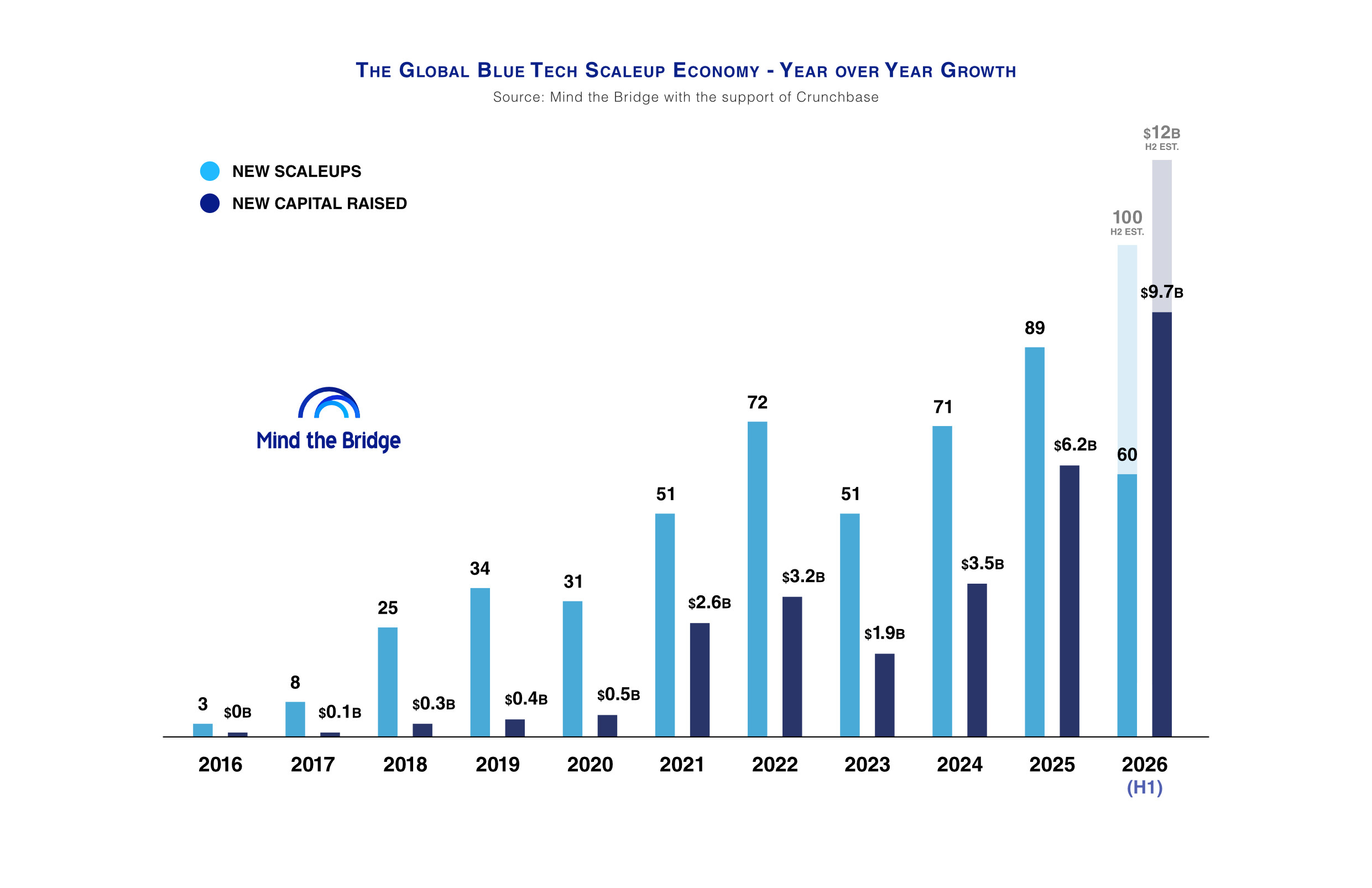
While broader tech ecosystems experienced sharp valuation corrections and funding slowdowns following the post-pandemic peak, the blue tech sector charted a completely different course. Beginning in 2021, the ecosystem established a consistent upward trajectory, generating an average of 70 new scaleups per year. Unlike speculative consumer tech plays, blue tech solutions were anchored in hard infrastructure, supply chain logistics, and environmental necessity—attributes that appealed heavily to forward-thinking institutional investors.
2025: The Inflection Point
The year 2025 served as a breakout milestone for marine innovation. Fueled by urgent demands for maritime security and decarbonization, total global funding for blue tech scaleups doubled compared to the previous year, crossing the $6.2 billion threshold. This capital injection was no longer limited to niche environmental grants; it represented heavy venture capital and private equity commitments into capital-intensive, high-impact maritime enterprises.
2026: The $10 Billion Surge and Defense Catalyst
The momentum accelerated exponentially moving into 2026. According to data tracked in the “Rethinking the Blue Economy” report—produced by Mind the Bridge with support from Crunchbase—blue tech companies had already raised nearly $10 billion through the third quarter of 2026, easily eclipsing the full-year figures of 2025 with an entire quarter still remaining.
Much of this extraordinary surge has been driven by massive rounds in maritime defense and infrastructure resilience. Major players like Anduril Industries (which secured a staggering $5 billion in 2026) and Helsing ($1.8 billion raised in 2026) have injected unprecedented liquidity into the sector, proving that maritime security and autonomous ocean defense are central pillars of modern geopolitical strategy. Driven by this velocity, preliminary projections indicate that total annual funding for blue tech will comfortably exceed $12 billion by the close of 2026, with an anticipated 100 new blue tech scaleups emerging within the calendar year.
Supporting Context & Metrics: Decoding the Blue Tech Matrix
Despite its unified moniker, the blue economy is not a monolithic sector. It is a complex, multi-layered ecosystem encompassing diverse technological sub-sectors, each operating at varying levels of commercial maturity and market readiness.
The 20-Group Technology Cluster
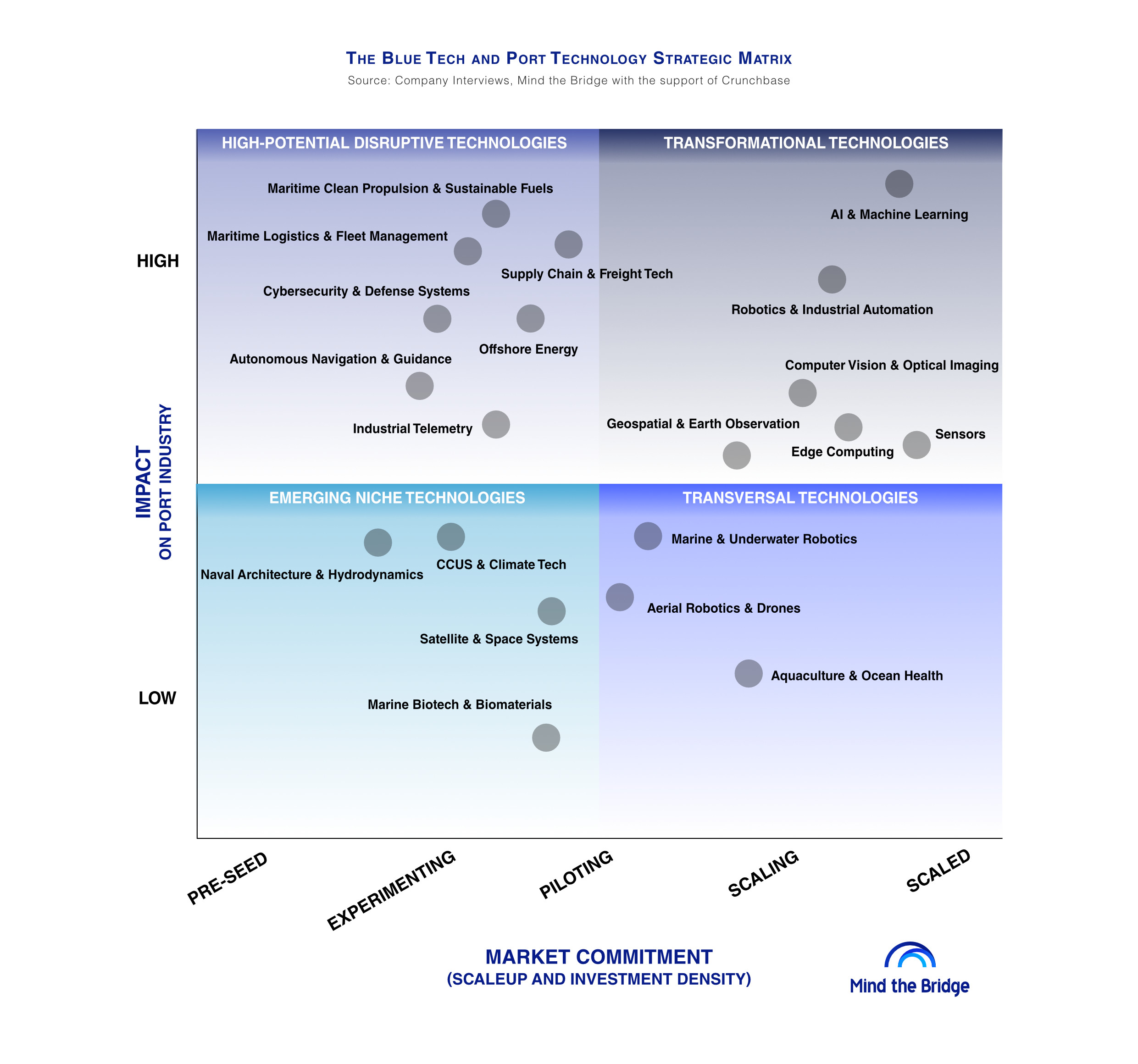
To bring analytical clarity to this sprawling landscape, researchers at Mind the Bridge categorized every unique technology developed by modern blue scaleups into 20 distinct groups. These groups were subsequently evaluated across two fundamental vectors:
Industry Impact: The fundamental capacity of the technology to disrupt, optimize, or radically transform traditional maritime operations.
Market Commitment: A composite metric measuring scaleup density and capital investment concentration within that specific vertical.
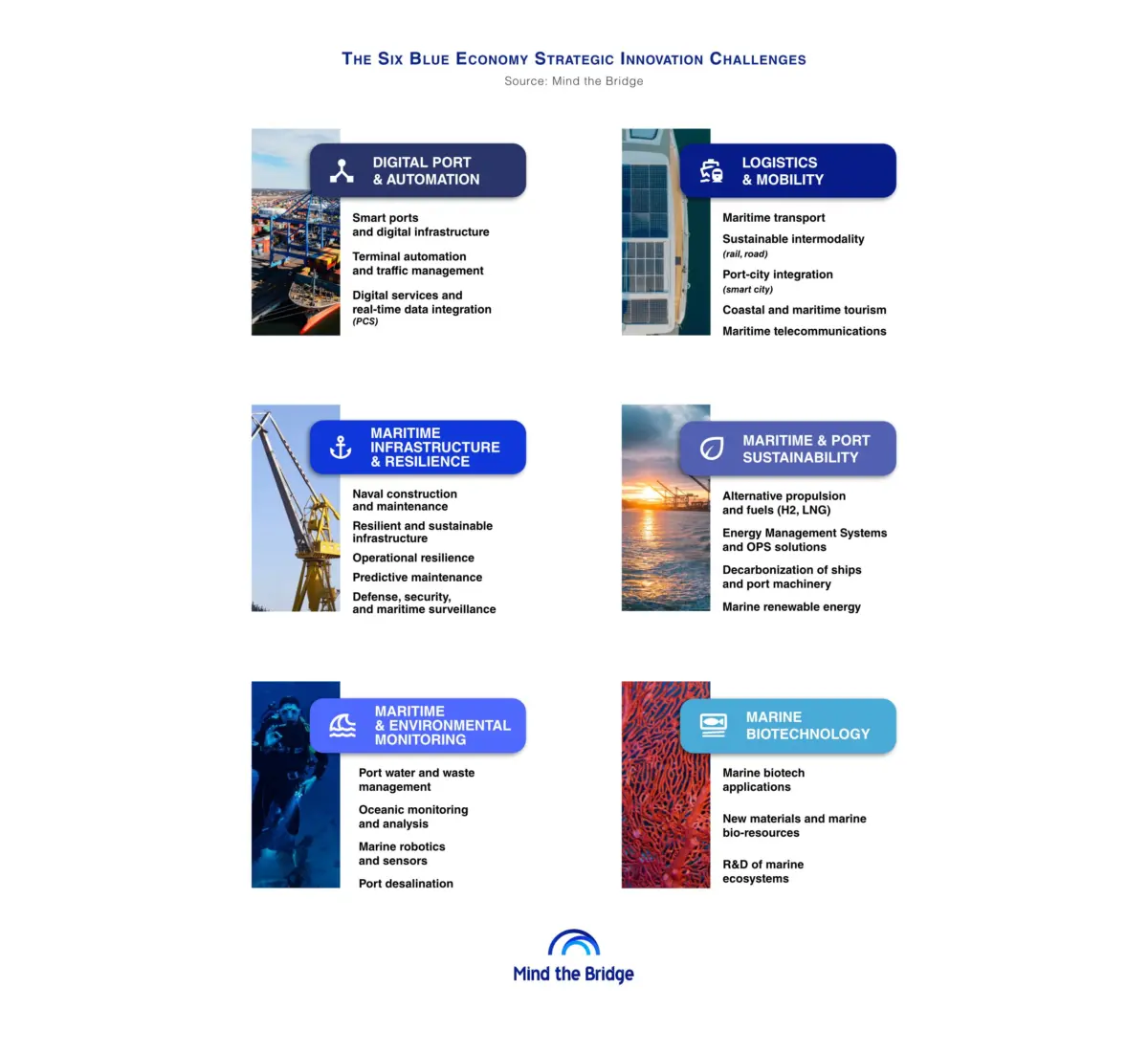
While transversal technologies (those with indirect or supporting impacts on maritime operations) and emerging, ultra-niche biotech solutions populate the exploratory quadrants of the matrix, the core growth is heavily anchored in high-commitment, high-impact domains. These include port automation, green propulsion systems, subsea data transmission, and autonomous oceanic monitoring.
The Port Paradigm: The World’s "Smartest Smart Cities"
If we ask where this technological convergence is most acutely felt, the answer is unequivocally found in our global ports.
Ports are the physical bottlenecks and operational epicenters of global trade. In many ways, modern ports operate as mini-blue economies unto themselves—dense, hyper-complex urban and industrial ecosystems where energy logistics, multimodal transport, digital data streams, and human mobility intersect. Put simply, ports are the smartest smart cities on Earth.
Just as smart cities required a standardized playbook a decade ago to manage urban digital transformation, modern ports are now seeking structured frameworks to integrate Internet of Things (IoT) sensors, autonomous cargo handlers, predictive AI maintenance, and zero-emission shore power. They represent the ultimate sandbox where maritime innovation can be tested at scale before cascading into the broader global economy.
Official Statements and Industry Insights
To capture the strategic priorities, operational bottlenecks, and real-world hurdles facing maritime hubs, the Rethinking the Blue Economy report incorporates qualitative insights and deep-dive interviews with leaders from 10 of the world’s leading port authorities.
By examining blueprints and best practices from trailblazing institutions such as the Port of Barcelona, the Port of Bergen, the Port of Seattle, the Port of Rotterdam, and the Port of Los Angeles, a clear consensus emerges: technological adoption is no longer optional; it is an existential requirement for global supply chain survival.
Alberto Onetti, Chairman of Mind the Bridge and professor at the University of Insubria, emphasizes the urgency of collaborative frameworks:
"The blue economy is one of the largest, yet least visible, engines of the global economy. For startups, that means unprecedented opportunities to modernize how we move goods, produce energy, and manage marine resources. To truly ‘get there,’ port authorities, operators, startups, investors, and policymakers need a shared agenda and vision, working on the exact same challenges."
To bridge the gap between legacy maritime operations and agile startup innovation, forward-thinking ports are actively deploying structured open innovation tools—ranging from dedicated venture client programs and corporate venture capital (CVC) arms to internal venture builders.
A prime operational model of this philosophy is BlueTechPort, spearheaded by the Port of Barcelona. Serving as a collaborative innovation hub, BlueTechPort physically connects entrepreneurs, technology providers, academic researchers, and established maritime corporations under one roof. Furthermore, this initiative is rapidly scaling its international footprint via the Lighthouse International Acceleration Program, powered by Mind the Bridge. Such programs prove that geographical ports can successfully transition from traditional real estate landlords of cargo space into dynamic orchestrators of global marine technology.
Future Outlook: Catching the Favorable Winds
As we look toward the remainder of the decade, the overarching trajectory of the blue economy is firmly established. The convergence of digitalization, deep-sea automation, marine biotechnology, and the global energy transition has transformed the oceans from passive trading routes into active, high-tech frontiers of economic value creation.
However, realizing the full $2.6 trillion potential of this sector requires intentional alignment among key stakeholders. Investors must continue to deploy patient, strategic capital into hard-tech maritime infrastructure. Policymakers must establish regulatory frameworks that incentivize decarbonization—such as strict emissions standards for shipping lanes and streamlined permitting for offshore renewable energy installations. Meanwhile, traditional maritime operators must lean into open innovation, opening their terminals and fleets as real-world testbeds for emerging technologies.
The course of blue economy innovation has been charted. The remaining challenge for entrepreneurs, investors, and industrial leaders is no longer about proving the viability of marine technology, but rather about hoisting the sails, catching the favorable winds, and riding them into a resilient, sustainable maritime future.
To dive deeper into the data, explore the complete technology matrices, and read full-length case studies on global port innovation, you can download the complete Mind the Bridge "Rethinking the Blue Economy" report here.