Published: February 7, 2018
By: Rachel Leah
Updated & Enriched: Modern Journalistic Edition
Executive Overview
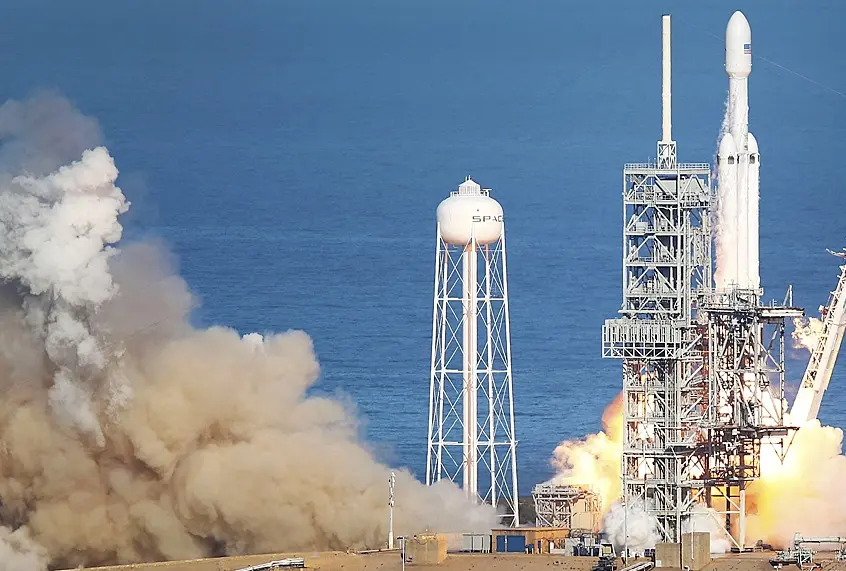
On February 6, 2018, Elon Musk’s aerospace company, SpaceX, achieved a monumental engineering feat. Launching from the historic Launch Complex 39A at the Kennedy Space Center in Florida, the Falcon Heavy—the world’s most powerful operational rocket at the time—blasted into the clear blue Florida sky. Encased within its payload fairing was an unconventional cargo: a cherry-red Tesla Roadster, complete with a spacesuit-clad mannequin nicknamed "Starman" in the driver’s seat.
While the successful deployment of the vehicle and the subsequent, simultaneous precision landings of two reusable Falcon boosters marked a watershed moment for commercial space exploration, the launch inadvertently triggered a massive cultural and digital phenomenon. As live, high-definition video feeds broadcasted the Roadster climbing past the outer atmosphere, the unmistakable, brilliant curve of planet Earth came into sharp focus against the black void of space.
Almost instantly, social media erupted. Millions of spectators watched in awe, but a significant faction of internet users immediately shifted the spotlight toward a different demographic: flat-Earth believers. Online commentators eagerly posted clips of the Earth’s horizon, declaring the conspiracy theory definitively dead. Yet, a deeper examination of the psychology behind pseudoscience suggests that no amount of live-streamed, high-altitude footage will ever convince the most ardent flat-Earth truthers to concede to reality.
Detailed Chronology: A Day That Captivated the Globe
The sequence of events on February 6, 2018, unfolded like a sci-fi epic brought to life.
- 3:45 PM EST (Launch Window Opens): Anticipation reached a fever pitch at the Kennedy Space Center and across global live streams. Millions tuned in to watch the maiden flight of the Falcon Heavy, a rocket formed by strapping three modified Falcon 9 first-stage cores together, boasting a combined 27 Merlin engines.
- 3:48 PM EST (Liftoff): Amid a deafening roar and a massive plume of smoke and fire, the Falcon Heavy cleared the tower. The ground shook for miles around as the behemoth rocket punched through the troposphere, visibly straining against maximum aerodynamic pressure (Max-Q) just over a minute into flight.
- 3:56 PM EST (The Booster Landings): In what many aerospace engineers viewed as the most visually stunning moment of the day, the two side boosters separated from the core stage, flipped in mid-air, and executed synchronized, propulsive retro-burns to touch down gracefully at Landing Zones 1 and 2 at Cape Canaveral Air Force Station. The third, center core was lost upon impact near its drone ship at sea, but the success of the side boosters was enough to send shockwaves of celebration through SpaceX mission control.
- Hours Later (The Orbital Cruise and Live Feeds): As the upper stage coasted through Earth’s orbit, cameras mounted to the Tesla Roadster beamed back surreal, crystal-clear footage of the car drifting against the backdrop of the spinning blue and white globe. It was during this phase that the distinct, uncompromised curvature of the Earth was captured from multiple angles, sparking an immediate internet firestorm.
Supporting Context & Metrics: The Scale of the Achievement and the Persistence of Myth
To understand why the 2018 Falcon Heavy launch became a cultural touchstone in the war against misinformation, one must examine both the technical metrics of the mission and the psychology of science denial.
The Engineering Statistics
- Thrust at Liftoff: Approximately 5 million pounds of thrust, roughly equivalent to eighteen 747 aircraft at full power.
- Payload Capacity: Capable of lifting nearly 141,000 pounds (64 metric tons) into low-Earth orbit.
- The Destination: An elliptical heliocentric orbit looping around the Sun, taking Starman and the Roadster out past the orbit of Mars.
The Psychology of Flat-Earth Belief
Despite these staggering figures and the verifiable physics governing them, proponents of the flat-Earth theory operate within a closed epistemological loop. Flat-Earth ideology posits that:
- The Earth is a stationary, flat disc centered around the North Pole, ringed by an impassable wall of ice ( Antarctica).
- Gravity is an illusion; objects fall either due to density and buoyancy or because the flat disc is accelerating upward through space at a rate of 9.8 meters per second squared.
- All space agencies, governments, and independent pilots are part of an international conspiracy designed to hide the "true nature" of creation from humanity.
Because this belief system relies entirely on the premise that institutional science and visual media are orchestrated fabrications, live footage from SpaceX—no matter how transparent or unedited—is immediately categorized by believers as CGI, fisheye-lens distortion, or government-sponsored deception.
Official Statements and Social Media Reactions
The juxtaposition between mainstream scientific jubilation and fringe denial was starkly visible across digital platforms.
Elon Musk himself leaned into the cultural spectacle, tweeting photos from SpaceX launch control with captions highlighting the absurdity and wonder of the moment: "View from SpaceX Launch Control. Apparently, there is a car in orbit around Earth."
Meanwhile, the public response on Twitter (now X) was swift, merciless, and often humorous:
- Sebastian Bell (@sepsis13): "Suck it Flat Earthers. #Starman"
- Skyler (@thatguysky13): "Look you can see the curvature of the Earth, I bet the flat Earthers are pissssed."
- State of Mind (@StateofMindNZ): "Tough day at the office for flat earthers…"
- Dave Days (@davedays): "Flat earth conspiracy officially debunked… with style @SpaceX #FlatEarth"
Other users opted for heavy sarcasm to mock the mental gymnastics required to maintain the flat-Earth stance in the face of visual proof. Darin (@darink) shared a panoramic shot of the globe from space with the dry caption: "Look at that flat earth."
Future Outlook: The Ongoing Battle for Scientific Literacy
The February 2018 Falcon Heavy launch was much more than a milestone for commercial rocketry; it served as a live stress test for public trust in empirical evidence.
As private space tourism expands, satellite constellations multiply, and interplanetary missions become more frequent, humanity will capture increasingly detailed views of our home planet. Yet, sociological experts warn that technological advancements alone cannot cure misinformation. Conspiracy theories often serve psychological needs—offering communities of belonging, a sense of special knowledge, and distrust of authority—that facts struggle to dismantle.
Ultimately, while the SpaceX cameras offered breathtaking, undeniable confirmation of our spherical world to the rational majority, the stubborn persistence of the flat-Earth movement reminds us that belief is often immune to altitude. No rocket, no matter how powerful, can punch through a closed mind.