Executive Overview
The landscape of cloud architecture is shaped as much by its boundaries as by its raw capabilities. For nearly a decade, foundational parameters like execution timeouts stood as immutable pillars of system design. When AWS Lambda first debuted in 2014, it imposed a strict 60-second execution ceiling. This constraint expanded incrementally to 5 minutes in 2015 and settled at 15 minutes in 2018—where it remained frozen for eight years.
This era of strict boundaries has officially ended. In a single, watershed week, Amazon Web Services fundamentally redefined the operational envelope of serverless computing, edge logic, global infrastructure, and agentic identity.
The scope of announcements rolling out of AWS reveals a coordinated strategy: transitioning the cloud from a reactive utility into an autonomous, low-latency execution layer tailor-made for artificial intelligence agents, complex multi-step workflows, and distributed enterprise scale.
At the center of this wave is a dramatic expansion of AWS Lambda, which has doubled its on-demand execution limits to 30 minutes, gained native GPU support for high-throughput inference, and introduced customer-managed runtimes for platform engineering teams.
Simultaneously, AWS has reinforced its global footprint with a new Local Zone in Bogotá, Colombia, upgraded Amazon Aurora DSQL with intercontinental multi-region peering and higher write throughput, and delivered critical security primitives designed specifically to govern autonomous AI agents.
This report provides an exhaustive, investigative breakdown of these developments, tracing their technological implications, enterprise adoption patterns, and the strategic trajectory of the world’s leading cloud platform.
Detailed Chronology of the Week’s Major Launches
The sheer velocity of infrastructure and platform updates released during this single week demands a meticulous, chronological examination of each foundational change.
1. Expanding the Serverless Horizon: AWS Lambda’s 30-Minute Timeout
After eight years at a 15-minute cap, AWS Lambda has doubled its on-demand event function timeout to 30 minutes (1,800 seconds). This adjustment applies across synchronous, asynchronous, and event source mapping invocations. For Lambda Managed Instances, synchronous invocations now match this 30-minute threshold, while asynchronous and event source mapping invocations maintain their extended 90-minute limit introduced earlier in the autumn.
- Target Workloads: AWS specifically positions this enhancement for agentic request chains that orchestrate complex multi-step model and tool interactions, alongside legacy batch processes like media transcoding and heavy file conversion.
- Architectural Caveats: Engineering teams cannot simply flip a switch without refactoring. Synchronous downstream services often carry their own strict timeout limits. Furthermore, underlying client read and socket timeouts must be adjusted upward. Crucially, standard AWS NAT gateways drop idle connections after 350 seconds, meaning exceptionally long-running calls must implement robust keep-alive packet transmissions to prevent silent connection termination. For workloads exceeding 30 minutes, durable serverless functions remain the preferred vehicle, which now feature native OpenTelemetry (OTel) tracing.
2. Bringing GPUs to Serverless: AI Inference on Lambda Managed Instances
Perhaps the most mechanically disruptive announcement of the week is the introduction of GPU-accelerated instances for Event Functions on Lambda Managed Instances. Developers can now package GPU-dependent workloads—such as deep learning inference, media processing, 3D rendering, and heavy scientific computations—directly into OCI container images.
- Operational Simplicity: The integration abstracts away the traditional administrative overhead of managing underlying GPU drivers, CUDA version parity, and Amazon Machine Image (AMI) synchronization.
- Performance and Economics: AWS documentation highlights a model architecture where four concurrent requests successfully share a single copy of a model on one physical GPU, achieving completion times comparable to isolated single-request execution. Optimized for inference using G-series instances ranging from G4dn to G6e, the pricing model combines standard EC2 instance rates (compatible with Savings Plans and Reserved Instances) with a 9.75% management fee for GPU instances and a flat $0.20 per million requests.
3. Bridging the Latency Gap: AWS Local Zone in Bogotá, Colombia
To capture burgeoning enterprise demand across South America, AWS expanded its edge infrastructure by launching a new Local Zone in Bogotá, Colombia.
- Performance Metrics: The facility brings enterprise compute, storage, and networking resources directly into a major metropolitan center, empowering financial institutions, real-time gaming platforms, and live-streaming services to achieve single-digit millisecond latency.
- Service Parity: Unlike standard edge caches, the Bogotá Local Zone matches the exact APIs and toolsets of the primary AWS Region. Launch configurations support Amazon EC2 C7i, M7i, and R7i instances; Amazon EBS gp3, gp2, and io1 volumes featuring local snapshots; Amazon S3 One Zone-Infrequent Access; Amazon ECS; Amazon EKS; AWS Direct Connect; and Application Load Balancer. Administrators can immediately provision workloads by enabling the
us-east-1-bog-1aavailability zone via AWS Global View.
4. Platform Engineering Control: Customer-Managed Runtimes
Platform teams have long wrestled with the tension between developer autonomy and centralized compliance. AWS addressed this directly by introducing customer-managed runtimes for Lambda.
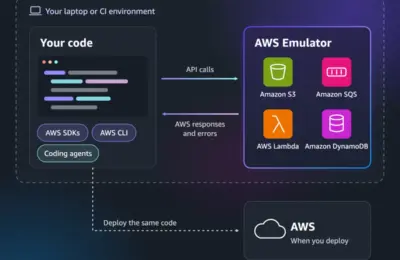
- Decoupling Runtimes from Code: Organizations can now package approved software development kits (SDKs), security certificates, monitoring agents, and compliance patches as an immutable OCI container image stored within Amazon ECR.
- Seamless Updates: Rather than forcing developers to manually redeploy hundreds of discrete functions, execution environments automatically adopt runtime updates as Lambda recycles underlying infrastructure. Platform teams can stage updates, monitor granular health metrics, and execute instantaneous rollbacks at zero additional cost.
5. Securing the Agentic Workforce: STS, Cognito, and CloudFront
As autonomous AI agents transition from experimental toys to production enterprise workers, the security paradigm must shift from human-centric Identity and Access Management (IAM) to programmatic least-privilege containment. AWS shipped three targeted updates to close this security gap:
- AWS STS
GetScopedCredentials: Workloads can now ingest existing temporary credentials and programmatically derive narrower, restricted permissions or shortened session durations. Crucially, these derived credentials preserve the caller’s immutable root identity, ensuring that sub-agents can never escalate privileges beyond their creators. Every transaction is logged natively in AWS CloudTrail. - Amazon Cognito Dynamic Client Registration: Complying with RFC 7591, Cognito now allows Model Context Protocol (MCP) clients and AI agents to register themselves dynamically at runtime, eliminating the manual friction of pre-provisioning app clients. Administrators can enforce strict validation via access tokens with designated registration scopes or open registration, using specialized client ID prefixes for downstream filtering and telemetry.
- Amazon CloudFront Functions Network Calls: CloudFront Functions can now execute outbound API calls using
cf.fetch(). This allows edge locations to perform real-time authorization checks, token validations, and fraud inspections—such as evaluating an AI agent’s token budget and usage quotas—before the request ever reaches an origin server or MCP backend. Priced at $0.10 per million calls (and bundled into the Pro flat-rate plan), this update is paired withcf.beacon()for low-overhead background analytics.
6. Voice Cloning, Distributed Databases, and Enterprise Scale
Rounding out the week’s releases:
- Amazon Polly Voice Cloning: Enterprises can now synthesize custom, highly realistic brand voices using just a few minutes of audio from a consenting speaker. Operating within a gated release framework across seven languages (including English, Spanish, and Portuguese), Polly’s generative engine processes the speech without retaining or training on the underlying source recordings.
- Amazon Aurora DSQL Evolution: Aurora DSQL received intercontinental multi-region peering support, enabling strongly consistent distributed transactions across disparate continents (such as US East and Europe Ireland). This was accompanied by native PL/pgSQL support and storage optimizations yielding up to 50% higher write throughput at no additional cost.
Supporting Context & Metrics
To understand the macro-economic forces driving these releases, one must examine the operational hurdles faced by modern enterprise engineering organizations. The software industry is pivoting rapidly toward agentic architectures—systems where Large Language Models (LLMs) execute autonomous tool loops, write code, query databases, and interact with external APIs without direct human intervention.
[User / AI Agent]
       │
       ▼ (Request / MCP Protocol)
[Amazon CloudFront] ──(cf.fetch checks budget/permissions)──► [Edge Validation]
       │
       ▼ (Forward Request)
[AWS Lambda (GPU / 30-min timeout)] ──(STS GetScopedCredentials)──► [Restricted IAM Scope]
       │
       ▼ (Data Layer)
[Amazon Aurora DSQL Intercontinental Cluster]
This structural shift introduces unprecedented operational challenges:
- Network Congestion and Token Latency: AI inference loops are inherently chatty. Requiring every sub-agent request to traverse back to origin data centers introduces unacceptable latency penalties. CloudFront’s ability to execute network calls at the edge solves this by placing authorization and budgeting logic within milliseconds of the user.
- Compute Duration Discrepancies: Standard web applications respond in milliseconds; complex AI reasoning tasks require sustained compute cycles. Extending Lambda to 30 minutes acknowledges that serverless is no longer just for micro-glue code—it is a viable compute substrate for heavy, multi-turn cognitive tasks.
- Infrastructure Scaling Economics: Case studies published during the week highlight the urgency of cost optimization. For instance, Klaviyo successfully migrated its event-processing backbone from RabbitMQ to Amazon MSK Express to absorb a seven-fold surge in event volume during Black Friday and Cyber Monday, slashing infrastructure costs by 30% through unified processor consolidation. Similarly, Cognition—creator of the AI coding agent Devin—leveraged Amazon EC2 Mac hosts to spin up fresh macOS virtual machines in under a minute, optimizing resource costs by allowing 90% of idle sessions to release their VMs and resume instantly from snapshots.
Official Statements and Industry Perspective
The strategic realignment of AWS toward agentic infrastructure reflects a deliberate response to enterprise maturation. Speaking on the architectural implications of these rollouts, enterprise systems analysts note that the traditional boundaries of cloud security and compute governance are dissolving.
"We are moving away from an era where infrastructure was provisioned for human operators clicking through management consoles," noted a prominent cloud architecture researcher during a briefing on the BMW Group’s agentic governance model. "When you have enterprises like BMW managing hundreds of autonomous AI agents across more than 12,500 research and development developers, human-speed governance is a systemic bottleneck. Security must be codified deterministically into the CI/CD pipeline, entirely independent of the agent’s reasoning loop, ensuring that prompts cannot bypass operational safety guardrails."
Furthermore, internal AWS product briefs emphasize that serverless compute must evolve to match the non-deterministic nature of modern machine learning workloads. By stripping away the operational drag of container orchestration, CUDA management, and rigid time limits, AWS is positioning Lambda not merely as a function runner, but as the foundational runtime engine for the autonomous enterprise.
Future Outlook: The Autonomous Cloud
As the dust settles on this monumental week of announcements, the horizon of cloud computing comes into sharper focus. The convergence of 30-minute serverless timeouts, native GPU acceleration, edge-native network capabilities, and least-privilege agentic identity management points toward a singular destination: the fully autonomous cloud.
In the coming quarters, we can expect enterprise architectures to shed legacy middle-tier bottlenecks. Applications will increasingly be composed of self-registering AI agents operating inside strictly scoped IAM boundaries, executing inference routines on ephemeral serverless GPU instances, governed by immutable platform-managed runtimes, and secured at the network edge by sub-millisecond telemetry checks.
For chief technology officers and systems architects, the mandate is clear. The tools required to build, secure, and scale autonomous distributed systems are no longer theoretical constructs; they are live, GA-ready services deployed across the global AWS footprint. The challenge ahead lies not in waiting for infrastructure to catch up with ambition, but in reimagining software architecture to exploit the boundless velocity of the new serverless paradigm.