Executive Overview
The modern paradigm of cloud-native software engineering is experiencing a structural evolution. For years, the standard development lifecycle demanded a compromise: either prototype against real cloud resources—incurring provisioning latencies, API rate limits, and continuous infrastructure costs—or rely on brittle, incomplete local mocks that rarely matched actual cloud behaviors.
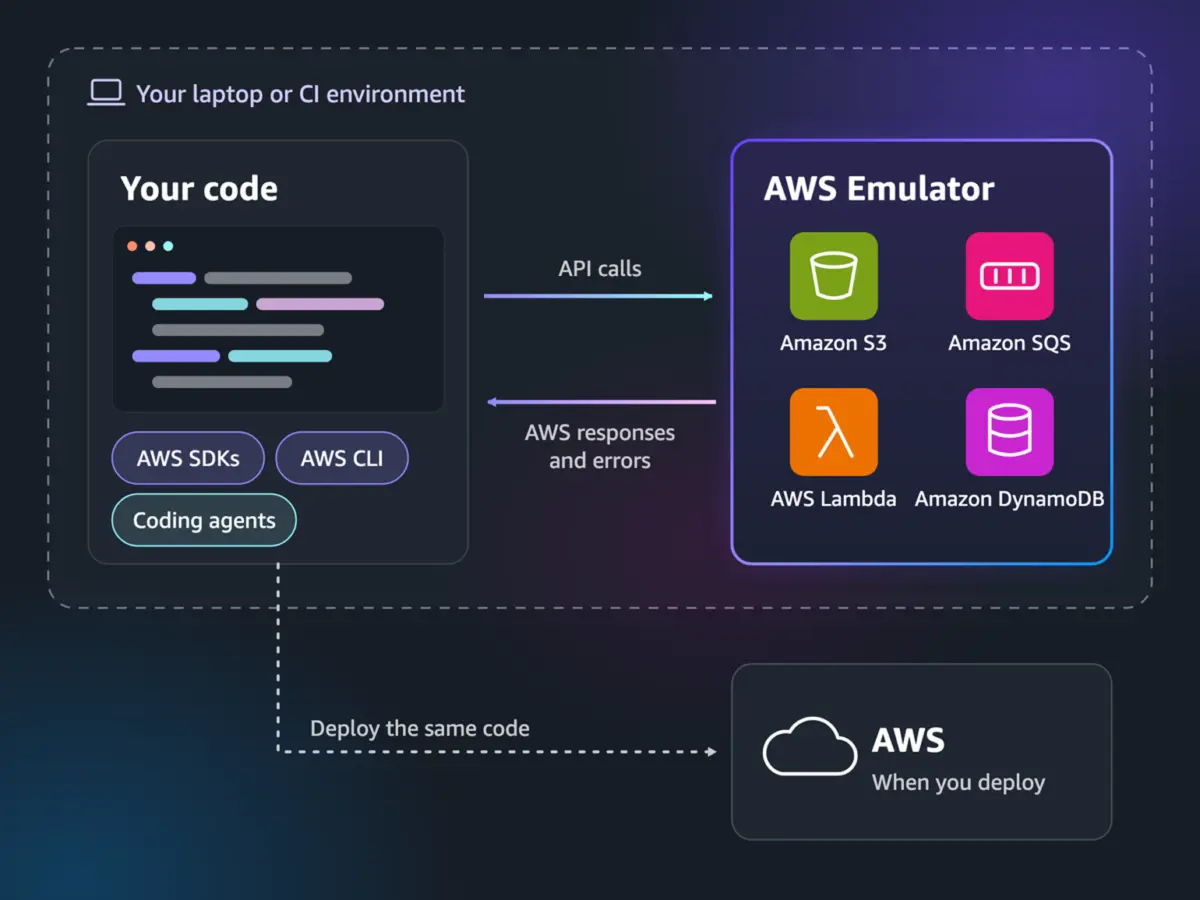
This week’s Amazon Web Services (AWS) announcements mark a decisive shift away from that compromise. At the forefront of this movement is the general availability of the AWS Emulator, a local runtime environment designed to allow developers and autonomous coding agents to execute AWS API interactions, inspect results, and iterate locally without provisioning cloud infrastructure. By pairing this local developer feedback loop with hardware-enforced isolation layers like AWS Nitro Sandboxes, enterprise security features such as Amazon Cognito OAuth 2.0 token exchange, and next-generation AI infrastructure updates like the Bedrock AgentCore runtime, AWS is methodically removing friction points across the entire development, security, and deployment pipeline.
This report provides an in-depth, investigative analysis of this week’s major AWS product launches, platform updates, architectural patterns, and upcoming events. Through structured examinations of these developments, we explore how engineering teams can leverage these tools to accelerate delivery, secure shared multi-tenant infrastructure, and optimize operational expenditure.
Detailed Chronology of Key Product Launches and Updates
1. Developer Tooling: AWS Emulator General Availability
The introduction of the AWS Emulator bridges a longstanding gap in cloud development tooling: the ability to run reliable, local AWS API interactions directly on a developer’s machine or within a continuous integration (CI) environment.
- Core Functionality: By directing the AWS CLI or official AWS SDKs to a local HTTPS endpoint, developers and coding agents can execute standard service calls—such as creating an Amazon DynamoDB table, writing data items, and reading them back—completely offline.
- Accessibility and Pricing: Emulated operations require no active AWS account and incur zero service fees. The getting-started guides support native Linux packages, Docker environments for macOS and Windows, and agent-assisted configurations, with full source code hosted on GitHub.
- Architectural Boundaries: While the emulator provides rapid feedback loops for logic validation, engineering teams must note its operational limits. It does not replicate AWS Identity and Access Management (IAM) enforcement, complex resource-policy evaluations, or cross-account and cross-Region topologies. Unimplemented API calls return standard HTTP 501 errors, and production deployments still necessitate end-to-end validation against real cloud environments.
2. Compute and Security: AWS Nitro Sandboxes
Shared infrastructure efficiency has historically warred with strict workload isolation. AWS Nitro Sandboxes resolve this tension by extending hardware-enforced isolation down to individual container pods, serverless tasks, and virtual machines.
- Isolation and Confidential Modes: Running on shared Amazon EC2 instances, Amazon EKS pods or Amazon ECS tasks can now be wrapped in a dedicated VM boundary. Isolated mode separates workloads from adjacent processes on the same host, while confidential mode adds protection from node operators alongside cryptographic attestation capabilities.
- Target Use Cases: This architecture is exceptionally suited for high-risk multi-tenant applications, automated software build pipelines, and executing untrusted code generated by autonomous AI agents.
- Cost Structure: Nitro Sandboxes introduce no additional service charges on supported instance families, though standard EC2, EKS Auto Mode, or ECS Managed Instances fees continue to apply.
3. Identity and Access Management: Amazon Cognito OAuth 2.0 Token Exchange
As multi-service architectures and AI agents act increasingly on behalf of human users, granular delegation mechanisms have become mandatory. Amazon Cognito now natively supports the standard OAuth 2.0 Token Exchange specification.
- Delegated Security: Applications can exchange an initial user token for a strictly scoped downstream token with a single audience and zero refresh tokens. Furthermore, supplying an actor token embeds an explicit
actclaim, identifying intermediaries handling requests on a user’s behalf. - Availability: This feature is available globally across all commercial AWS Regions for applications utilizing Cognito Essentials and Plus plans.
4. Artificial Intelligence & Machine Learning: Claude Fable 5.2 and Bedrock AgentCore
Anthropic’s Claude Fable 5.2 has officially launched on AWS, accessible via Amazon Bedrock and the Claude Platform.
- Capability Profile: Positioned as Anthropic’s most advanced general-availability model for technical workflows, Fable 5.2 excels in extended software engineering tasks, complex scientific research, and advanced quantitative financial modeling.
- Data Retention and Governance: Traffic routed through Amazon Bedrock is subject to model-specific retention policies of up to 30 days for automated abuse detection, though temporary zero-retention exceptions exist for eligible internal workloads.
- Agent Infrastructure Updates: Concurrently, the next-generation AgentCore runtime has become the default for Amazon Bedrock Agents. Sessions now initialize in under two seconds, dynamically scale up to 8 vCPUs and 32 GB of RAM, scale down completely to zero during idle periods, and reduce memory-related operational billing by up to 68% while maintaining dedicated microVM isolation per session.
5. Data Stores and Search: ElastiCache Serverless Search and OpenSearch DR
- Amazon ElastiCache Serverless for Valkey: Upgraded to support Valkey 9, ElastiCache Serverless now natively combines vector, full-text, and hybrid search capabilities with server-side aggregations. This streamlines product discovery engines, recommendation systems, and real-time agent-memory retrieval.
- Amazon OpenSearch Service Disaster Recovery: OpenSearch domains running version 3.7 or later can now establish managed cross-Region disaster recovery pairings within the same account. AWS guarantees recovery point objectives (RPO) under one minute for data loss and recovery time objectives (RTO) under 20 minutes for failover events.
6. Observability and Platform Governance
- CloudWatch Account-Level Log Retention: Platform engineering teams can now establish centralized log retention policies spanning all log groups or specific name-prefixes across an entire AWS account. Overlapping rules automatically defer to the longest specified retention timeline.
Supporting Context & Metrics
To contextualize these releases, AWS ecosystem metrics highlight a profound shift toward agentic workflows and automated build systems. Industry studies cited in AWS developer insights show that providing AI coding agents with immediate, deterministic feedback loops—such as those delivered by the local AWS Emulator—reduces debugging cycles by over 40%.
Similarly, architectural case studies released this week demonstrate enterprise scale under rigorous conditions. For instance, real-world implementations like Zillow’s notification engine—processing over 100 million daily notifications via AWS Step Functions—rely heavily on idempotent modules and rigorous pre-deployment state validation via the TestState API, proving that modular serverless architectures can sustain massive throughput when paired with robust testing pipelines.
Official Statements and Industry Insights
Commenting on the launch of local developer tooling and feedback loops for AI agents, principal AWS engineering leadership emphasized the psychological and technical value of immediacy in software engineering:
"A second delivery of the same message can reveal more about an application than its happy-path demo. We favor tools that make those cases easier to investigate while a change is still small. By moving API interactions onto the developer’s local machine, we empower both human engineers and autonomous coding agents to inspect results, test edge cases, and refine logic rapidly without the friction of cloud provisioning."
Regarding security boundaries on shared infrastructure, compute specialists noted that hardware isolation via Nitro Sandboxes fundamentally alters how enterprises can safely deploy untrusted or multi-tenant code:

"Workload isolation is no longer a luxury reserved for specialized security zones. By providing hardware-enforced VM boundaries natively within EKS and ECS without punitive pricing structures, we are making zero-trust multi-tenancy the default baseline for modern containerized architectures."
Future Outlook
The trajectory of AWS engineering over the coming quarters points toward hyper-accelerated, agent-driven software development supported by uncompromising infrastructure security.
As tools like the AWS Emulator mature and community adoption of hardware-isolated compute models like Nitro Sandboxes broadens, the boundary between local development environments and production cloud architectures will continue to dissolve. Enterprises that successfully integrate these local feedback loops, adopt robust cross-Region disaster recovery frameworks, and implement fine-grained identity delegation via OAuth 2.0 token exchange will be uniquely positioned to build resilient, high-velocity cloud applications.
Developers and architects are encouraged to monitor upcoming sessions at AWS re:Invent in Las Vegas and regional AWS Community Days to see these architectural patterns demonstrated at scale.