Executive Overview
The modern consumer technology landscape is experiencing a profound paradox: while our pocket-sized and portable devices—from handheld gaming PCs to professional-grade laptops—deliver unprecedented computational performance, their hunger for electrical energy has outpaced traditional battery architecture. For years, mobile power banks remained stagnant, constrained to slow 5V/2A outputs that could barely sustain a smartphone under heavy load, let alone revive a drained workstation.
Enter a new tier of mobile power delivery. Driven by rapid advancements in USB Power Delivery (USB-PD 3.1) and high-density lithium-ion battery chemistry, high-capacity, high-output power banks have transformed from niche accessories into essential infrastructure for mobile professionals, digital nomads, and portable gamers alike.
In a market dominated by recognizable legacy brands that often command exorbitant price points, a new wave of manufacturing alliances is democratizing access to enterprise-grade charging technology. A prime example is the newly surfaced Talix 20,000mAh 140W Power Bank. Backed by industry giant Lenovo, Talix has introduced a device that matches the performance profile of top-tier OEM hardware at a fraction of the cost.
Currently featured in a major promotional rollout via Amazon, the Talix 20,000mAh 140W Power Bank is available for a limited time at an unprecedented price of $35.99 with free shipping. By applying the exclusive 64% off coupon code 7FD9RN0U, consumers can acquire a heavy-duty power solution without even needing an Amazon Prime subscription.
This analytical report examines the engineering pedigree, market positioning, technical specifications, and broader industry implications of this high-output power bank. We will explore how its 140W USB-C architecture satisfies the grueling demands of modern handheld gaming PCs like the Asus ROG Ally X and Lenovo Legion Go S, evaluate its compliance with international air travel regulations, and assess the strategic maneuvers of Lenovo-backed manufacturing subsidiaries in the current consumer tech ecosystem.
Detailed Chronology: The Evolution of USB-PD and the Birth of High-Wattage Mobile Power
To fully appreciate the engineering significance of the Talix 20,000mAh 140W Power Bank, one must understand the historical trajectory of mobile
charging protocols and how the industry arrived at the 140W threshold.
The Era of Slow Charging (Pre-2016)
For over a decade, universal mobile charging was governed by the USB Battery Charging specification (BC 1.2) and standard USB-A ports, which maxed out at 7.5W (5V/1.5A) or, later, 12W (5V/2.4A). While sufficient for feature phones and early smartphones, these rates were woefully inadequate for notebook computers, which typically required proprietary barrel-plug power bricks delivering 45W to 90W. Traveling with a laptop meant carrying a heavy, dedicated power adapter for every device in your bag.
The USB-C and USB-PD 2.0/3.0 Revolution (2016–2021)
The introduction of the reversible USB Type-C connector fundamentally altered the consumer hardware landscape. Paired with USB Power Delivery (USB-PD), the standard scaled power delivery dynamically up to 100W (20V/5A). This allowed a single cable and charger to negotiate voltage and current profiles across smartphones, tablets, and mid-range laptops. However, mobile power banks lagged behind wall adapters; portable batteries producing more than 65W output were rare, expensive, and bulky.
The USB-PD 3.1 Extended Power Range (EPR) Standard (2021–Present)
As high-performance laptops—particularly mobile workstations and gaming notebooks—pushed power consumption past the 100W barrier, the USB Implementers Forum (USB-IF) introduced USB-PD 3.1 Extended Power Range (EPR). This protocol unlocked fixed and adjustable voltage steps up to 28V, 36V, and 48V, enabling a maximum output of 240W.
Apple was among the first to adopt this standard commercially with the introduction of its 140W USB-C Power Adapter bundled with the 16-inch MacBook Pro. Soon after, high-end PC manufacturers, including Lenovo with its ThinkPad and Legion product lines, adopted 140W (7A at 20V) fast-charging protocols.
The industry bottleneck shifted from wall chargers to portable batteries. Consumers demanded power banks capable of matching the 140W output of desktop bricks to charge laptops and power-hungry gaming handhelds on the go. Early iterations of 140W power banks routinely retailed for $120 to $180, placing them out of reach for casual consumers. The launch of the Talix 20,000mAh 140W Power Bank—and its aggressive promotional pricing—marks a watershed moment in the commoditization of high-output mobile power.
Supporting Context & Metrics: Engineering and Performance Breakdown
The Talix 20,000mAh 140W Power Bank is not merely a high-capacity brick; it is a meticulously engineered piece of mobile hardware. Beneath its industrial aesthetic lies a sophisticated power management system designed to handle high thermal loads and demanding multi-device charging scenarios.
1. Corporate Lineage and Manufacturing Pedigree
For consumers unfamiliar with the brand name "Talix," industry transparency is essential. Talix operates as a Lenovo-backed subsidiary and technology incubator. A careful examination of the hardware reveals that the Talix 20,000mAh 140W Power Bank is structurally and electrically identical to the Lenovo Thinkplus Fluxo power bank.
By leveraging Lenovo’s supply chain, manufacturing rigor, and safety testing protocols, Talix delivers enterprise-grade reliability under an alternate consumer brand. This corporate backing ensures that the unit includes robust over-current, over-voltage, short-circuit, and thermal protection circuitry—safeguards that cheaper, unbranded white-label power banks frequently omit.
2. Industrial Design and Aesthetics
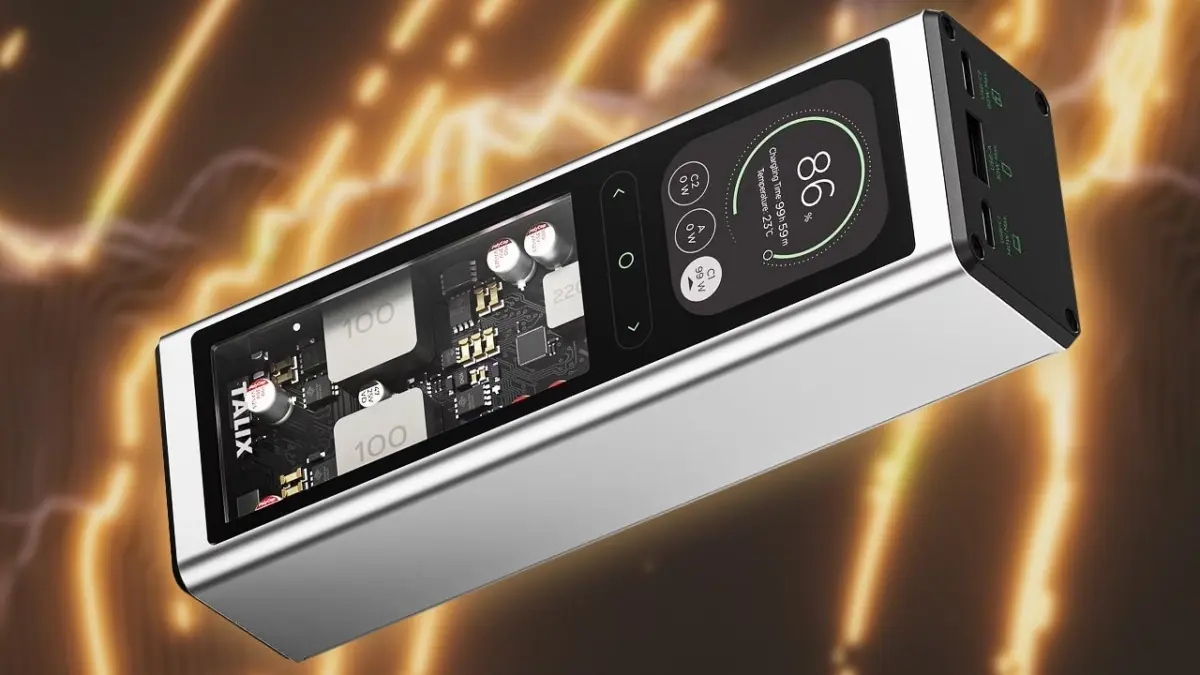
Departing from the drab, monolithic black plastic blocks that have defined the power bank market for a decade, the Talix unit adopts a candy-bar form factor characterized by an avant-garde aesthetic. Most notably, the chassis features a transparent or semi-translucent viewing window that showcases the internal circuit boards, copper shielding, and primary controller chips. This cyberpunk-inspired design caters directly to the tech enthusiast, creator, and gaming demographics.

3. Comprehensive Port Architecture
Versatility is a core pillar of the Talix design. The unit features a robust three-port array capable of simultaneous multi-device charging:
- Port 1 (USB-C 1): Capable of delivering a staggering 140W maximum output. This is among the highest single-port outputs commercially available in a portable battery, matching the power requirements of the most demanding USB-C laptops on the market.
- Port 2 (USB-C 2): Delivers up to 65W, ideal for fast-charging secondary devices such as tablets, corporate ultrabooks, or smartphones.
- Port 3 (USB-A): Outputs up to 30W, maintaining backward compatibility with legacy peripherals, accessories, and older mobile devices.
4. Raw Capacity and Efficiency Metrics
The power bank boasts a nominal battery capacity of 20,000mAh, which translates to a total energy storage of 74 Watt-hours (Whr).
When evaluating power banks, practical energy delivery is governed by conversion efficiency. Due to voltage step-up/step-down processes and thermal dissipation within the internal DC-DC converters, real-world power banks typically operate at approximately 80% efficiency. Factoring in this 80% effective retention rate yields the following real-world charge capacities:
| Target Device | Battery Capacity (Approx.) | Estimated Full Recharges (via Talix 74Whr / 80% Efficiency) |
|---|---|---|
| Asus ROG Ally X | 80 Wh | ~0.74 full charges |
| Lenovo Legion Go S | ~49.2 Wh | ~1.20 full charges |
| Valve Steam Deck (OLED) | 50 Wh | ~1.18 full charges |
| Apple iPhone 17 Pro Max | ~17.5 Wh | ~3.38 full charges |
| Apple MacBook Pro 16" (2026) | 100 Wh | ~0.59 full charges (Significant runtime extension) |
5. Air Travel and TSA Regulatory Compliance
A frequent concern for digital nomads and frequent flyers is whether high-capacity power banks will be confiscated by airport security. Under Transportation Security Administration (TSA) and Federal Aviation Administration (FAA) guidelines in the United States—alongside international civil aviation standards—lithium-ion power banks must be carried in carry-on luggage and are strictly prohibited in checked baggage.
The critical regulatory threshold is 100 Watt-hours (Wh), or approximately 27,000mAh at standard nominal voltages. Because the Talix power bank is rated at 74Whr (20,000mAh), it sits safely below the regulatory ceiling. Travelers can pass through airport security checkpoints globally without administrative friction or risk of device confiscation.
Official Statements & Industry Expert Insights
Industry analysts and consumer tech authorities have taken note of the shifting pricing dynamics in the power accessories market.
Eric Song, Commerce Manager and lead technology deals curator, emphasized the exceptional value proposition presented by the Talix promotional campaign:
"The introduction of 140W portable power at this price point fundamentally disrupts consumer expectations. For years, users invested in power-hungry handheld gaming PCs like the Asus ROG Ally X or professional laptops had to pay a steep luxury tax for high-wattage mobile charging solutions. By utilizing Lenovo-backed manufacturing to mirror enterprise hardware specs while slashing the retail price down to $35.99 via coupon code
7FD9RN0U, Talix has effectively eliminated the economic barrier to entry for next-generation charging technology."
Furthermore, engineering representatives from hardware component suppliers have noted that the integration of high-density lithium-cobalt or nickel-manganese-cobalt (NMC) cells in compact form factors represents a major leap in consumer safety. Modern thermal management controllers embedded within these units actively monitor cell temperatures across all three output ports, ensuring that high-draw sessions—such as powering a gaming laptop while simultaneously fast-charging a smartphone—do not compromise structural battery integrity.
Future Outlook: The Next Generation of Mobile Power Ecosystems
As we look toward the horizon of consumer electronics, the trajectory of power delivery systems points toward even greater integration, higher energy densities, and smarter power distribution.
The Rise of Solid-State and Advanced Silicon-Anode Batteries
While traditional liquid-electrolyte lithium-ion cells remain the cost-effective industry standard, research and development in silicon-anode and solid-state battery chemistry are accelerating. Within the next three to five years, consumers can expect power banks matching or exceeding the capacity of the Talix 20,000mAh model to shrink by 30% to 40% in physical volume while simultaneously increasing energy throughput.
Standardization of Multi-Device Dynamic Allocation
Future iterations of high-output power banks will increasingly rely on intelligent, software-driven power allocation chips. Rather than relying on static port limits (e.g., 140W on port one, 65W on port two), next-generation mobile batteries will dynamically sense the real-time power requirements of connected devices and distribute total wattage fluidly across all available ports to optimize charging speeds and minimize energy loss.
The Proliferation of High-Performance Handheld Ecosystems
The demand for mobile power is inextricably linked to the booming market for portable gaming hardware and mobile productivity workstations. As mobile graphics architectures become more power-efficient yet capable of sustained high-performance gaming, accessories like the Talix 20,000mAh 140W Power Bank transition from optional luxury gadgets into core components of the modern computing toolkit.
Summary of the Current Deal
For consumers looking to upgrade their mobile charging setup ahead of heavy travel seasons or extended gaming sessions, the current promotional window offers a rare convergence of enterprise-grade engineering and consumer-level pricing:
- Product: Talix 20,000mAh 140W Power Bank (Lenovo Thinkplus Fluxo equivalent)
- Promotional Price: $35.99 (Down from standard retail pricing)
- Shipping: Free standard shipping (No Amazon Prime membership required)
- Redemption Mechanism: Apply coupon code
7FD9RN0Uat checkout on Amazon. - Key Specifications: 20,000mAh (74Whr) capacity, 140W USB-C Max Output, 65W USB-C secondary, 30W USB-A tertiary, TSA air travel compliant, transparent circuit display design.
As high-wattage mobile charging transitions from an expensive novelty to an everyday standard, devices like the Talix 20,000mAh 140W Power Bank set a new benchmark for what consumers should expect from their portable power infrastructure.