Executive Overview
In an era dominated by automated content generation and algorithmic shortcuts, a paradox has emerged within the digital marketing landscape: while the volume of published material has skyrocketed, genuine user engagement has plummeted. Nowhere is this more apparent than on LinkedIn. Despite boasting hundreds of millions of registered accounts, data reveals that a mere 1% of the platform’s user base actively generates content. This massive supply-and-demand gap creates an extraordinary window of opportunity for professionals willing to show up with high-integrity, human-crafted material.
However, consistency alone is no longer a silver bullet. Modern audiences have developed an acute radar for templated, generic posts—particularly those manufactured by artificial intelligence. To truly cut through the noise, creators must adopt a disciplined, audience-first methodology.
Co-created by digital marketing authorities Kasey Brown and Michael Stelzner, a powerful paradigm shift is taking root among top-tier creators. By moving away from self-absorbed broadcasting and embracing a structured blueprint known as the Triple S Framework, professionals can systematically capture attention, hold reader retention, and drive organic business growth—all without relying on artificial intelligence tools to draft their narrative.
Detailed Chronology: The Evolution of the LinkedIn Content Gap
To understand why traditional posting strategies are failing, one must examine the historical shift in LinkedIn’s ecosystem. Over the past half-decade, the platform transitioned from a digital resume repository into a vibrant content-first social network.
The Shift Toward Organic Content Systems
As remote work expanded and digital networking became paramount, executives, founders, and consultants rushed to build personal brands. Initially, simply publishing a text-based post or sharing an industry article was enough to command thousands of impressions. The algorithm, eager to populate feeds with active discussions, heavily rewarded raw frequency.
However, the proliferation of generative AI tools flooded the market with homogenous, predictable phrasing. Feeds quickly became saturated with identical sentence structures, generic corporate platitudes, and hollow motivational hooks. Users responded by tuning out.
Recognizing this fatigue, strategists like Kasey Brown—founder of Digital Kairos—began dissecting what actually compels a busy professional to stop scrolling. Through rigorous testing, Brown established that sustainable LinkedIn success requires a rock-solid foundation built long before a single word is typed into a draft.
Laying the Foundational Pillars
Before applying any advanced tactics, creators must establish three fundamental pillars:

- The Precision Ideal Client Profile (ICP): A vague demographic sketch will yield vague results. Brown stresses that an ICP must be precise enough that a virtual assistant could plug its keywords into LinkedIn’s search bar and instantly identify viable prospects. Instead of targeting "people who want to build a brand online," an effective ICP is defined as: "Speakers, coaches, and consultants earning at least $20K per month who need systems for organic content so they can scale their impact and their business."
- The Defined 30-Day Transformation: Every content strategy must be anchored to a specific transformation. What distinct capability, mindset shift, or operational upgrade will a follower walk away with after engaging with your content for 30 days? This outcome frames every individual post.
- The Reader-First Mentality: Most creators post with self-serving motives: Did I sound smart? Did I highlight my achievements? Will this drive an immediate sale? High-performing content completely inverts this paradigm, focusing exclusively on the tangible value delivered to the audience.
The Triple S Framework: Stop, Stay, and Share
With these foundational components secured, creators can deploy the Triple S Framework, a rigorous three-dimensional system designed to govern user psychology from the initial impression to the final viral distribution.
[ THE TRIPLE S FRAMEWORK ]
 ├── 1. STOP  ──> Visuals (0.5x Wide-Angle Selfies) & Hooks (Five Cs)
 ├── 2. STAY  ──> Re-Hooks, Rhythm, & Fourth-Grade Reading Levels
 └── 3. SHARE ──> Tangible Takeaways & Actionable Goodie Bags
1: Stop – Capturing Attention Through Visuals and Hooks
The immediate objective of any LinkedIn post is to halt the user’s scroll. According to industry analysis, roughly 80% of a post’s impressions are determined by two elements working in tandem: the attached visual asset and the opening two lines of text.
Disrupting the Visual Status Quo
Most professionals default to polished speaking photographs or sterile corporate headshots. Because feeds are oversaturated with this polished aesthetic, consistency has inadvertently bred invisibility.
- The Unpolished Advantage: Brown’s empirical testing proved this thesis decisively. Following a speaking engagement, she published a wide-angle selfie captured from the stage using her smartphone’s rear camera at a 0.5x zoom. The framing was casual, revealing the expansive audience behind her. Paired with an offer for presentation slides, this unpolished post generated 3,000 leads.
- The Polished Contrast: When Brown subsequently republished the identical offer accompanied by a professionally lit, high-resolution photograph of herself at the microphone, the post yielded a mere 200 leads.
The tactical takeaway is clear: vertical imagery claims more vertical screen real estate on mobile devices and resists awkward cropping. Furthermore, wide-angle mobile shots create natural environmental curiosity, acting as a visual pattern interrupt.
Engineering Hooks via the Five Cs
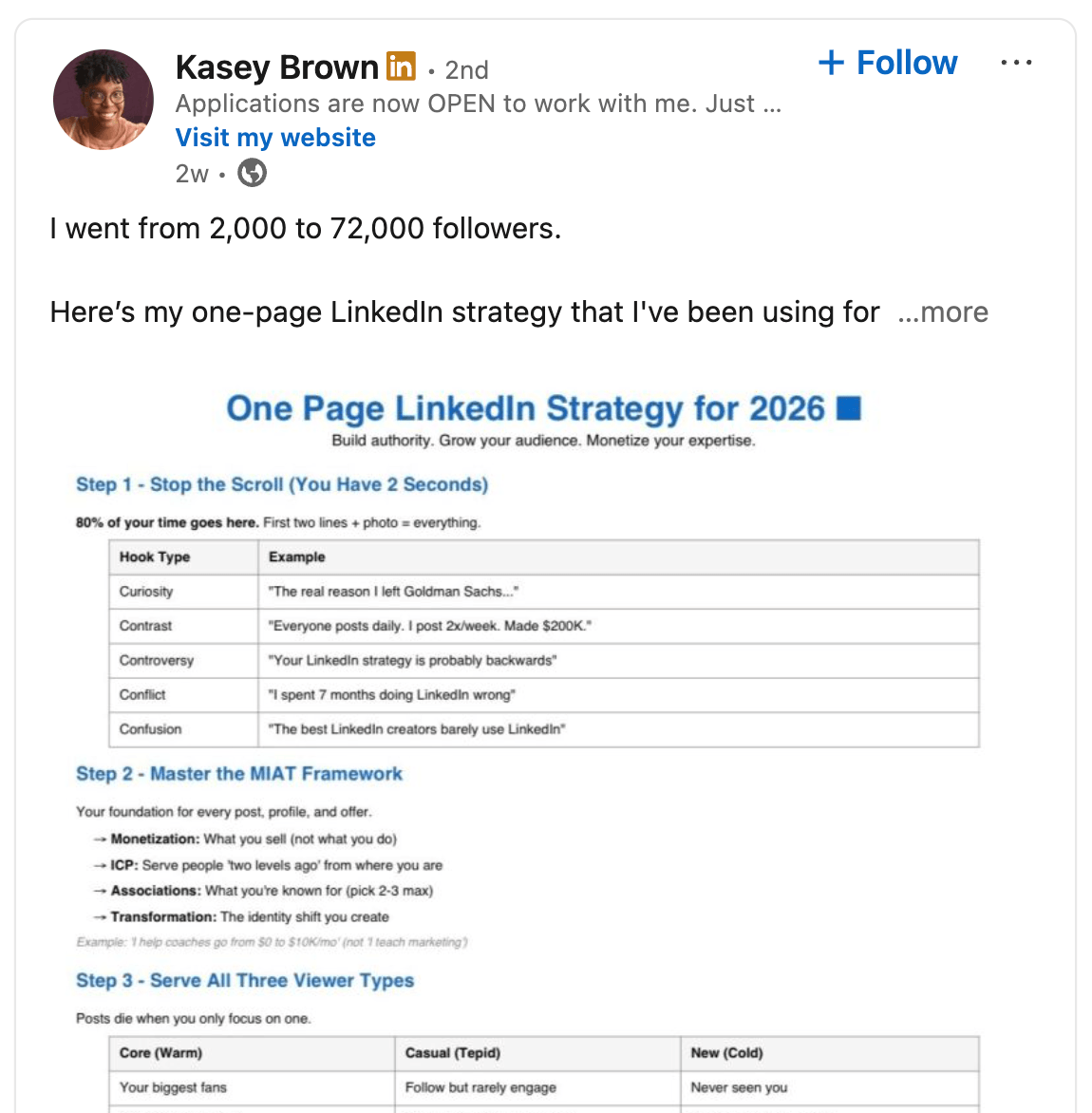
Once the visual stops the eye, the text must engage the mind. Borrowing from short-form video psychology, Brown evaluates textual hooks through the Five Cs: Curiosity, Contrast, Contradiction, Controversy, and Confusion.
A weak hook is purely descriptive ("Having a wonderful summer vacation in Bali"). A high-performing hook triggers multiple psychological levers simultaneously by pitting contrasting realities against one another ("I was at a job I hated. 2021." followed by "2026. I just spent $30K to come here…"). The reader is instantly hooked by the cognitive dissonance and compelled to click "see more."
2: Stay – Sustaining Attention From Hook to Finish
Earning the click is only half the battle; keeping the reader engaged through the conclusion of the post is where most content fails.
Executing the Re-Hook
When a user clicks "see more," the third line of the post must validate their decision immediately by escalating the tension rather than resolving it prematurely. Prematurely giving away the narrative payoff destroys reader momentum. Instead, creators must prolong the narrative arc—much like the first sixty seconds of a high-retention YouTube video—keeping the audience invested in the resolution.
Structuring for Readability and Rhythm
Textual architecture dictates whether a reader finishes a post or abandons it halfway through:
- Cadence and Rhythm: Avoid uniform line breaks after every single sentence. Instead, establish a rhythmic cadence: deploy three or four punchy, single-sentence lines to drive home core points, followed by a dense, two-to-three-sentence paragraph to develop the underlying concept.
- Reading Level Accessibility: Top-tier content consistently hits a fourth-to-seventh-grade reading level on readability indices. Tools like the Hemingway App serve as invaluable editors to strip away corporate jargon.
- Mobile Optimization: Because over 70% of LinkedIn consumption occurs on mobile devices, drafts must be previewed directly within the mobile app or specialized rendering tools like Authored Up to ensure paragraphs do not morph into intimidating text walls on small screens.
3: Share – Multiplying Distribution Through Tangible Value
The ultimate validation of a LinkedIn post is not views or superficial comments, but shares and reposts. A share represents an endorsement of the highest order: a user attaching their personal professional reputation to your ideas and broadcasting them to their own network.
Tracking the Share-to-Impression Ratio
Strategists measure content efficacy using the shares-per-impression ratio:
- 0.3 Ratio: Solid performance indicating healthy resonance.
- 0.5+ Ratio: Exceptional performance. Any post achieving this threshold should be archived and systematically recycled into rotation every 60 to 90 days using identical assets.
The "Goodie Bag" Principle
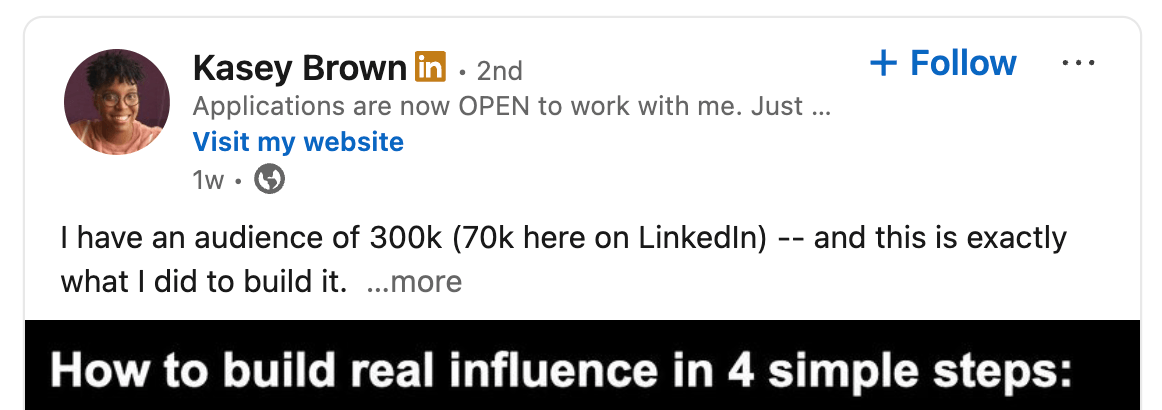
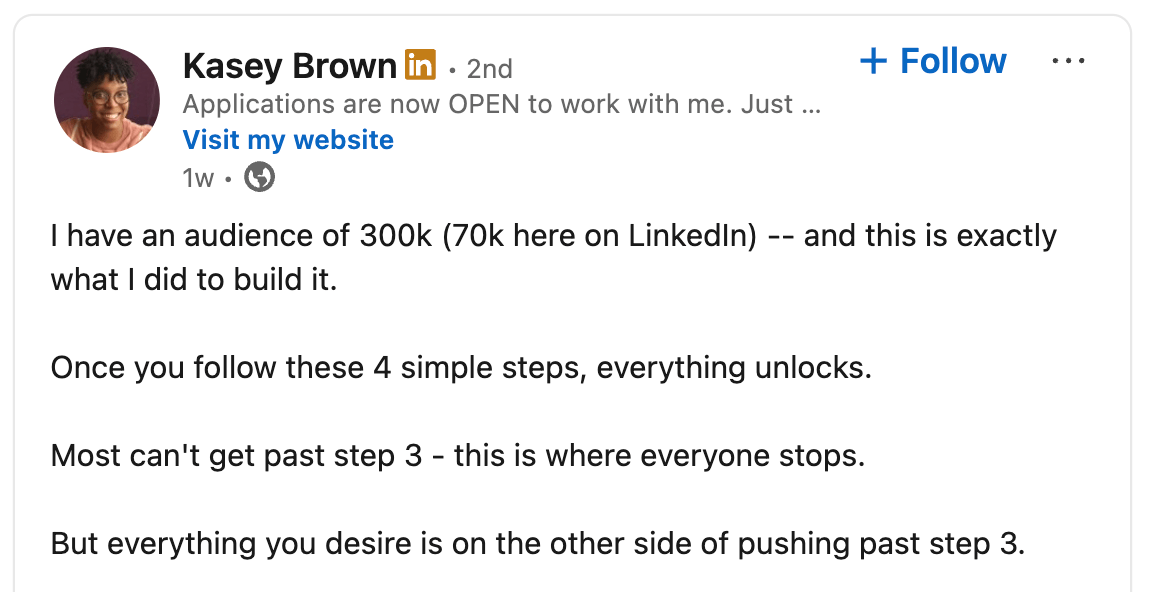
Posts achieve high shareability when they conclude with a concrete, actionable transformation—what Brown describes as handing the reader a "goodie bag" at the end of a presentation. By transforming a personal narrative into a step-by-step framework ("Step 1: Audit your time. Step 2…"), creators give their audience a practical resource worth forwarding to colleagues, saving for later reference, or leveraging to claim a lead magnet.
Supporting Context & Metrics
| Metric / Framework Component | Traditional Approach | High-Performance Organic Approach | Impact on Results |
|---|---|---|---|
| Visual Asset | Polished headshots / stock graphics | 0.5x wide-angle mobile selfies / dense infographics | Up to 15x increase in lead generation via pattern interruption |
| Targeting (ICP) | Vague demographics ("Entrepreneurs") | Hyper-specific criteria ("Consultants earning $20K/mo…") | Higher-intent engagement and qualified pipeline growth |
| Content Generation | AI-generated templated text | Human-crafted stories edited via readability metrics | Elimination of reader fatigue; improved retention metrics |
| Success Indicator | Vanity metrics (Raw impressions, generic likes) | Share-to-impression ratio (0.3 to 0.5+ benchmarks) | Accurate measurement of true network value and viral distribution |
Official Statements and Industry Insights
The philosophy underpinning the Triple S Framework directly challenges the prevailing industry rush toward full automation. As digital platforms become saturated with synthetic content, industry authorities emphasize that authenticity is no longer just a nice-to-have brand attribute—it is a functional algorithmic requirement.
"We don’t have to be better. We have to be different," notes LinkedIn strategist Kasey Brown. This core tenet underscores the reality that incremental improvements to corporate polish pale in comparison to raw, human distinctiveness.
When creators shift their internal monologue from “How do I sound smart?” to “What tangible value does the reader walk away with?”, the entire dynamic of social selling transforms. The platform naturally favors those who bridge the content gap with genuine insight, rigorous structure, and profound respect for the reader’s time.
Future Outlook
As artificial intelligence continues to lower the barrier to entry for content creation, the volume of digital noise on professional networks will only accelerate. However, this hyper-saturation will inevitably drive a massive counter-movement toward radical authenticity and human-centric storytelling.
Future-proof personal brands and B2B enterprises will abandon mass-produced, automated post generation in favor of meticulous, systems-driven organic frameworks. By mastering the foundational triad of precise ICPs, clear transformations, and audience-first delivery—and by executing the mechanics of the Triple S Framework (Stop, Stay, Share)—creators can insulate themselves against algorithmic shifts.
Ultimately, the future of LinkedIn belongs not to the algorithms that generate words at scale, but to the humans who write with purpose, clarity, and uncompromising value.