Executive Overview
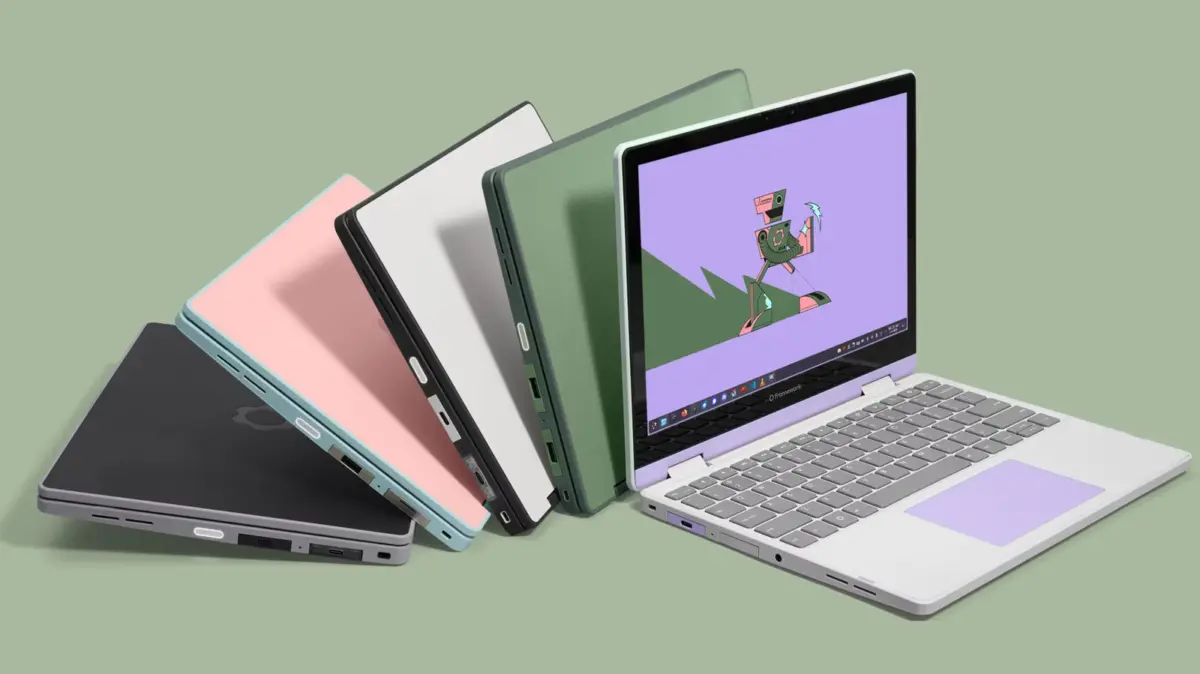
Modular computing pioneer Framework is continuing its aggressive hardware refresh cycle, turning its focus from high-end performance platforms toward its more compact and colorful offering. Following the recent rollout of the Laptop 13 Pro powered by Intel’s advanced Panther Lake architecture, the company has announced a comprehensive hardware overhaul for its smallest form-factor machine: the Framework Laptop 12.
The newly revised Laptop 12 introduces Intel’s latest mainstream Core Series 3 processors, addressing critical feedback regarding power efficiency and longevity that accompanied the debut of the original generation. Beyond the silicon upgrade, the refresh brings much-needed quality-of-life improvements, including an optional backlit keyboard, an integrated fingerprint reader, faster DDR5 memory, and native Thunderbolt 4 support across select expansion slots.
Significantly, Framework is leaning heavily into its core demographic by expanding its Linux pre-installation program. Building on internal telemetry revealing that more than 80 percent of original Laptop 12 owners rely on open-source operating systems, the company is offering Fedora pre-installed out of the box on Linux configurations, while relegating Windows 11 to a $100 add-on.
With starting prices holding steady at $549 for the modular Do-It-Yourself (DIY) edition and $699 for pre-built variants, the updated Laptop 12 aims to solidify Framework’s standing in the ultra-portable sector. However, it enters the market amid persistent global memory supply chain pressures—colloquially termed "RAMaggedon"—which dictate baseline memory configurations and upgrade pricing. Pre-orders are open now, with initial shipments scheduled to commence in October.
Detailed Chronology
The Evolution of Framework’s Compact Form Factor
When Framework first introduced its 12-inch line, the company intended to fill a niche for users seeking a highly portable, easily repairable machine that stepped away from the standard 13- and 14-inch industry defaults. While the device won praise for its charming aesthetic, vibrant colorways, and uncompromised right-to-repair ethos, reviews noted that the first-generation hardware came at a significant cost in terms of battery efficiency and processing headroom relative to its price tag.
The release of the Laptop 13 Pro earlier in the cycle provided a technical proving ground. By leveraging the low-power architecture of Intel’s newer silicon, Framework successfully mitigated the thermal and power-draw constraints that plagued its previous portable iterations. The company rapidly applied these engineering lessons to the drawing board for the Laptop 12, culminating in the current hardware refresh.
Transition to Core Series 3 Silicon
The core of the new update lies in the integration of Intel’s Core Series 3 processors. Diverging from the high-end Ultra variants found in the brand’s flagship models, these mainstream chips are engineered specifically for balanced performance and heightened power efficiency in thin-and-light chassis.
Framework has structured its pre-built configurations hierarchically around the new silicon:
- Core 3 configurations are paired with 8GB of RAM.
- Core 5 configurations step up to 16GB of RAM.
- Core 7 configurations top out the pre-built tier with 32GB of RAM.
For enthusiasts requiring maximum multitasking capacity, the DIY edition bypasses these limits, allowing users to configure the machine with up to 48GB of DDR5 RAM—though doing so carries a substantial premium.
Software Alignment and Linux First-Class Support
Concurrently with the hardware announcement, Framework refined its operating system strategy. Recognizing that over 80 percent of early Laptop 12 adopters discarded Windows in favor of open-source environments, the company shifted its default posture.
Pre-built Linux models now ship with Fedora pre-installed, optimized to take immediate advantage of the Core Series 3 power management profiles. Furthermore, Framework distributed pre-release hardware to various Linux distribution maintainers well ahead of launch, ensuring that out-of-the-box driver stability—spanning Wi-Fi, audio, power states, and fingerprint authentication—will be natively supported across major distros when shipments begin.
Supporting Context & Metrics
Battery Life and Efficiency Gains
The transition to Intel’s Core Series 3 architecture yields performance-per-watt improvements that directly address the primary shortcoming of the first-generation Laptop 12. According to internal metrics and engineering benchmarks provided by Framework, the efficiency gains are most pronounced during media consumption and light productivity tasks.
The most striking metric highlighted by the company involves the Core 5 variant of the new Laptop 12. When subjected to continuous Netflix streaming tests under standardized conditions, the updated Core 5 model demonstrated up to a 70 percent improvement in battery life compared to the Core i5 processor found in the first-generation Laptop 12. This leap stems from a combination of the silicon’s more aggressive power-gating, improved thread scheduling, and optimized display-refresh management.
The "RAMaggedon" Factor and Component Pricing
Despite the architectural leaps, the updated Laptop 12 launch occurs against a turbulent backdrop in the global semiconductor and memory markets. Industry analysts have tracked persistent supply chain constraints and rising component costs, a phenomenon increasingly referenced as "RAMaggedon."
These pressures are reflected in Framework’s baseline configurations. Starting an entry-level machine with 8GB of RAM in the modern computing landscape is less than ideal for heavy multitasking, yet it remains a necessary concession to maintain an accessible entry price point. Consumers seeking a more future-proof specification must navigate steep component pricing; expanding the system memory to the maximum supported 48GB capacity via the DIY route commands an additional $659 upgrade fee.
I/O Modernization and Hardware Upgrades
Beyond the processor and memory subsystems, the integration of Intel’s newer platform unlocks crucial I/O enhancements across Framework’s signature modular Expansion Card system:
- Thunderbolt 4 Support: Two of the Laptop 12’s four hot-swappable expansion bays now feature full Thunderbolt 4 protocol support, drastically increasing external display bandwidth and data transfer speeds.
- DDR5 Memory Integration: The move to faster DDR5 RAM reduces latency and improves memory bandwidth, complementing the integrated graphics capabilities of the Core Series 3 chips.
- Peripherals: The chassis retains its 12.2-inch display panel without major resolution or refresh rate alterations, but it finally introduces options for a native backlit keyboard and an integrated fingerprint reader. These additions were notably absent or restricted in earlier iterations, forcing users to compromise between feature sets and cost.
Official Statements
Framework’s leadership has framed the Laptop 12 refresh not merely as a routine generational spec bump, but as a direct response to community feedback and evolving user demographics.
"When we look at how our hardware is deployed in the wild, the engagement from the open-source community continues to surpass our initial projections," a Framework representative noted during the hardware unveiling. "With over 80 percent of Laptop 12 users choosing Linux, it became imperative that we stop treating alternative operating systems as an afterthought. Offering Fedora out-of-the-box, backed by early developer seeding across other distributions, ensures that the user experience matches the hardware’s reliability from the moment the lid is opened."
Addressing the performance and thermal profile of the new machines, engineering leads emphasized the role of Intel’s mainstream silicon: "The Core Series 3 chips allowed us to bridge the gap between compact form factors and all-day usability. Achieving a 70 percent jump in media streaming longevity wasn’t just about a bigger battery—it was about choosing architecture that respects the thermal envelope of a 12-inch chassis without sacrificing responsive daily compute."
Future Outlook
The launch of the updated Framework Laptop 12 signals a maturing strategy for the modular PC manufacturer. By systematically applying the efficiency lessons learned from its 13-inch Pro line to its smaller sibling, Framework is proving that modularity does not inherently require compromises in battery longevity or core performance.
However, the brand faces notable headwinds as it moves into the final quarter of the year. The broader PC market continues to grapple with inflationary pressures on raw components, as highlighted by downward revisions in macroeconomic forecasts for 2026. Maintaining competitive pricing while preserving the ethical supply chain, repairability standards, and modular upgrade paths that define Framework’s ethos will remain a delicate balancing act.
Looking ahead, the success of the Laptop 12 will likely depend on whether its blend of open-source software alignment, improved power efficiency, and targeted hardware upgrades can attract mainstream consumers beyond the hardcore enthusiast and Linux developer communities. With pre-orders live and shipments slated for October, the market will soon decide if Framework’s refined compact offering strikes the right chord between sustainability and everyday practicality.