Executive Overview
On February 6, 2018, the aerospace industry crossed a historic threshold. From historic Launch Pad 39A at the Kennedy Space Center in Florida—the very site from which Apollo missions once departed for the moon—Elon Musk’s SpaceX successfully launched its Falcon Heavy rocket. Billed as the world’s most powerful operational rocket at the time, the maiden flight carried an unorthodox, highly publicized payload: a cherry-red Tesla Roadster driven by a mannequin affectionately dubbed "Starman."
While the unprecedented engineering feat captured global attention, the launch generated a cultural shockwave that extended far beyond the aerospace community. As the Falcon Heavy propelled itself through the Earth’s atmosphere, high-definition cameras beamed back pristine, continuous live footage of the ascent. For millions of viewers worldwide, the broadcast provided a breathtaking, undeniable visual confirmation of our planet’s spherical geometry, instantly fueling viral commentary across social media platforms.
Yet, this triumph of modern engineering immediately collided with a persistent modern paradox: the unwavering tenacity of the flat-Earth movement. For years, proponents of the flat-Earth theory have rejected centuries of established physics, mathematics, and photographic evidence, dismissing global imagery as elaborate simulations or government conspiracies. As high-altitude footage of Earth’s distinct curvature flooded the internet, commentators and space enthusiasts eagerly asked a singular question: Would this definitive, real-time broadcast finally put an end to flat-Earth conspiracy theories once and for all?
A deeper examination of the psychology behind pseudoscience suggests otherwise. While the Falcon Heavy launch stands as a watershed moment for commercial space exploration and orbital imaging, the psychological fortifications of pseudo-scientific belief systems prove remarkably resilient against empirical contradiction.
Detailed Chronology of a Historic Launch
The countdown to the February 6 launch was fraught with anticipation and skepticism. For years, aerospace analysts had debated whether SpaceX could successfully cluster three Falcon 9 boosters together to generate the massive 5 million pounds of thrust required for the Falcon Heavy. Musk himself had repeatedly tempered expectations, publicly noting that the risk of failure on a maiden flight was exceptionally high.
Liftoff and the Ascent
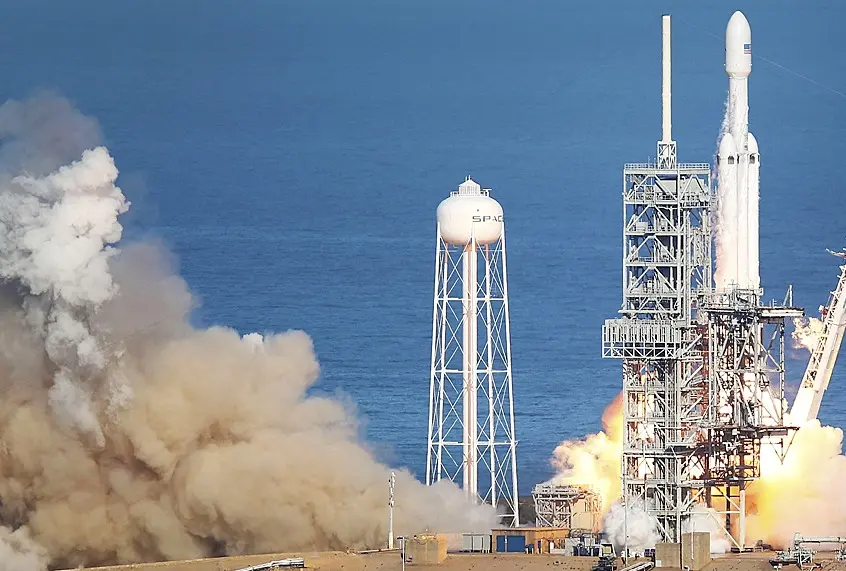
At precisely 3:45 PM EST, the engines ignited. The sheer concussive force of the 27 Merlin engines rattled windows and rattled nerves miles away from the launch complex. As the massive rocket cleared the tower, it ascended rapidly into the clear Florida sky, streaming white plumes against the Atlantic backdrop.
Within minutes, the rocket crossed Max-Q—the point of maximum aerodynamic pressure—and successfully staged separation. In what became an instantly iconic visual milestone for the company, two of the three reusable side boosters detached, executed coordinated flip maneuvers, and descended back toward Cape Canaveral, landing near-simultaneously on designated landing pads in a synchronized display of precision engineering.
Reaching Orbit and the "Starman" Broadcast
Meanwhile, the core booster continued its push, placing the second stage and its eccentric payload—the Tesla Roadster playing David Bowie’s "Space Oddity" on a continuous loop—into an initial parking orbit. As the spacecraft coasted toward deep space, onboard cameras activated, streaming live feeds back to mission control and millions of online viewers.
The resulting visuals were nothing short of cinematic. Framed against the black void of space, the gleaming curves of the sports car—complete with a space-suited mannequin resting its hand on the steering wheel and a sign reading "Don’t Panic!" on the dashboard—hovered effortlessly. Below it, the blue expanse of the Earth curved gracefully toward the horizon, wrapped in a thin, fragile veil of atmosphere.
For the general public and the scientific community, it was a moment of pure awe. For internet humorists and skeptics of conspiracy theories, it was viewed as the ultimate mic-drop moment in the ongoing cultural war against scientific illiteracy.
Supporting Context & Metrics: The Physics and the Pseudoscience
To understand why the Falcon Heavy’s visual proof resonated so deeply—and why it simultaneously failed to move ideological opponents—one must examine both the technical reality of the flight and the core tenets of the belief system it challenged.
The Engineering Scale of Falcon Heavy
The metrics behind the February 6 launch underscored a massive leap forward in heavy-lift capability:
- Total Thrust at Liftoff: Approximately 5 million pounds (roughly equivalent to eighteen 747 aircraft at full power).
- Payload Capacity to Low Earth Orbit (LEO): Up to 63,800 kilograms (140,660 pounds).
- Cost Efficiency: Designed to drastically reduce the cost per pound to orbit, opening commercial pathways to the moon, Mars, and beyond.
- Reusable Architecture: The successful landing of two orbital-class side boosters proved that rapid reusability was no longer a theoretical goal, but an operational reality.
The Flat-Earth Counter-Narrative
In stark contrast to these empirical metrics sits the flat-Earth paradigm. Adherents of the theory—often organizing under various digital banners and international conferences—contend that the Earth is not an oblate spheroid. Instead, they visualize the world as a disc-like structure centered around the Arctic, bounded by an impassable wall of Antarctic ice that acts as a retainer for the oceans.
Key arguments typically deployed by flat-Earth proponents include:
- The "Water Finds Its Level" Fallacy: A foundational belief that large bodies of standing water must maintain a perfectly flat surface, ignoring the scale-dependent effects of planetary gravity.
- The Denial of Gravity: Many flat-Earther models replace gravity with alternative hypotheses, such as upward acceleration of the disc through space or universal buoyancy.
- The Global Conspiracy Claim: The insistence that space agencies like NASA, private aerospace corporations, and international governments are engaged in a multi-trillion-dollar conspiracy to fabricate space exploration, manipulate imagery, and conceal the "true" nature of creation.
When confronted with continuous, unedited live feeds from private entities like SpaceX—where viewers could watch the continuous transition from the stratosphere to orbital insertion without editorial cuts—flat-Earth advocates typically retreat into accusations of fish-eye lens distortion, computer-generated graphics (CGI), or complicity within corporate-state narratives.
Official Statements and Reactions
The juxtaposition between monumental scientific achievement and fringe skepticism drew commentary from leaders across industry, media, and digital culture.
Following the successful deployment, Elon Musk addressed reporters at a press conference, expressing both relief and philosophical wonder at the images sent back by the Roadster.
"It looks so fake it’s real, you know?" Musk remarked to reporters when asked about the surreal nature of the footage. "We’ve got cameras on the car, and they’re broadcasting back. You can see the Earth in the background. That’s real. You can tell because things like that can’t be faked right now."
Musk’s off-hand observation inadvertently highlighted the exact cognitive barrier dividing mainstream science from conspiracy culture. In an era where hyper-realistic CGI dominates Hollywood cinema and digital fabrication tools are ubiquitous, visual proof alone is easily rationalized away by those predisposed to distrust institutional authority.
Social media platforms instantly mirrored this dichotomy. Within minutes of the broadcast, hashtags such as #Starman, #FalconHeavy, and #FlatEarth trended globally. Mainstream users flooded timelines with triumphant declarations:
- "Suck it, flat-Earthers. The game is over."
- "Tough day at the office for flat-Earthers watching a car float above a visibly curved globe."
Conversely, within designated alternative-truth forums, skepticism remained entirely unperturbed. Commentators within those circles quickly pivoted to analyzing compression artifacts, framing angles, and lens curvature—arguing that the wide-angle lenses utilized on the Falcon Heavy upper stage artificially warped the horizon to create an illusion of sphericity.
Future Outlook: The Persistent Divide in an Age of Information
The debut of the SpaceX Falcon Heavy will forever be remembered as a technical tour de force—a catalyst that permanently altered the economics of space launch and expanded humanity’s footprint toward the cosmos. Yet, its intersection with the flat-Earth phenomenon offers a sobering case study in modern media consumption and psychological defense mechanisms.
As commercial space tourism accelerates, and as private companies routinely place civilian passengers, lunar probes, and interplanetary payloads into orbit, the physical evidence of our spherical home will only grow more accessible. High-definition cameras, constellations of commercial imaging satellites, and public livestreaming have democratized the view from above.
However, history and behavioral psychology suggest that empirical data alone cannot cure willful skepticism. Belief systems built upon foundational distrust are inherently self-sealing; any evidence contradicting the core doctrine is automatically reinterpreted as proof of the conspiracy itself.
Ultimately, the Falcon Heavy did not dismantle the flat-Earth movement on February 6, 2018, nor was it ever truly designed to. Its purpose was far greater: to bridge the gap between Earth and the stars. While the flat-Earth truthers remain anchored to their ideological disk below, the rest of humanity continues its ascent into a magnificent, round, and ever-expanding universe.