
Executive Overview
The rapid integration of artificial intelligence into the modern workplace has created an unprecedented operational fault line. While corporate boardrooms across the globe enthusiastically champion AI transformation, the frontline troops responsible for executing this vision—enterprise IT and device management teams—are staring down a massive deficit in tooling, visibility, and control.
A comprehensive new report from Fleet, titled The Road to AI in IT, lays bare a startling reality: the vast majority of organizations believe they are nowhere near ready to effectively manage, secure, or optimize AI workloads across their Mac fleets and broader corporate devices. Based on a survey of more than 500 IT decision-makers—all holding director-level positions or higher at major enterprises with workforces exceeding 2,000 employees—the findings expose a systemic crisis of "shadow AI," exploding operational costs, and an unsustainable expansion of IT workloads.
For years, IT departments have been handed the mandate to spearhead digital transformation, secure corporate networks, and maintain endpoint hygiene. Now, they are expected to absorb the monumental task of AI governance, often without proportional increases in headcount, budget, or specialized tooling. As employees rapidly adopt personal and unauthorized AI tools on company devices, enterprise infrastructure is being pushed to its absolute limits, transforming what should be a technological advantage into a high-stakes security and financial liability.
Detailed Chronology: The Evolution of the Enterprise AI Dilemma
To understand how enterprise IT arrived at its current precarious position regarding artificial intelligence, it is necessary to examine the rapid, chaotic timeline of AI adoption within the modern workforce.
Phase One: The Consumer Explosion (Late 2022 – Early 2023)
The catalyst for the modern enterprise AI challenge arrived virtually overnight with the public release of consumer-facing generative AI models. Unlike previous enterprise software rollouts, which typically followed a top-down procurement cycle involving rigorous security reviews, pilot programs, and IT approvals, generative AI bypassed traditional gatekeepers entirely.

Employees discovered that web-based large language models (LLMs) could instantly draft emails, debug code, and summarize lengthy documents. Because these tools were freely accessible via web browsers, workers began integrating them into their daily workflows without notifying IT departments. This marked the birth of widespread "Shadow AI"—the unauthorized use of artificial intelligence applications on corporate-issued hardware, including Mac and PC fleets.
Phase Two: Operational Overload and Tool Proliferation (2024 – 2025)
As organizations recognized the productivity potential of generative AI, leadership teams began demanding enterprise-wide integration. However, rather than establishing centralized, secure, and vendor-vetted pathways, many companies adopted a fragmented approach. Departments independently subscribed to various niche AI platforms, coding assistants, and automated workflow generators.
By 2025, the average enterprise infrastructure was buckling under the weight of tool sprawl. According to industry data highlighted in the Fleet report, the average enterprise now quietly runs roughly 14 different AI tools internally. Yet, corporate IT departments—the teams ultimately responsible for monitoring endpoints, safeguarding sensitive intellectual property, and managing data compliance—are actively aware of only four of them. This massive visibility gap left ten out of every fourteen tools operating completely outside the bounds of corporate governance.
Phase Three: The Breaking Point and the 2026 Reckoning (Present Day)
Entering 2026, the consequences of this ungoverned expansion have finally caught up with corporate balance sheets and security operations centers. IT leaders are no longer dealing with a theoretical future technology; they are firefighting active budget depletion, severe data leakage risks, and unexpected infrastructure strain.
The Fleet survey emphasizes that while AI-driven automation has rocketed to the top of enterprise investment priorities—cited by 46.5% of IT leaders as their primary future focus, outranking vulnerability remediation and device visibility—the foundational infrastructure required to support these initiatives safely simply does not exist for the average IT team.

Supporting Context & Metrics: By the Numbers
The quantitative data compiled in The Road to AI in IT report paints a vivid, often alarming picture of the disconnect between executive ambition and IT reality.
Investment Priorities vs. Operational Reality
When asked to rank their top future investment categories, IT decision-makers placed AI-driven automation at the absolute peak:
- AI-Driven Automation: 46.5%
- Vulnerability Remediation: 42.5%
- Device Visibility & Telemetry: 42.1%
While prioritizing automation reflects an understanding of the need for efficiency, it creates an immediate paradox: IT teams are prioritizing the deployment of a technology they currently lack the visibility and security tooling to manage safely.
The Shadow AI Scale
The survey’s findings regarding employee behavior underscore the depth of the shadow IT problem:
- 78% of employees admit to actively using personal or unvetted AI tools while executing corporate work duties.
- The average enterprise operates 14 distinct internal AI tools, while IT oversight captures only 4 of them.
The Financial Cost of Blind Spots
The lack of visibility into AI usage is not merely an administrative headache; it carries severe financial consequences. The Fleet report highlights a cautionary tale of a major enterprise that rolled out a popular AI coding assistant to 5,000 software engineers, only to burn through its entire annual API token budget in a staggering four months due to a lack of usage guardrails and telemetry.

Furthermore, data from IBM’s benchmark Cost of a Data Breach report indicates that security breaches directly resulting from shadow AI incidents cost organizations an extra $670,000 on average compared to standard, expected data breaches. These inflated costs stem from the complex nature of leaked proprietary source code, unmasked customer personally identifiable information (PII), and intellectual property embedded within third-party LLM training datasets.
Official Perspectives: Voices from the IT Trenches
The burden placed on modern IT administrators has drawn sharp critiques from industry veterans who see history repeating itself. Bradley Chambers, a veteran Apple IT administrator with decades of experience managing enterprise-grade infrastructure, thousands of Macs, and complex device ecosystems, has drawn direct parallels between the current AI wave and past technological shifts.
"IT teams are expected to handle security, cost management, vulnerability management, and training as well," Chambers notes, discussing the expanding scope of IT responsibilities. "This is on top of their existing jobs and roles. Nothing is getting taken away. This reminds me of when IT had to learn enterprise Wi-Fi during the mobility era and manage it on top of existing roles and responsibilities."
For years, IT departments have functioned as the shock absorbers of corporate modernization. When mobile devices flooded the workplace, IT was tasked with building secure enterprise Wi-Fi networks and Mobile Device Management (MDM) frameworks from scratch. When remote work necessitated sudden cloud migrations, IT engineered secure VPN and zero-trust architectures overnight.
Now, the expectation is that IT personnel will effortlessly absorb AI governance—monitoring token consumption, vetting LLM security postures, auditing data privacy compliance, and educating end-users—without receiving additional headcount, expanded budgets, or purpose-built management platforms.
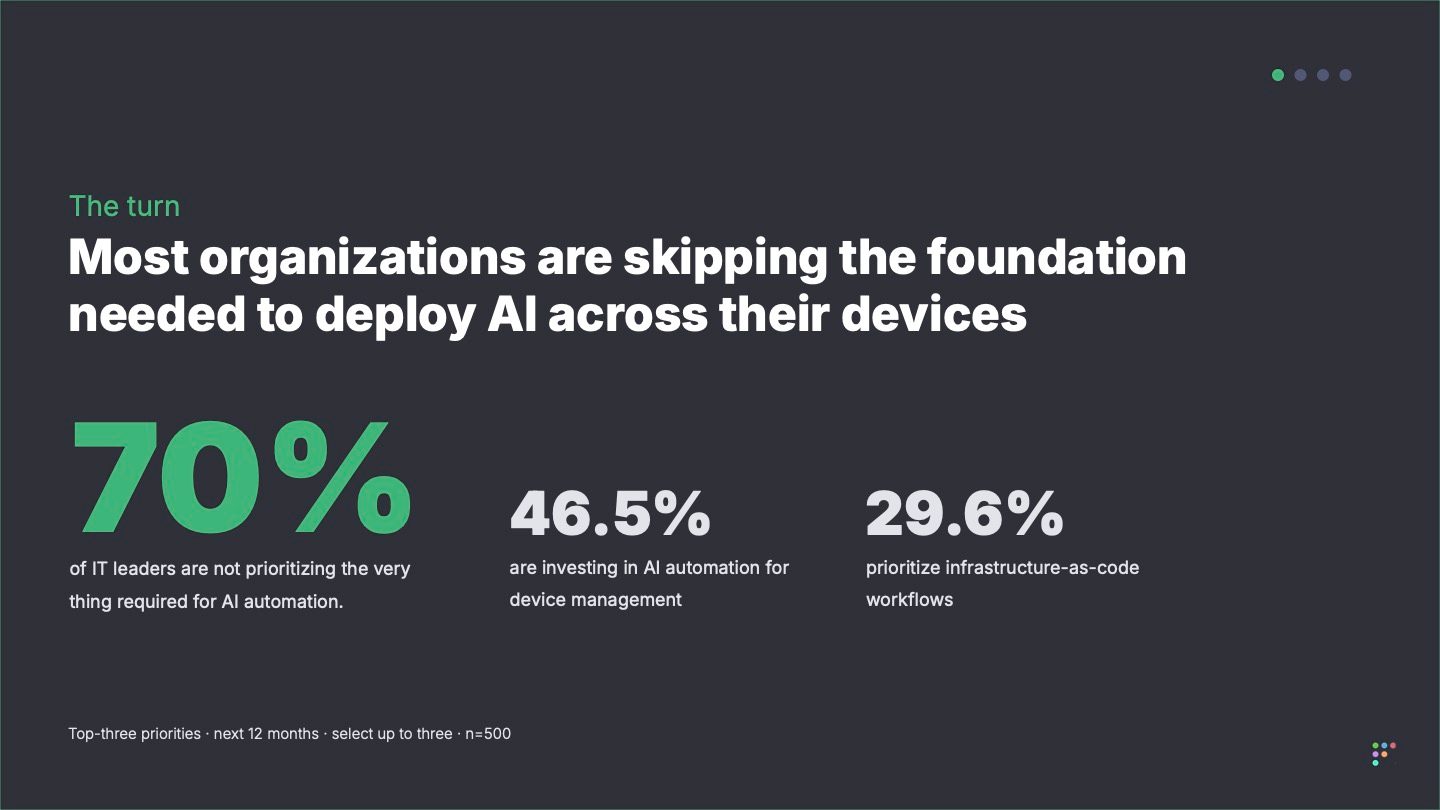
The industry consensus emerging from the Fleet report is clear: leadership cannot simply mandate AI adoption and leave IT departments to figure out the mechanics in the shadows. Without a unified platform approach—such as integrating professional-grade device management, automated security, and comprehensive endpoint telemetry—IT professionals are set up for systemic burnout and operational failure.
Future Outlook: Bridging the Gap Between Ambition and Control
As enterprises look toward the remainder of the decade, the path forward requires a fundamental recalibration of how organizations approach AI governance and device fleet management. Simply hoping that employees will self-regulate their use of generative tools is no longer a viable strategy.
1. Unified Endpoint Management Meets AI Telemetry
The future of Mac and device fleet management must evolve past basic software deployment and security patching. Modern IT platforms need to incorporate native AI telemetry—tools capable of tracking token usage, identifying unauthorized local AI models running on endpoint hardware, and auditing data outflows in real time. Vendors in the Apple device management space, such as Mosyle, are increasingly pressured to bridge this gap by offering integrated platforms that combine device deployment, automated security, and visibility into the expanding application landscape.
2. Shifting from Restriction to Enabled Governance
History proves that heavy-handed bans on new technologies invariably fail; employees simply find workarounds, deepening the shadow AI problem. Instead of blocking access, forward-thinking organizations must transition toward enabled governance. This involves deploying enterprise-approved, secure AI wrappers that provide workers with the productivity benefits they crave while ensuring corporate data remains protected within private, walled-garden architectures.
3. Right-Sizing IT Headcount and Tooling
Executives must recognize that AI is not a self-maintaining utility. It is a powerful, resource-intensive operational layer that demands dedicated oversight. Organizations that successfully navigate the AI era will be those that invest proactively in IT enablement—providing their administrators with the specialized tools, budget, and personnel necessary to tame shadow AI before it compromises corporate security and financial stability.

Ultimately, The Road to AI in IT serves as an urgent wake-up call. The AI revolution is already happening on office Macs and corporate laptops across the globe, whether IT departments are officially ready or not. Closing the visibility gap is no longer optional; it is the single most critical prerequisite for sustainable enterprise growth in the age of artificial intelligence.