Executive Overview
The conversation surrounding Artificial Intelligence in software engineering is rapidly shifting from abstract capability to operational reality. For months, the bleeding edge of the developer ecosystem has fixated on extreme models of autonomy—such as a single engineer orchestrating an army of forty concurrent coding agents. While these high-octane configurations showcase remarkable technical achievements, they expose an underlying disconnect: they often fail to reflect the ground-level realities of standard engineering departments.
For a typical team of ten developers—each balancing codebases, product roadmaps, and cross-functional dependencies—the primary challenge is not how to manage a sprawling digital workforce of automated agents. Instead, it is far more grounded: what does sustainable, day-to-day agentic development look like when implemented at a team scale? How do developers leverage AI without devolving into siloed "hero coders" who inadvertently become organizational bottlenecks?
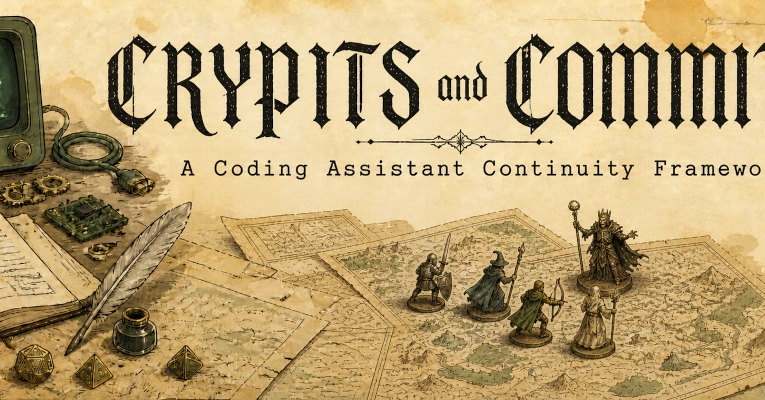
Enter Crypts and Commits, an open-source framework developed to address this exact operational niche. Moving away from massive, generalized multi-agent orchestration engines like Gas Town or Gas City, Crypts and Commits pivots toward a different philosophical baseline. It treats the developer and the AI coding assistant not as a manager-and-subordinate hierarchy, but as reasoning partners. By employing a tabletop roleplaying game (RPG) metaphor—where the human serves as the Game Master and the AI acts as the player—the project introduces a structured, git-backed methodology for capturing intent, planning features, and maintaining durable context across sessions.
This article explores the architectural rationale behind Crypts and Commits, its alignment with recent industry corrections from veteran developer Steve Yegge, and why building bespoke, repository-bound harnesses may be the definitive path forward for engineering teams navigating the current AI inflection point.
Detailed Chronology & Genesis
To understand the mechanics of Crypts and Commits, one must first trace the lineage of modern agent-assisted engineering workflows. The project did not originate as a commercial venture or a top-down enterprise product. Rather, it evolved organically from an engineer’s long-standing habit of meticulous documentation and markdown-based task planning.
Phase 1: The Evolution of Documentation
Years before coding agents became sophisticated enough to parse complex repositories, the author relied on extensive Markdown files to outline architectural roadmaps, track technical debt, and plan feature implementations. Initially, these documents served a traditional human-centric purpose: asynchronous communication, design reviews, and onboarding references.
However, as frontier LLMs (such as Claude and Codex) matured, the functional utility of these files underwent a profound phase shift. Documentation stopped being merely something written for other human engineers; it became a rich, semantic data source that an AI assistant could actively read, update, and execute against.
Phase 2: The Influence of Beads and Tabletop Metaphors
The conceptual breakthrough for Crypts and Commits crystallized upon encountering Beads, a git-backed record-keeping system for tracking work items. Unlike traditional enterprise issue trackers like Jira—which are designed primarily to broadcast status updates to stakeholders, managers, and product owners—Beads focused tightly on the technical actor. It recorded the deep architectural "why" behind a code change, the immediate execution plan, and the cryptographic receipts left in the wake of completed tasks.
Simultaneously, alternative operational paradigms like Steve Yegge’s Gas Town demonstrated the power of novel conceptual frameworks. By introducing a rich, non-traditional vocabulary (borrowed from industrial-era metaphors), Gas Town proved that utilizing a coherent world-building framework could dramatically shorten the conversation between a human and an LLM. It eliminated the need to repeatedly re-explain fundamental system relationships from first principles.
Capitalizing on this insight, Crypts and Commits adopted a tabletop gaming motif:
- The Human Engineer: Acts as the Game Master (GM), establishing the rules, constraints, and ultimate vision.
- The AI Agent: Acts as the Player, executing tasks within the defined boundaries of the world.
- Encounters: Replace abstract "tickets" or "epics" with localized, context-rich missions containing explicit rationales, plans, and verification steps.
Phase 3: Steve Yegge’s Course Correction and the Rise of Bespoke Harnesses
The timing of Crypts and Commits aligned directly with a broader industry reckoning regarding agent harnesses. In his influential essay, "The Shape of Things to Come," veteran developer Steve Yegge detailed how early iterations of Gas Town fractured as underlying foundational models evolved. Consequently, Yegge announced a pivot away from maintaining generalized, reusable harnesses in favor of a hyper-specialized, personal setup named Wheelhouse, chemically bonded to his decades-old application, Wyvern.
This echoed lessons learned while building internal prototypes like Chi-Town for enterprise environments and Crypts and Commits for personal repositories. The core realization was absolute: You cannot take a generic, off-the-shelf process, drop it into an arbitrary repository, and expect the AI to intuitively grasp what makes that specific codebase unique.
An agent must be taught the "world":
- How the system is structured.
- What its strict boundaries and invariants are.
- Which architectural decisions are inviolable.
- How the model should behave when encountering undocumented edge cases.
Consequently, Crypts and Commits established a strategic middle ground. While the overarching package is fully open-source and reusable—providing common abstractions for skills, documentation structures, and repository receipts—its actual implementation inside any given codebase is strictly bespoke. The developer must still author the game world, document system-specific nuances, and explicitly configure how agents operate within those digital walls.
Supporting Context & Operational Metrics
To evaluate the efficacy of Crypts and Commits, it is vital to contrast its architectural philosophy against heavy multi-agent orchestration models currently dominating technical discourse.
| Metric / Dimension | Multi-Agent Orchestration (e.g., Gas Town / Gas City) | Partner-Based Harness (e.g., Crypts and Commits) |
|---|---|---|
| Primary Unit of Work | Autonomous tasks, sprawling background jobs, multi-step queues. | Collaborative "Encounters": localized plans, rationales, and verifications. |
| Human Involvement | High-level delegation; the human acts as an executive manager. | Direct reasoning partnership; the human actively co-authors the plan. |
| Context Retention | Maintained via centralized daemon systems and persistent agent memory nodes. | Stored natively in the repository via git-backed units and Markdown artifacts. |
| Organizational Readiness | High barrier to entry; requires mature agentic infrastructure and advanced oversight. | Low barrier to entry; immediately usable by small teams or solo developers. |
| Failure Modes | Amplification of the "hero coder" bottleneck; silent cascading agent errors. | Explicit reasoning breakdown caught early through human-in-the-loop refinement. |
The Death of the "Hero Coder" Anti-Pattern
Software engineering has long suffered from the "hero coder" failure mode: a singular developer who carries the entire context of a complex system in their head, pushes impossible deadlines through sheer force of will, and inadvertently becomes a crippling single point of failure.
Introducing unvetted, mass-scale multi-agent orchestration into an organization lacking architectural maturity runs the distinct risk of turning this exact problem "up to eleven." If an organization struggles to manage a single hero engineer, it is fundamentally unready to support that same engineer commanding an army of forty autonomous agents operating without direct, continuous oversight.
Crypts and Commits counteracts this anti-party dynamic by decentralizing context into the repository itself. Because the requirements, rationales, and execution receipts live natively within git-backed documentation, no single engineer has to serve as the exclusive repository of institutional memory. Team members can fluidly rotate across modules, utilize their preferred local AI assistants, and instantly reference the shared historical context of prior agentic interactions.
Official Perspectives & Expert Analysis
The release and philosophy of Crypts and Commits reflect a growing maturity within the AI developer community. Industry observers note a distinct fatigue regarding silver-bullet automation frameworks that promise total autonomy while obscuring internal logic.
"You cannot take a generic process, drop it into a repository, and expect it to understand what matters about that project. Someone has to define the world: how the system is organized, what its boundaries are, which decisions matter, and how the agents should behave…"
— Insight from the Crypts and Commits Architectural Documentation
Software architects tracking the evolution of AI-assisted workflows emphasize that the value of an LLM lies less in its ability to generate raw lines of code and more in its capacity to externalize human reasoning. By forcing developers to articulate why a change is being made through structured "encounters," frameworks like Crypts and Commits enforce disciplined engineering practices that benefit human and machine alike.
Furthermore, industry analysts point out that the open-source release strategy of Crypts and Commits—acknowledging its potential shelf-life of mere months in a hyper-accelerated technological landscape—serves as a model for pragmatic tool-building. Engineers are encouraged not to wait for a mythical "stable standard" to emerge, but to actively build, test, and discard bespoke harnesses tailored to their immediate environments.
Future Outlook & Next Steps
As the software development lifecycle continues its rapid metamorphosis, frameworks like Crypts and Commits point toward a balanced, sustainable future for team-based AI adoption.
What Lies Ahead
- Short-Term Iteration cycles: Given the rapid cadence of foundational model updates, developer tooling must remain modular and ephemeral. Crypts and Commits is explicitly designed to be easily bolted onto or stripped from an existing repository with zero structural friction.
- Team-Scale Standardization: As organizations move past individual experimentation, the demand for shared repository-backed context patterns—rather than proprietary, black-box orchestration layers—will surge.
- Deepening the Methodology: As detailed in upcoming releases (Part Two exploring historical documentation habits and Part Three covering team-wide scaling practices), the integration of structured prompt-engineering frameworks with git workflows will likely become standard operating procedure for mid-sized engineering squads.
Conclusion: Embracing the Bespoke Harness
The ultimate takeaway from the advent of Crypts and Commits is clear: the future of AI-assisted development will not be won by passive delegation to massive, monolithic agent systems. It will be forged through active, structured collaboration between human reasoning and domain-specific AI partners.
For developers seeking to bridge the gap between solo agent experiments and cohesive team workflows, exploring frameworks like Crypts and Commits offers an immediate, highly practical starting point. Whether adopting the package wholesale or simply borrowing its underlying philosophy of git-backed, world-building context management, the mandate for modern engineers is unequivocal: stop waiting for the ultimate harness to arrive, and start building the one your project demands today.